Kirjojen hintavertailu. Mukana 11 239 951 kirjaa ja 12 kauppaa.

Kirjahaku

Etsi kirjoja tekijän nimen, kirjan nimen tai ISBN:n perusteella.

1000 tulosta hakusanalla Warren J. Samuels

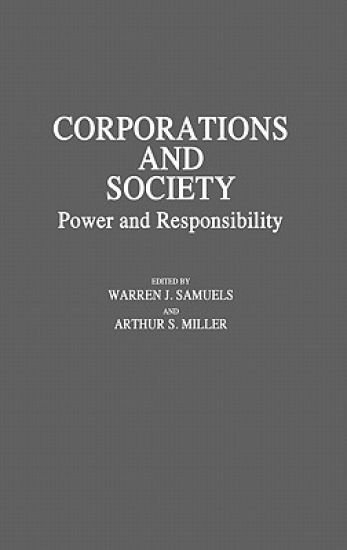
Corporations and Society

Corporations and Society

Warren J. Samuels

Praeger Publishers Inc
1987
sidottu
This volume provides an interesting evaluation of the role of the corporation in American society. The book traces the historical role of the corporation. It discusses the corporation's obligations and influence in the policy-making process of government. Business Library NewsletterThe year 1986 marked the 100th anniversary of one of the Supreme Court's most important decisions, in which it unanimously held that a business corporation was a person within the meaning of the Constitution, and thus entitled to constitutional protection. The decision, made almost casually, has had enormous impact on the development of the system of corporate capitalism in the United States. This collection of original essays, written by leading authorities from the fields of economics, law, history and political science, assesses the implications of the Supreme Court ruling from a variety of perspectives. The collected essays provide a thorough evaluation of the role of the corporation, and discusses its obligations, its influence in the policymaking process of government, and its internal structure as a political order.
Essays in the History of Mainstream Political Economy

Essays in the History of Mainstream Political Economy

Warren J. Samuels

Palgrave Macmillan
1992
sidottu
This book is a collection of articles on schools, individuals and topics within the mainstream of the history of economic thought. The principal schools are the Physiocrats and the English Classical Economists. The principal individuals are Francois Quesnay, Adam Smith, Thomas Malthus, Francis Y. Edgeworth, Friedrich von Wieser, Frank W. Taussig, and William H. Hutt. The principal topics include the economic role of government, power, the psychology of economics, and the early history of macroeconomics.
Erasing the Invisible Hand

Erasing the Invisible Hand

Warren J. Samuels

Cambridge University Press
2011
sidottu
This book examines the use, principally in economics, of the concept of the invisible hand, centering on Adam Smith. It interprets the concept as ideology, knowledge, and a linguistic phenomenon. It shows how the principal Chicago School interpretation misperceives and distorts what Smith believed on the economic role of government. The essays further show how Smith was silent as to his intended meaning, using the term to set minds at rest; how the claim that the invisible hand is the foundational concept of economics is repudiated by numerous leading economic theorists; that several dozen identities given the invisible hand renders the term ambiguous and inconclusive; that no such thing as an invisible hand exists; and that calling something an invisible hand adds nothing to knowledge. Finally, the essays show that the leading doctrines purporting to claim an invisible hand for the case for capitalism cannot invoke the term but that other nonnormative invisible hand processes are still useful tools.
Erasing the Invisible Hand

Erasing the Invisible Hand

Warren J. Samuels

Cambridge University Press
2014
pokkari
This book examines the use, principally in economics, of the concept of the invisible hand, centering on Adam Smith. It interprets the concept as ideology, knowledge, and a linguistic phenomenon. It shows how the principal Chicago School interpretation misperceives and distorts what Smith believed on the economic role of government. The essays further show how Smith was silent as to his intended meaning, using the term to set minds at rest; how the claim that the invisible hand is the foundational concept of economics is repudiated by numerous leading economic theorists; that several dozen identities given the invisible hand renders the term ambiguous and inconclusive; that no such thing as an invisible hand exists; and that calling something an invisible hand adds nothing to knowledge. Finally, the essays show that the leading doctrines purporting to claim an invisible hand for the case for capitalism cannot invoke the term but that other nonnormative invisible hand processes are still useful tools.
Essays in the History of Mainstream Political Economy

Essays in the History of Mainstream Political Economy

Warren J. Samuels

Palgrave Macmillan
1992
nidottu
This book is a collection of articles on schools, individuals and topics within the mainstream of the history of economic thought. The principal schools are the Physiocrats and the English Classical Economists. The principal individuals are Francois Quesnay, Adam Smith, Thomas Malthus, Francis Y. Edgeworth, Friedrich von Wieser, Frank W. Taussig, and William H. Hutt. The principal topics include the economic role of government, power, the psychology of economics, and the early history of macroeconomics.
Essays on the Economic Role of Government

Essays on the Economic Role of Government

Warren J. Samuels

Palgrave Macmillan
1992
nidottu
Contains a collection of articles applying fundamental concepts of power, property, regulation and the compensation principle to contemporary topics: the wealth maximization hypothesis, the Coase theorem, public utility regulation, and other topics in law and economics.
Economics, Governance and Law

Economics, Governance and Law

Warren J. Samuels

Edward Elgar Publishing Ltd
2002
sidottu
This coherent collection of previously published and unpublished papers also includes a specially written introduction by Warren Samuels. The book examines some of the fundamental issues in political economy in a non-judgemental and non-ideological way. The political economy is a process of decision making and these papers attempt to identify the deepest levels of conduct of collective choice. These include official and private government, the 'rule of law', the nature of property, rules and markets, deliberative and non-deliberative choice, and the operation of selective perception and of intellectual fraud in politics. After an objective reading of these essays, no reader should look at government, globalization, rule of law, constitutions, and revolution in quite the same way.
Gardiner C.Mean's Institutional and Post-Keynesian Economics

Gardiner C.Mean's Institutional and Post-Keynesian Economics

Warren J. Samuels; Steven G. Medema

M.E. Sharpe
1990
sidottu
Gardiner Means has a secure place in the history of 20th century economic thought, as the co-author with A.A.Berle of "The Modern Corporation and Private Property". But according to Samuels and Medema, Means should be remembered for major contributions in both micro- and macroeconomics. The authors discuss Means's ideas of administered pricing and profit maximization within the giant corporation, the possible links between industrial structure and macroeconomic performance, a theory of the firm as it relates to the market, and the micro foundations of macroeconomics. Central to Means's macroeconomics is his theory that administered pricing generates inflation and stagflation. Means, in the authors' view, was a seminal thinker and a post-Keynesian economist, as well as an institutionalist. This book also gives an precis of Means's unusual career in government and the academy.
ECONOMIC THOUGHT AND DISCOURSE IN THE 20TH CENTURY

ECONOMIC THOUGHT AND DISCOURSE IN THE 20TH CENTURY

Warren J. Samuels; Jeff Biddle; Thomas W. Patchak-Schuster

Edward Elgar Publishing Ltd
1993
sidottu
The history of economics comprises the accumulated capital of the discipline; its study permits both the retrieval of important ideas and the conduct of analysis which places present day work in context. The essays in this book demonstrate some of the variety of uses to which the history of economics, as a sub-discipline, can be put.Economic Thought and Discourse in the 20th Century commences with an essay on John R. Hicks, one of the leading economic theorists of the twentieth century and a writer with much to say about the nature of economic theory and the functions of the history of economic thought. An essay on Thorstein Veblen examines a figure who is at once both idiosyncratic and monumental, and whose work on war and peace is seen both to have been deeply prescient at the time it was written, and to be critically relevant at the close of the twentieth century. The third piece in this collection is a study of the discursive and interpretative structure of Alfred Marshall's Principles of Economics. More than a century after its publication, the Principles is widely regarded as one of the most important, and immediately influential, works of economic science ever written. Yet, it is argued, Marshall's use of language and argument may well have been equal in importance to the analytical techniques which he demonstrated. The concluding essay on the early journal history of law and economics places in perspective much of the contemporary work in this area and suggests that more could be expected from a field with such a rich and suggestive history. These essays will make significant contributions both to their respective subjects and to the historiography of economics.
The Economy as a Process of Valuation

The Economy as a Process of Valuation

Warren J. Samuels; Steven G. Medema; A. A. Schmid

Edward Elgar Publishing Ltd
1997
sidottu
The Economy as Process of Valuation sheds new light on the potential benefits of concept and theory formation along dynamic and evolutionary lines for understanding economic processes. The emphasis is on aspects of the economy as a process of valuation rather than as a mechanistic result of transcendental forces yielding unique determinate results.The book begins by examining instrumentalism and the process of valuation, arguing that to choose involves the process of valuation. It then focuses on Coases's work on institutions and considers the implications for a variety of subjects including the theory of the firm and the theory and policy of externalities - all aspects of the economy as a process of valuation. This is followed by analyses of the concepts of coercion and cost in economics, with special reference to one agent's interest being another agent's cost. Each elicits key aspects of analysis, valuation and the complexities and conflictual nature of valuation processes and structures. Finally, Kenneth Boulding's work on 'The Image' is examined, arguing that definitions of reality and values derive, in part from language.
Classics in Institutional Economics, Part I, Volume 1

Classics in Institutional Economics, Part I, Volume 1

Warren J Samuels; Malcolm Rutherford

Routledge
1997
sidottu
Institutional economics is recognised as a peculiarly American development in economics — nothing quite like it emerged in Britain or continental Europe. As such, a knowledge of the literature of institutionalism is a necessary part of understanding the history of American economics and American social thought more broadly. The work of the authors featured in this collection served to create and define the American institutionalist tradition in economics: Thorstein Veblen, Richard Theodore Ely, John Rogers Commons, Robert Franklin Hoxie, Wesley Clair Mitchell and Walton Hale Hamilton. These figures were also central to institutionalism’s numerous debates on the unifying characteristics of the movement and its principal contributions — making this collection of their most important works a convenient vehicle to assess these issues. It is also of increasing value given the fact that the main concerns of institutionalists, such as the role of institutions and development of an evolutionary approach, having been coming back into prominence as important issues in economics.
Classics in Institutional Economics, Part I, Volume 2

Classics in Institutional Economics, Part I, Volume 2

Warren J Samuels; Malcolm Rutherford

Routledge
1997
sidottu
Institutional economics is recognised as a peculiarly American development in economics — nothing quite like it emerged in Britain or continental Europe. As such, a knowledge of the literature of institutionalism is a necessary part of understanding the history of American economics and American social thought more broadly. The work of the authors featured in this collection served to create and define the American institutionalist tradition in economics: Thorstein Veblen, Richard Theodore Ely, John Rogers Commons, Robert Franklin Hoxie, Wesley Clair Mitchell and Walton Hale Hamilton. These figures were also central to institutionalism’s numerous debates on the unifying characteristics of the movement and its principal contributions — making this collection of their most important works a convenient vehicle to assess these issues. It is also of increasing value given the fact that the main concerns of institutionalists, such as the role of institutions and development of an evolutionary approach, having been coming back into prominence as important issues in economics.
Classics in Institutional Economics, Part I, Volume 3

Classics in Institutional Economics, Part I, Volume 3

Warren J Samuels; Malcolm Rutherford

Routledge
1997
sidottu
Institutional economics is recognised as a peculiarly American development in economics — nothing quite like it emerged in Britain or continental Europe. As such, a knowledge of the literature of institutionalism is a necessary part of understanding the history of American economics and American social thought more broadly. The work of the authors featured in this collection served to create and define the American institutionalist tradition in economics: Thorstein Veblen, Richard Theodore Ely, John Rogers Commons, Robert Franklin Hoxie, Wesley Clair Mitchell and Walton Hale Hamilton. These figures were also central to institutionalism’s numerous debates on the unifying characteristics of the movement and its principal contributions — making this collection of their most important works a convenient vehicle to assess these issues. It is also of increasing value given the fact that the main concerns of institutionalists, such as the role of institutions and development of an evolutionary approach, having been coming back into prominence as important issues in economics.
Classics in Institutional Economics, Part I, Volume 4

Classics in Institutional Economics, Part I, Volume 4

Warren J Samuels; Malcolm Rutherford

Routledge
1997
sidottu
Institutional economics is recognised as a peculiarly American development in economics — nothing quite like it emerged in Britain or continental Europe. As such, a knowledge of the literature of institutionalism is a necessary part of understanding the history of American economics and American social thought more broadly. The work of the authors featured in this collection served to create and define the American institutionalist tradition in economics: Thorstein Veblen, Richard Theodore Ely, John Rogers Commons, Robert Franklin Hoxie, Wesley Clair Mitchell and Walton Hale Hamilton. These figures were also central to institutionalism’s numerous debates on the unifying characteristics of the movement and its principal contributions — making this collection of their most important works a convenient vehicle to assess these issues. It is also of increasing value given the fact that the main concerns of institutionalists, such as the role of institutions and development of an evolutionary approach, having been coming back into prominence as important issues in economics.
Classics in Institutional Economics, Part I, Volume 5

Classics in Institutional Economics, Part I, Volume 5

Warren J Samuels; Malcolm Rutherford

Routledge
1997
sidottu
Institutional economics is recognised as a peculiarly American development in economics — nothing quite like it emerged in Britain or continental Europe. As such, a knowledge of the literature of institutionalism is a necessary part of understanding the history of American economics and American social thought more broadly. The work of the authors featured in this collection served to create and define the American institutionalist tradition in economics: Thorstein Veblen, Richard Theodore Ely, John Rogers Commons, Robert Franklin Hoxie, Wesley Clair Mitchell and Walton Hale Hamilton. These figures were also central to institutionalism’s numerous debates on the unifying characteristics of the movement and its principal contributions — making this collection of their most important works a convenient vehicle to assess these issues. It is also of increasing value given the fact that the main concerns of institutionalists, such as the role of institutions and development of an evolutionary approach, having been coming back into prominence as important issues in economics.