Kirjojen hintavertailu. Mukana 11 213 693 kirjaa ja 12 kauppaa.

Kirjahaku

Etsi kirjoja tekijän nimen, kirjan nimen tai ISBN:n perusteella.

1000 tulosta hakusanalla Warren Magnusson

Politics of Urbanism

Politics of Urbanism

Warren Magnusson

Routledge
2011
sidottu
To see like a city, rather than seeing like a state, is the key to understanding modern politics. In this book, Magnusson draws from theorists such as Weber, Wirth, Hayek, Jacobs, Sennett, and Foucault to articulate some of the ideas that we need to make sense of the city as a form of political order. Locally and globally, the city exists by virtue of complicated patterns of government and self-government, prompted by proximate diversity. A multiplicity of authorities in different registers is typical. Sovereignty, although often claimed, is infinitely deferred. What emerges by virtue of self-organization is not susceptible to control by any central authority, and so we are impelled to engage politically in a world that does not match our expectations of sovereignty. How then are we are to engage realistically and creatively? We have to begin from where we are if we are to understand the possibilities.Building on traditions of political and urban theory in order to advance a new interpretation of the role of cities/urbanism in contemporary political life, this work will be of great interest to scholars of political theory and urban theory, international relations theory and international relations.
Politics of Urbanism

Politics of Urbanism

Warren Magnusson

Routledge
2012
nidottu
To see like a city, rather than seeing like a state, is the key to understanding modern politics. In this book, Magnusson draws from theorists such as Weber, Wirth, Hayek, Jacobs, Sennett, and Foucault to articulate some of the ideas that we need to make sense of the city as a form of political order. Locally and globally, the city exists by virtue of complicated patterns of government and self-government, prompted by proximate diversity. A multiplicity of authorities in different registers is typical. Sovereignty, although often claimed, is infinitely deferred. What emerges by virtue of self-organization is not susceptible to control by any central authority, and so we are impelled to engage politically in a world that does not match our expectations of sovereignty. How then are we are to engage realistically and creatively? We have to begin from where we are if we are to understand the possibilities.Building on traditions of political and urban theory in order to advance a new interpretation of the role of cities/urbanism in contemporary political life, this work will be of great interest to scholars of political theory and urban theory, international relations theory and international relations.
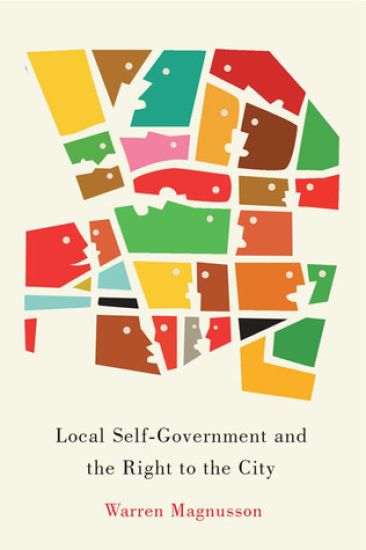
Local Self-Government and the Right to the City

Local Self-Government and the Right to the City

Warren Magnusson

McGill-Queen's University Press
2015
sidottu
Despite decades of talk about globalization, democracy still depends on local self-government. In Local Self-Government and the Right to the City, Warren Magnusson argues that it is the principle behind claims to personal autonomy, community control, and national self-determination, and holds the promise of more peaceful politics. Unfortunately, state-centred thinking has obscured understanding of what local self-government can mean and hindered efforts to make good on what activists have called the "right to the city." In this collection of essays, Magnusson reflects on his own efforts to make sense of what local self-government can actually mean, using the old ideal of the town meeting as a touchstone. Why cannot communities govern themselves? Why fear direct democracy? As he suggests, putting more trust in the proliferating practices of government and self-government will actually make cities work better, and enable us to see how to localize democracy appropriately. He shows that doing so will require citizens and governments to come to terms with the multiplicity, indeterminacy, and uncertainty implicit in politics and steer clear of sovereign solutions. The culmination of a life's work by Canada's leading political theorist in the field, Local Self-Government and the Right to the City ranges across topics such as local government, social movements, constitutional law, urban political economy, and democratic theory.
Local Self-Government and the Right to the City

Local Self-Government and the Right to the City

Warren Magnusson

McGill-Queen's University Press
2015
nidottu
Despite decades of talk about globalization, democracy still depends on local self-government. In Local Self-Government and the Right to the City, Warren Magnusson argues that it is the principle behind claims to personal autonomy, community control, and national self-determination, and holds the promise of more peaceful politics. Unfortunately, state-centred thinking has obscured understanding of what local self-government can mean and hindered efforts to make good on what activists have called the "right to the city." In this collection of essays, Magnusson reflects on his own efforts to make sense of what local self-government can actually mean, using the old ideal of the town meeting as a touchstone. Why cannot communities govern themselves? Why fear direct democracy? As he suggests, putting more trust in the proliferating practices of government and self-government will actually make cities work better, and enable us to see how to localize democracy appropriately. He shows that doing so will require citizens and governments to come to terms with the multiplicity, indeterminacy, and uncertainty implicit in politics and steer clear of sovereign solutions. The culmination of a life's work by Canada's leading political theorist in the field, Local Self-Government and the Right to the City ranges across topics such as local government, social movements, constitutional law, urban political economy, and democratic theory.
The Search for Political Space

The Search for Political Space

Warren Magnusson

University of Toronto Press
1991
pokkari
In The Search for Political Space, Warren Magnusson argues that the emergent political spaces of the twenty-first century will be more like local municipalities than sovereign states. These ambivalent spaces point beyond themselves and disrupt the dominant discourse of sovereignty. In an effort to rethink the boundaries and horizons of contemporary politics, the author focuses on the practical experiences of recent social movements in relation to municipal government. Using examples from Britain, the United States, and Canada, he proposes that, although constrained by the state, the market, and the modern social disciplines, municipal politics offers a place where ordinary people can engage locally with global issues. The discussion ranges over such topics as socialist economics, municipal foreign policy, feminist direct action intergovernmental fiscal struggles, environmental activism, the politics of identity, and the practices of local democracy. From various perspectives, Magnusson addresses the underlying question: how can people use the space afforded by the municipality to transcend the political limits of the state?The Search for Political Space is a valuable contribution to the study of urban politics within the context of political theory, and the issues and arguments it raises are fundamental to discussions of the future of politics in the twenty-first century.
Political Space

Political Space

Warren Magnusson

University of Minnesota Press
2002
sidottu
On the remote outer coast of Vancouver Island in British Columbia, Clayoquot Sound might seem to be situated at the periphery of contemporary power and authority. And yet, as the disputed land of native peoples and the contentious site of corporate logging in one of the world's last remaining temperate rain forests, Clayoquot Sound is also squarely in the middle of global politics today. These authors develop a new way of making sense of the rapidly changing character of political life in our day, revealing the political problems and possibilities inherent in the convergence of the global and the local so dramatically enacted in Clayoquot Sound.
Warren G. Magnuson and the Shaping of Twentieth-Century America

Warren G. Magnuson and the Shaping of Twentieth-Century America

Shelby Scates

University of Washington Press
2015
pokkari
Warren G. Magnuson served as U.S. senator from the state of Washington for six terms. The sheer sweep of his accomplishments is astonishing: authoring the 1964 Civil Rights Act, protecting Puget Sound, saving Boeing for Seattle, championing consumer protection legislation, reorganizing the railroads, and godfathering the electrification of the Pacific Northwest by pressing for Columbia and Snake River dams. He pushed for federal aid to education, kept Pentagon budgets down, and established the National Institutes of Health while arguing throughout the McCarthy era against U.S. isolation from China. He was also a whiskey-and-poker companion to Presidents Roosevelt, Truman, Kennedy, and Johnson.
Warren G. Magnuson and the Shaping of Twentieth-Century America

Warren G. Magnuson and the Shaping of Twentieth-Century America

Shelby Scates

University of Washington Press
2015
sidottu
Warren G. Magnuson served as U.S. senator from the state of Washington for six terms. The sheer sweep of his accomplishments is astonishing: authoring the 1964 Civil Rights Act, protecting Puget Sound, saving Boeing for Seattle, championing consumer protection legislation, reorganizing the railroads, and godfathering the electrification of the Pacific Northwest by pressing for Columbia and Snake River dams. He pushed for federal aid to education, kept Pentagon budgets down, and established the National Institutes of Health while arguing throughout the McCarthy era against U.S. isolation from China. He was also a whiskey-and-poker companion to Presidents Roosevelt, Truman, Kennedy, and Johnson.
The Speeches, Remarks, Press Conferences, and Study Papers, V1: Of Vice President Richard M. Nixon, August 1 Through November 7, 1960
""The Speeches, Remarks, Press Conferences, And Study Papers, V1: Of Vice President Richard M. Nixon, August 1 Through November 7, 1960"" is a book that compiles various written and spoken materials by Richard M. Nixon, who was the Vice President of the United States from 1953 to 1961. The contents of the book span from August 1 to November 7, 1960, a period during which Nixon was running for the presidency against John F. Kennedy.The book includes transcripts of speeches and remarks that Nixon made during his campaign, as well as press conferences and study papers that he wrote. These materials give readers insight into Nixon's political views and strategies, as well as his responses to various issues and events that arose during the campaign.Overall, ""The Speeches, Remarks, Press Conferences, And Study Papers, V1: Of Vice President Richard M. Nixon, August 1 Through November 7, 1960"" offers a comprehensive look at one of the most significant presidential campaigns in American history, as well as the political career of one of its key players.Freedom Of Communications. Final Report Of The Committee On Commerce, United States Senate. The Speeches Of Vice President Richard M. Nixon, Presidential Campaign Of 1960.This scarce antiquarian book is a facsimile reprint of the old original and may contain some imperfections such as library marks and notations. Because we believe this work is culturally important, we have made it available as part of our commitment for protecting, preserving, and promoting the world's literature in affordable, high quality, modern editions, that are true to their original work.
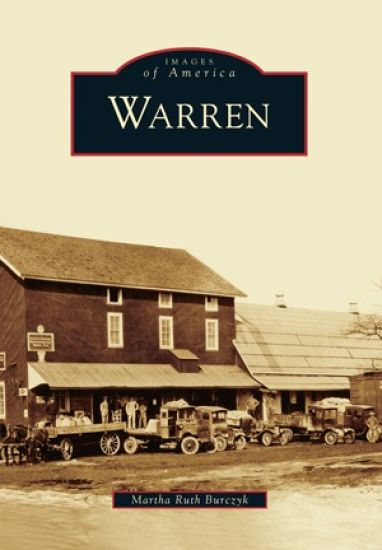
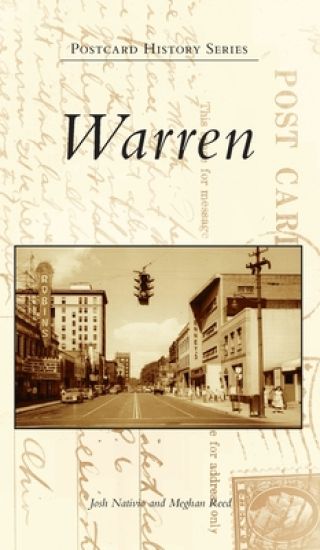
Warren

Warren

Josh Nativio; Meghan Reed

Arcadia Publishing Library Editions
2019
sidottu
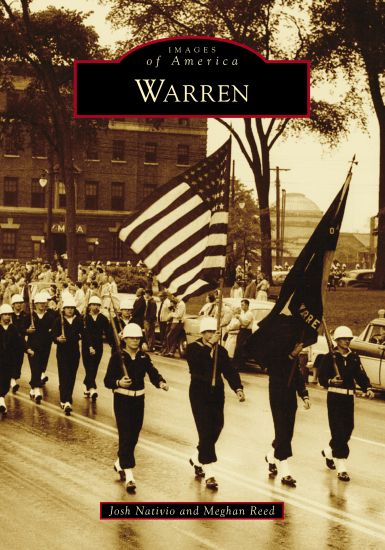
Founded in 1798 as the capital of the Connecticut Western Reserve, Warren, Ohio, began its storied history as a small village of Connecticut settlers along the banks of the Mahoning River. Rapid economic growth over the next 200 years saw Warren transform into a cutting-edge manufacturing powerhouse of steel mills, automobile producers, and electric companies, creating a community of industry and innovation that led to Warren's motto, "The City of Modern Methods." From hosting the headquarters for the National Woman Suffrage Association to boasting the largest steel blast furnace in the world, Warren's illustrious legacy is chronicled in this book through images that showcase its landscapes and businesses and the people who created them.
Warren

Warren

Josh Nativio; Meghan Reed

Arcadia Publishing (SC)
2019
nidottu
Founded in 1798 as the capital of the Connecticut Western Reserve, Warren, Ohio, began its storied history as a small village of Connecticut settlers along the banks of the Mahoning River. Rapid economic growth over the next 200 years saw Warren transform into a cutting-edge manufacturing powerhouse of steel mills, automobile producers, and electric companies, creating a community of industry and innovation that led to Warren's motto, "The City of Modern Methods." From hosting the headquarters for the National Woman Suffrage Association to boasting the largest steel blast furnace in the world, Warren's illustrious legacy is chronicled in this book through images that showcase its landscapes and businesses and the people who created them.
Warren Buffett Invests Like a Girl

Warren Buffett Invests Like a Girl

The Motley Fool; LouAnn Lofton

HarperBusiness
2012
nidottu
Investing isn't a man's world anymore - and that's a good thing for individual portfolios, "Wall Street", and the world's financial system. Compared to their male counterparts, women have scientifically been show to be more patient and wiser when it comes to making decisions - characteristics that epitomize the Foolish investment philosophy, as well as the investment temperament of the most successful investor in history, Warren Buffett. While men may be brash, compulsive, and overly daring, women tend to be more studious, skeptical, and reasonable. ""Warren Buffett Invests Like a Girl" empowers and educates women - and the men smart enough to embrace a "feminine" investing style - on how to strengthen their portfolios and find success in the market. You'll have to read her book to see the criteria she used, but I'd say I probably plead guilty". (Warren Buffett).