Kirjojen hintavertailu. Mukana 11 232 919 kirjaa ja 12 kauppaa.

Kirjahaku

Etsi kirjoja tekijän nimen, kirjan nimen tai ISBN:n perusteella.

1000 tulosta hakusanalla Wayne A. Davis

Nondescriptive Meaning and Reference

Nondescriptive Meaning and Reference

Wayne A. Davis

Clarendon Press
2005
sidottu
Nondescriptive Meaning and Reference extends Wayne Davis's groundbreaking work on the foundations of semantics. Davis revives the classical doctrine that meaning consists in the expression of ideas, and advances the expression theory by showing how it can account for standard proper names, and the distinctive way their meaning determines their reference. He also shows how the theory can handle interjections, syncategorematic terms, conventional implicatures, and other cases long seen as difficult for both ideational and referential theories. The expression theory is founded on the fact that thoughts are event types with a constituent structure, and that thinking is a fundamental propositional attitude, distinct from belief and desire. Thought parts ('ideas' or 'concepts') are distinguished from both sensory images and conceptions. Word meaning is defined recursively: sentences and other complex expressions mean what they do in virtue of what thought parts their component words express and what thought structure the linguistic structure expresses; and unstructured words mean what they do in living languages in virtue of evolving conventions to use them to express ideas. The difficulties of descriptivism show that the ideas expressed by names are atomic or basic. The reference of a name is the extension of the idea it expresses, which is determined not by causal relations, but by its identity or content together with the nature of objects in the world. Hence a name's reference is dependent on, but not identical to, its meaning. A name is directly and rigidly referential because the extension of the idea it expresses is not determined by the extensions of component ideas. The expression theory thus has the strength of Fregeanism without its descriptivist bias, and of Millianism without its referentialist or causalist shortcomings. The referential properties of ideas can be set out recursively by providing a generative theory of ideas, assigning extensions to atomic ideas, and formulating rules whereby the semantic value of a complex idea is determined by the semantic values of its components. Davis also shows how referential properties can be treated using situation semantics and possible worlds semantics. The key is to drop the assumption that the values of intension functions are the referents of the words whose meaning they represent, and to abandon the necessity of identity for logical modalities. Many other pillars of contemporary philosophical semantics, such as the twin earth arguments, are shown to be unfounded.
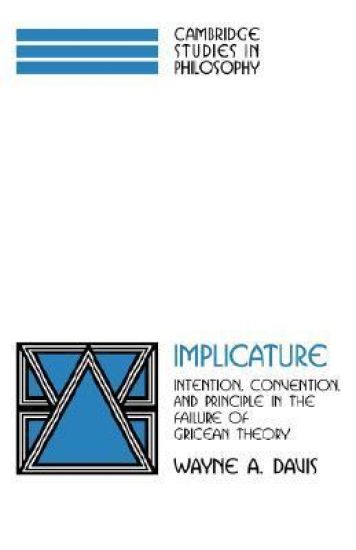
Implicature

Implicature

Wayne A. Davis

Cambridge University Press
2007
pokkari
H. P. Grice virtually discovered the phenomenon of implicature (to denote the implications of an utterance that are not strictly implied by its content). Gricean theory claims that conversational implicatures can be explained and predicted using general psycho-social principles. This theory has established itself as one of the orthodoxes in the philosophy of language. Wayne Davis argues controversially that Gricean theory does not work. He shows that any principle-based theory understates both the intentionality of what a speaker implicates and the conventionality of what a sentence implicates. In developing his argument the author explains that the psycho-social principles actually define the social function of implicature conventions, which contribute to the satisfaction of those principles. This challenging book will be of importance to philosophers of language and linguists, especially those working in pragmatics and sociolinguistics.
Meaning, Expression and Thought

Meaning, Expression and Thought

Wayne A. Davis

Cambridge University Press
2007
pokkari
This philosophical treatise on the foundations of semantics is a systematic effort to clarify, deepen and defend the classical doctrine that words are conventional signs of mental states, principally thoughts and ideas, and that meaning consists in their expression. This expression theory of meaning is developed by carrying out the Gricean programme, explaining what it is for words to have meaning in terms of speaker meaning, and what it is for a speaker to mean something in terms of intention. But Grice's own formulations are rejected and alternatives developed. The foundations of the expression theory are explored at length, and the author develops the theory of thought as a fundamental cognitive phenomenon distinct from belief and desire, argues for the thesis that thoughts have parts, and identifies ideas or concepts with parts of thoughts. This book will appeal to students and professionals interested in the philosophy of language.
Meaning, Expression and Thought

Meaning, Expression and Thought

Wayne A. Davis

Cambridge University Press
2002
sidottu
This philosophical treatise on the foundations of semantics is a systematic effort to clarify, deepen and defend the classical doctrine that words are conventional signs of mental states, principally thoughts and ideas, and that meaning consists in their expression. This expression theory of meaning is developed by carrying out the Gricean programme, explaining what it is for words to have meaning in terms of speaker meaning, and what it is for a speaker to mean something in terms of intention. But Grice's own formulations are rejected and alternatives developed. The foundations of the expression theory are explored at length, and the author develops the theory of thought as a fundamental cognitive phenomenon distinct from belief and desire, argues for the thesis that thoughts have parts, and identifies ideas or concepts with parts of thoughts. This book will appeal to students and professionals interested in the philosophy of language.
Implicature

Implicature

Wayne A. Davis

Cambridge University Press
1998
sidottu
H. P. Grice virtually discovered the phenomenon of implicature (to denote the implications of an utterance that are not strictly implied by its content). Gricean theory claims that conversational implicatures can be explained and predicted using general psycho-social principles. This theory has established itself as one of the orthodoxes in the philosophy of language. Wayne Davis argues controversially that Gricean theory does not work. He shows that any principle-based theory understates both the intentionality of what a speaker implicates and the conventionality of what a sentence implicates. In developing his argument the author explains that the psycho-social principles actually define the social function of implicature conventions, which contribute to the satisfaction of those principles. This challenging book will be of importance to philosophers of language and linguists, especially those working in pragmatics and sociolinguistics.
Irregular Negatives, Implicatures, and Idioms
The author integrates, expands, and deepens his previous publications about irregular (or “metalinguistic”) negations. A total of ten distinct negatives—several previously unclassified—are analyzed. The logically irregular negations deny different implicatures of their root. All are partially non-compositional but completely conventional.The author argues that two of the irregular negative meanings are implicatures. The others are semantically rather than pragmatically ambiguous. Since their ambiguity is neither lexical nor structural, direct irregular negatives satisfy the standard definition of idioms as syntactically complex expressions whose meaning is non-compositional. Unlike stereotypical idioms, idiomatic negatives lack fixed syntactic forms and are highly compositional. The final chapter analyzes other “free form” idioms, including irregular interrogatives and comparatives, self-restricted verb phrases, numerical verb phrases, and transparent propositional attitude and speech act reports.
Irregular Negatives, Implicatures, and Idioms
The author integrates, expands, and deepens his previous publications about irregular (or “metalinguistic”) negations. A total of ten distinct negatives—several previously unclassified—are analyzed. The logically irregular negations deny different implicatures of their root. All are partially non-compositional but completely conventional.The author argues that two of the irregular negative meanings are implicatures. The others are semantically rather than pragmatically ambiguous. Since their ambiguity is neither lexical nor structural, direct irregular negatives satisfy the standard definition of idioms as syntactically complex expressions whose meaning is non-compositional. Unlike stereotypical idioms, idiomatic negatives lack fixed syntactic forms and are highly compositional. The final chapter analyzes other “free form” idioms, including irregular interrogatives and comparatives, self-restricted verb phrases, numerical verb phrases, and transparent propositional attitude and speech act reports.
Encyclopedia of Library History

Encyclopedia of Library History

Wayne A. Wiegand; Donald G. Jr. Davis

Garland Publishing Inc
1994
sidottu
First Published in 1994. This book focuses on the historical development of the library as an institution. Its contents assume no single theoretical foundation or philosophical perspective but instead reflect the richly diverse opinions of its many contributors. This text is intended to serve as a reference tool for undergraduate and graduate students interested in library history, for library school educators whose teaching requires knowledge of the historical development of library institutions, services, and user groups, and for practicing library professionals.
Surveying

Surveying

Jack C. McCormac; Wayne A. Sarasua; William J. Davis

John Wiley Sons Inc
2012
nidottu
Surveying Sixth Edition is designed to cover the standard topics in a basic surveying course in a streamlined manner, meeting the learning needs of today's student. This text provides comprehensive yet concise coverage of the essential skills necessary in surveying and civil engineering, such as measurement, distance corrections, leveling, angles, area computation, computer calculations, topographic surveying, electronic distance measuring instruments, and construction surveying. The text includes photos and diagrams, lists of useful addresses and degree programs, surveying tables, and formulas. New co-authors Wayne A. Sarasua and William J. Davis bring a fresh perspective to this classic text. This text is suitable for students in a one-semester course at two and four-year colleges taking their first course on surveying.
A Guide to Executing Change for Managers

A Guide to Executing Change for Managers

Wayne R. Davis

John Wiley Sons Inc
2009
nidottu
Executing Change in the Organization: The Consultant's Toolkit In today's fast-paced environment, organizations put a premium on managers, on the front lines within their companies, who can react and move quickly in response to changing conditions and pressures. A Guide to Executing Change for Managers offers you the information and tools you need to successfully execute change within your organization. During the course of the Executing Change in the Organization workshop, you will help to establish the framework and structure for your organization's project and identify and address the key issues that will impact the change process. A Guide to Executing Change for Managers is your hands-on resource for playing a vital role in driving change successfully in your organization and keeping one step ahead of the competition. The workshop is designed to help you Understand how different work styles can benefit the change process Consider the dimensions of change?what will change and what are the opportunities and challenges ahead Assess the effects of the work environment, work outputs, and information management and flow Summarize the change in the form of a scorecard
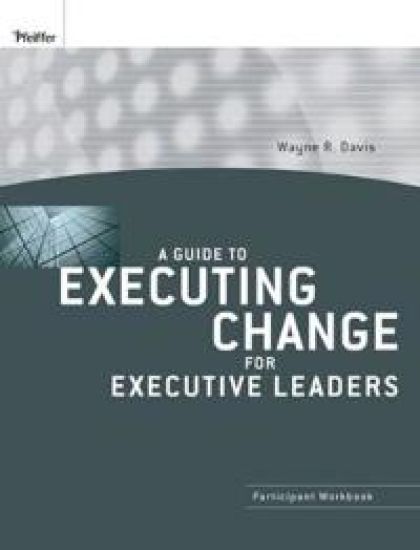
A Guide to Executing Change for Executive Leaders

A Guide to Executing Change for Executive Leaders

Wayne R. Davis

John Wiley Sons Inc
2009
nidottu
Most often, change fails because a leader attempts to shortcut a critical phase of the change process. This package provides the resources and tools needed for the practical implementation of any change initiative, from simple process-step change to large-scale assimilation projects. It is a resource for implementing transformational change such as mergers and acquisitions, change in strategic intent, or entering a global market. It is equally effective for incremental change. The toolkit contains a series of four workshops--each aimed at a difference audience--all of which include complete facilitation instructions and a participant workbook.
A Guide to Executing Change for the Project Management Team
Executing Change in the Organization In today's fast-paced environment, organizations put a premium on project management team members, like you, who can react and move quickly in response to changing conditions and pressures. A Guide to Executing Change for the Project Management Team offers you and your other project management team members the information and tools needed to successfully execute change within your team and ultimately your organization. During the course of the Executing Change in the Organization workshop, you will help to establish the framework and structure for your team's project and identify and address the key issues that will impact your team's change process. A Guide to Executing Change for the Project Management Team is the hands-on resource for guiding you in your pivotal role to drive change successfully in your organization and keep one step ahead of the competition. Your team will Determine the resources requirements Build a conceptual work plan Identify the risks and obstacles Develop the information needs Create a project calendar Address issues of communication Establish the measures and indicators
Typical work for a U.S. police officer

Typical work for a U.S. police officer

Wayne L Davis; Mahdia Ben-Salem

Logiudice Publishing
2019
pokkari
This book is designed for young readers. This book may be helpful to students who are learning multiple languages. This book presents information about U.S. local law enforcement work in English and Spanish, which allow the students to make quick comparisons between the languages.Supported by colorful illustrations to support the text.
Typical work for a U.S. police officer

Typical work for a U.S. police officer

Wayne L Davis; Mahdia Ben-Salem; Dawn M Larder

Logiudice Publishing
2019
sidottu
This book is designed for young readers. This book may be helpful to students who are learning multiple languages. This book presents information about U.S. local law enforcement work in English and Spanish, which allow the students to make quick comparisons between the languages.Supported by colorful illustrations to support the text.
Typical Work for a U.S. Police Officer

Typical Work for a U.S. Police Officer

Wayne L Davis; Yu-Wen Lai; Qiangjian Song

Logiudice Publishing
2019
pokkari
This book is designed for young readers. This book may be helpful to students who are learning multiple languages. This book presents information about U.S. local law enforcement work in English and bidialectal Chinese, which allow the students to make quick comparisons between the languages.Supported by colorful illustrations to support the text.