Kirjojen hintavertailu. Mukana 11 244 527 kirjaa ja 12 kauppaa.

Kirjahaku

Etsi kirjoja tekijän nimen, kirjan nimen tai ISBN:n perusteella.

1000 tulosta hakusanalla William Allin Storrer

The Anonymous Frank Lloyd Wright and the 700 William Street, River Forest Projec: 100th Anniversary Edition
At the celebration dinner for the completion of the manuscript for The Architecture of Frank Lloyd Wright: A Complete Catalog, dean of architectural historians Henry-Russell Hitchcock pointedly told me that Frank Lloyd Wright would drive him through the streets of Evanston, River Forest and Oak Park, and Hyde Park, and would point to a building and often say, "I did that, but nobody will ever know." This book offers the 700 William Street houses as houses to which Wright pointed as he drove Hitchcock through the neighborhood so near the architect's home.Those who deny these homes as Wright's designs - yes, there are some - need to show where in River Forest there are any other homes to which Wright could have pointed. Failing that, these homes are by Frank Lloyd Wright, produced anonymously so as to conceal Wright's involvement at a time his scandalous affair with Mamah Borthwick Cheney, wife of a client, would have demonized the project.So enjoy the discovery of 27 new homes by America's creator of Prairie architecture as his American architecture, the first stage of his developing a Democratic American architecture.---William Allin Storrer, Ph.D.
The Architecture of Frank Lloyd Wright, Fourth Edition

The Architecture of Frank Lloyd Wright, Fourth Edition

William Allin Storrer

University of Chicago Press
2017
nidottu
From sprawling houses to compact bungalows and from world-famous museums to a still-working gas station, Frank Lloyd Wright's designs can be found in nearly every corner of the country. While the renowned architect passed away more than fifty years ago, researchers and enthusiasts are still uncovering structures that should be attributed to him. William Allin Storrer is one of the experts leading this charge, and his definitive guide, The Architecture of Frank Lloyd Wright, has long been the resource of choice for anyone interested in Wright. Thanks to the work of Storrer and his colleagues at the Rediscovering Wright Project, thirty-seven new sites have recently been identified as the work of Wright. Together with more photos, updated and expanded entries, and a new essay on the evolution of Wright's unparalleled architectural style, this new edition is the most comprehensive and authoritative catalog available. Organized chronologically, the catalog includes full-color photos, location information, and historical and architectural background for all of Wright's extant structures in the United States and abroad, as well as entries for works that have been demolished over the years. A geographic listing makes it easy for traveling Wright fans to find nearby structures and a new key indicates whether a site is open to the public. Publishing for Wright's sesquicentennial, this new edition will be a trusted companion for anyone embarking on their own journeys through the wonder and genius of Frank Lloyd Wright.
Frank Lloyd Wright: Plans Drawn to a Common Scale

Frank Lloyd Wright: Plans Drawn to a Common Scale

William Allin Storrer

Createspace Independent Publishing Platform
2016
nidottu
Born in Bear Valley, Wisconsin, raised in nearby Richland Center, then Massachusetts before settling in south central Wisconsin, Frank Lloyd Wright always knew that he would be an architect. He wanted to create a Democratic American Architecture. With his Prairie homes, he achieved the first part of his goal, American Architecture. It was based upon geometry, the cruciform/pinwheel and square. With his Usonian houses, he created the next part, Democratic, thus achieving Democratic American Architecture. This was achieved by reducing the Prairie cruciform to a simple L.It is not easy for most to visualize in three dimensions, especially when one must do so from a two-dimensional plan. Yet Wright could visualize his idea for a building in three dimensions before he drew it in two.Two plans that, on paper, look identical, might be hugely different, depending on scale. SIZE MATTERS.For the author of this book, William Allin Storrer, Ph.D., the ability to visualize in three dimensions came when he took special tests with the Detroit Board of Education. Supposedly difficult spatial problems he solved quickly. But this ability didn't come into focus until he was enrolled in his doctoral program. For an architectural seminar, he was required to draw the plan of a "typical" building of each era in modern architecture: Greek, Roman, Medieval, Renaissance . . . First the Parthenon, then the Pantheon. Each fit the 11 x 8 1/2 inch paper. Seeking a perfect Gothic work, he discovered the cathedral of Amiens, France, Notre Dame D'Amiens, constructed in less than fifty years, a perfect example of Gothic. By the time he'd drawn the upper half of the east end, he'd filled the paper. Had he visualized the entire work in three dimensions, the full size of the cathedral would have been apparent and he'd have used a larger paper rather than tape pages together SIZE MATTERS.Thus this book includes American houses and apartment buildings, for it is devoted to "the space within to be lived in," as Wright stated it. It is hoped that this will open new ways of envisioning Wright's monumental catalog of domestic works.
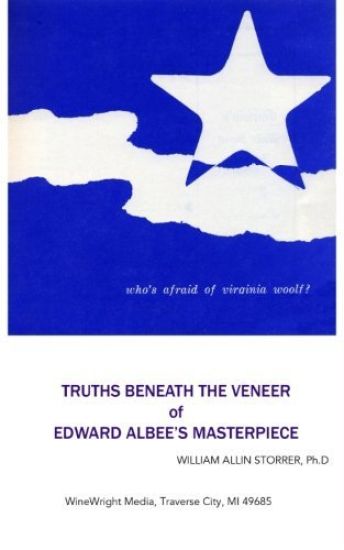
Who's Afraid of Virginia Woolf?: Truths Beneath the Veneer of Edward Albee's Masterpiece

Who's Afraid of Virginia Woolf?: Truths Beneath the Veneer of Edward Albee's Masterpiece

William Allin Storrer Ph. D.

Createspace Independent Publishing Platform
2015
nidottu
William Allin Storrer, Ph.D., after earning an A.B. in Engineering Sciences at Harvard College where he had been publicity director for the college Gilbert & Sullivan Society and the producer for the Harvard Opera Guild, decamped to Boston University. While earning his M.F.A. in Theatre Arts, Directing, he produced plays for Olawami Ritimi of Nigeria and G ksel Kortay, now a leading personage in Turkish theatre. He also directed a play in French, and his graduate thesis was a rarely allowed original play by Harvard classmate, John Wolfson, Poison Ivy, a look at drugs on Ivy campuses.His Ph.D. dissertation compared Edward Albee's Who's Afraid of Virginia Woolf? as drama and film, opening his world to the differences in the two media. Here he shares his insights into Albee's world. Having directed the play, his unique insights that go well beyond what New York and later London critics have offered about the play, he reveals a view that is comprehensive and finally explains both the title and the location of the play as significant elements in understanding Albee's first full-length masterpiece.
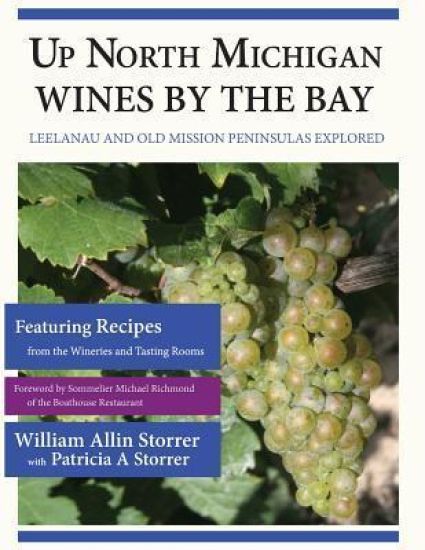
Up North Michigan Wines by the Bay: Leelanau and Old Mission Peninsulas Explored

Up North Michigan Wines by the Bay: Leelanau and Old Mission Peninsulas Explored

Patricia a. Storrer; William Allin Storrer

Createspace Independent Publishing Platform
2013
nidottu
Up North Michigan Wines By The Bay is a comprehensive portrayal of the wine industry of Leelanau and Old Mission peninsulas of northwest Michigan - describing not only the region's distinctive climate and its wineries, wines and grapes but also the determined and dedicated personalities who make it happen. Working to a remarkable level of detail, Storrer supports his research with extensive photography and maps. He brings the whole to life in conversations with owners, winemakers, growers and support organizations. Not content with nor losing sight of the "romance of the grape", Storrer delves into the work and the risk - and thus the value - behind a glass of wine. Storrer rounds out his presentation with essays on wine labeling and marketing and with photo essays on the seasonal work of growing grapes and producing wine. Presenting his information in a format that is easy to follow and well-organized, Storrer writes in an informal style that includes helpful hints to the wine-buyer on the tasting, transportation, storage and serving of wine. In keeping with the region's "foodie-destination" reputation, the book includes winery recipes and food-pairing suggestions. Linda Jones, Executive Director of the Michigan Grape and Wine Industry Council, describes this book: "Wines by the Bay is a valuable resource for those following the burgeoning growth of the wine industry in northwest lower Michigan. Bill and Pat Storrer have truly undertaken a "labor of love" in their detailed documentation of the wineries and vineyards. The excitement emanating from this emerging wine region is captured in this beautifully presented book." Of Storrer's book, Linda Murphy, author of American Wine: The Ultimate Companion to the Wines and Wineries of the United State", writes: "Those who love Michigan wine - and those savvy enough to explore it -- should not miss this in-depth, engagingly written book. All the wineries, vineyards and personalities of the Leelanau and Old Mission peninsulas are detailed in a conversational style. More than a guide for visiting tasting rooms (and an excellent one at that), it also explains how Northwest Michigan has become one of the nation's rising-star wine producers. Mouthwateringly good reading " With its microscopic view of the region's wineries, this book will compliment the (mostly "macro level") wine literature collection of the wine enthusiast.