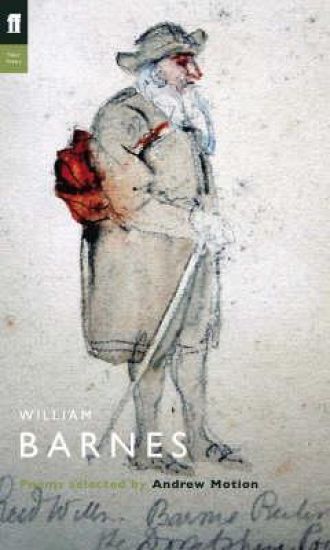
In this series, a contemporary poet selects and introduces a poet of the past. By their choice of poems and by the personal and critical reactions they express in their prefaces, the editors offer insights into their own work as well as providing an accessible and passionate introduction to the most important poets in our literature.William Barnes was born in 1801 near Sturminster Newton in Dorset, of a farming family. He learned Greek, Latin and music, taught himself wood engraving, and in 1823 became a schoolmaster in Mere. He was deply interested in grammar and language, and waged a lifelong campaign to rid English of classical and foreign influences. Among his best-known books of poetry are Poems of Rural Life in the Dorset Dialect (1844) and Homely Rhymes (1859. His work has often been praised for its evocations of Dorset life, landscape and customs; he also wrote political poems of great power and was a master elegist. Barnes died in 1886.
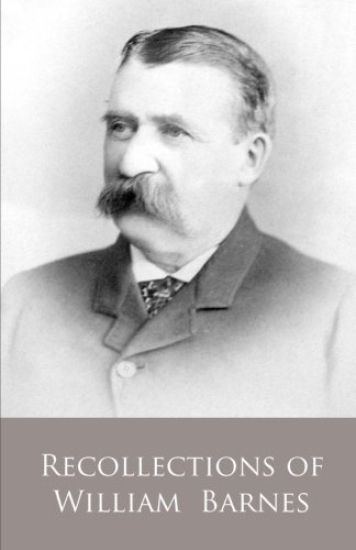
A combined and indexed edition of "Recollections of Sixty Years in Methuen" and "Recollections of Civil War", historical addressed read before the Methuen Historical Society in 1905. William Barnes was born on March 15, 1834, in Orford, NH; his family moved to Methuen when he was 11 years old. At 27 years old, Barnes a married man with 4 children, joined the 1st Massachusetts Heavy Artillery and fought in ten battles in a span of three months during the civil war. He worked in a Methuen hat factory for over thirty years, and as janitor of the new Nevins Memorial Library for eighteen years after that. He wrote these essays shortly after his retirement in 1905. William Barnes died tragically in a fall at the Odd Fellows building, on February 5, 1913. His recollections of Methuen are an integral part of all Methuen historical research.
This is the first volume of Oxford's three-volume edition of The Complete Poems of William Barnes. William Barnes (1801-1886) was an outstanding but undervalued dialect poet, and this will be the first critical edition of his complete poems. Volume I provides the first critical edition of his Poems of Rural Life, in the Dorset Dialect (1844), which broke new ground by memorializing in print the speech of a rapidly disappearing rural culture. Unfortunately, that 1844 volume has never been reprinted. This is partly because Barnes was persuaded to make its constituent poems more accessible to metropolitan readers of subsequent editions by spelling Dorset words in ways that approximated more closely to standard English, and partly because most editors and anthologists have reprinted only those revised versions of 1844 poems which Barnes published in his 1879 (and final) collection of his dialect poems. By restoring the integrity of Barnes's first volume, and investigating both its literary lineages and dialectological preoccupations, this annotated edition will enable readers to experience the initial products of those extraordinary years when Barnes was unwaveringly confident in the expressive adequacy of the Dorset dialect as a medium for poetry. Much of the literary, historical, and topographical information here brought to bear on the 1844 volume is drawn from rarely cited regional publications as well as from Barnes's uncollected contributions to newspapers and journals. The Editors' Introduction, which describes the origins, nature, and reception of Barnes's inaugural volume, offers historical accounts of both the kinds of poetry it represents and the dialectological interests that underpin it. This edition of Barnes's earliest poems in the Dorset dialect will prompt a reconsideration of their present status in the Victorian literary canon.
This is the second volume of Oxford's three-volume edition of The Complete Poems of William Barnes. Volume II contains all the poems Barnes wrote in the modified form of the Dorset dialect that he used from the mid 1850s onwards: those in the second and third collections of his Poems of Rural Life in the Dorset Dialect (1859 and 1862); those from the first collection (1844), originally written in the broad form of the dialect and here re-written in the modified form); The Song of Solomon in the Dorset dialect (1859); poems published in newspapers and periodicals after 1855 but not included in any of his collections; and posthumously published poems surviving in manuscript. Variants are included from all surviving versions of the poems. There are two introductions, the first general and the second textual. Notes on the poems record their provenance, describe their prosody, and add contextualizing information. The volume concludes with discursive appendices on textual, literary, and dialectological matters, a list of references cited, an annotated glossary, a glossary of place-names occurring in the poems, and an index of titles and first lines.
William Barnes' reputation as one of the pre-eminent British "dialect" poets, the equal of Robert Burns and John Clare, is being increasingly recognized. The range of his writings is extraordinary as evidenced by the contents of this collection, which includes works on etymology, philology, topography, mathematics, ancient history and economics. This collection displays the full diversity of Barnes' considerable intellect. Included are major and lesser-known works, biographical pieces by Thomas Hardy, and the biography by his daughter, Lucy Baxter.
Trieste Publishing has a massive catalogue of classic book titles. Our aim is to provide readers with the highest quality reproductions of fiction and non-fiction literature that has stood the test of time. The many thousands of books in our collection have been sourced from libraries and private collections around the world.The titles that Trieste Publishing has chosen to be part of the collection have been scanned to simulate the original. Our readers see the books the same way that their first readers did decades or a hundred or more years ago. Books from that period are often spoiled by imperfections that did not exist in the original. Imperfections could be in the form of blurred text, photographs, or missing pages. It is highly unlikely that this would occur with one of our books. Our extensive quality control ensures that the readers of Trieste Publishing's books will be delighted with their purchase. Our staff has thoroughly reviewed every page of all the books in the collection, repairing, or if necessary, rejecting titles that are not of the highest quality. This process ensures that the reader of one of Trieste Publishing's titles receives a volume that faithfully reproduces the original, and to the maximum degree possible, gives them the experience of owning the original work.We pride ourselves on not only creating a pathway to an extensive reservoir of books of the finest quality, but also providing value to every one of our readers. Generally, Trieste books are purchased singly - on demand, however they may also be purchased in bulk. Readers interested in bulk purchases are invited to contact us directly to enquire about our tailored bulk rates.
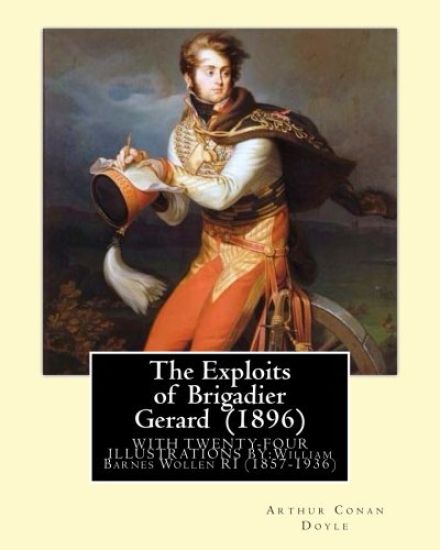
Brigadier Gerard is the hero of a series of historical short stories by the British writer Arthur Conan Doyle. The hero, Etienne Gerard, is a Hussar officer in the French Army during the Napoleonic Wars. Gerard's most notable attribute is his vanity - he is utterly convinced that he is the bravest soldier, greatest swordsman, most accomplished horseman and most gallant lover in all France. Gerard is not entirely wrong, since he displays notable bravery on many occasions, but his self-satisfaction undercuts this quite often. Obsessed with honour and glory, he is always ready with a stirring speech or a gallant remark to a lady. Conan Doyle, in making his hero a vain, and often rather uncomprehending, Frenchman, was able to satirise both the stereotypical English view of the French and - by presenting them from Gerard's baffled point of view - English manners and attitudes.Gerard tells the stories from the point of view of an old man now living in retirement in Paris. We discover that he was born in Gascony in the early 1780s (he is 25 in "How the Brigadier Captured Saragossa"). In "How the Brigadier Rode to Minsk" he attends a review of troops about to depart for the Crimea (1854-5), and this is the last identifiable date in his life, although "The Last Adventure of the Brigadier" has a still later setting, with Gerard about to return to his Gascon homeland. He first joins the 2nd Hussars - the Hussars of Chamberan - around 1799, serving as a lieutenant and junior captain. He first sees action at Marengo in Italy in 1800. He transfers to the 3rd Hussars of Conflans in 1807 as a senior captain. He speaks somewhat idiosyncratic English, having learned it from an officer of the Irish Brigade of the French Army. By 1810 he is colonel of the 2nd Hussars. He serves in Spain, Portugal, Italy, Germany and Russia. He is awarded the Grand-Cross of the L gion d'honneur by Napoleon in 1814. There are various discrepancies in the accounts of his life, not the least that in none of the stories except the last is he married. Conan Doyle enthusiasts have noted that Gerard is modelled on the real-life Baron Jean Baptiste Antoine Marcellin de Marbot, a noted French light cavalry officer during the Napoleonic Wars.Conan Doyle wrote with great affection about Marbot's memoirs in Through the Magic Door. The fictional Gerard is not to be confused with the real Napoleonic officer tienne Maurice G rard (1777-1852), who rose to become a Marshal and later Prime Minister of France.... Sir Arthur Ignatius Conan Doyle KStJ, DL (22 May 1859 - 7 July 1930) was a British writer and physician, most noted for creating the fictional detective Sherlock Holmes and writing stories about him which are generally considered milestones in the field of crime fiction. He is also known for writing the fictional adventures of a second character he invented, Professor Challenger, and for popularising the mystery of the Mary Celeste. He was a prolific writer whose other works include fantasy and science fiction stories, plays, romances, poetry, nonfiction and historical novels.
This work has been selected by scholars as being culturally important, and is part of the knowledge base of civilization as we know it. This work was reproduced from the original artifact, and remains as true to the original work as possible. Therefore, you will see the original copyright references, library stamps (as most of these works have been housed in our most important libraries around the world), and other notations in the work.This work is in the public domain in the United States of America, and possibly other nations. Within the United States, you may freely copy and distribute this work, as no entity (individual or corporate) has a copyright on the body of the work.As a reproduction of a historical artifact, this work may contain missing or blurred pages, poor pictures, errant marks, etc. Scholars believe, and we concur, that this work is important enough to be preserved, reproduced, and made generally available to the public. We appreciate your support of the preservation process, and thank you for being an important part of keeping this knowledge alive and relevant.



![Bombastes Furioso; A Burlesque Tragic Opera in One Act, Etc. [by William Barnes Rhodes. in Verse.]](/covers/9781241056278.jpg)