A History of Banking in all the Leading Nations - Comprising the United States; Great Britain; Germany; Austro-Hungary; France; Italy; Belgium; Spain; Switzerland; Portugal; Roumania; Russia; Holland; the Scandinavian nations; Canada; China; Japan; is an unchanged, high-quality reprint of the original edition of 1896. Hansebooks is editor of the literature on different topic areas such as research and science, travel and expeditions, cooking and nutrition, medicine, and other genres. As a publisher we focus on the preservation of historical literature. Many works of historical writers and scientists are available today as antiques only. Hansebooks newly publishes these books and contributes to the preservation of literature which has become rare and historical knowledge for the future.
Andrew Jackson is an unchanged, high-quality reprint of the original edition of 1899. Hansebooks is editor of the literature on different topic areas such as research and science, travel and expeditions, cooking and nutrition, medicine, and other genres. As a publisher we focus on the preservation of historical literature. Many works of historical writers and scientists are available today as antiques only. Hansebooks newly publishes these books and contributes to the preservation of literature which has become rare and historical knowledge for the future.
The Financier and the Finances of the American Revolution - Volume II is an unchanged, high-quality reprint of the original edition of 1891. Hansebooks is editor of the literature on different topic areas such as research and science, travel and expeditions, cooking and nutrition, medicine, and other genres. As a publisher we focus on the preservation of historical literature. Many works of historical writers and scientists are available today as antiques only. Hansebooks newly publishes these books and contributes to the preservation of literature which has become rare and historical knowledge for the future.
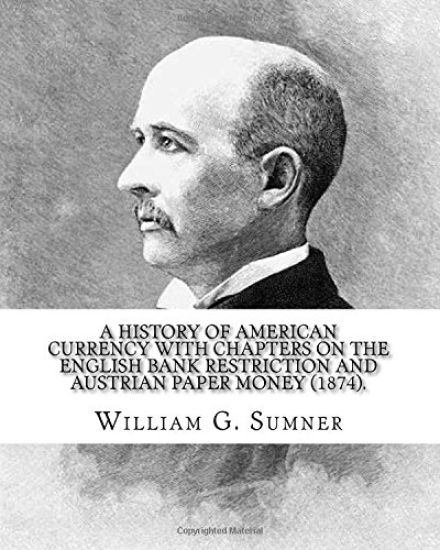
William Graham Sumner (October 30, 1840 - April 12, 1910) was a classical liberal (now a branch of "libertarianism" in American political philosophy) American social scientist. He taught social sciences at Yale, where he held the nation's first professorship in sociology. He was one of the most influential teachers at Yale or any major schools. Sumner was a polymath with numerous books and essays on American history, economic history, political theory, sociology, and anthropology. He supported laissez-faire economics, free markets, and the gold standard. He adopted the term "ethnocentrism" to identify the roots of imperialism, which he strongly opposed. He was a spokesman against imperialism and in favor of the "forgotten man" of the middle class, a term he coined. He had a long-term influence on conservatism in the United States.Sumner wrote an autobiographical sketch for the fourth of the histories of the Class of 1863 Yale College. In 1925, Rev. Harris E. Starr, class of 1910 Yale Department of Theology, published the first full length biography of Sumner. A second full length biography by Bruce Curtis was published in 1981. Other authors have included biographical information about Sumner as shown by citations in this "Biography" section.Sumner was born in Paterson, New Jersey, on October 30, 1840. His father, Thomas Sumner, was born in England and immigrated to the United States in 1836. His mother, Sarah Graham, was also born in England. She was brought to the United States in 1825 by her parents. Sumner's mother died when he was eight.In 1841, Sumner's father went prospecting as far west as Ohio, but came back east to New England and settled in Hartford, Connecticut, in about 1845. Sumner wrote about his high regard for his father: "His principles and habits of life were the best possible." Earlier in his life, Sumner said, that he accepted from others "views and opinions" different from his father's. However, "at the present time," Sumner wrote, "in regard to those matters, I hold with him and not with the others." Sumner did not name the "matters". Sumner was educated in the Hartford public schools. After graduation, he worked for two years as a clerk in a store before going to Yale College from which he graduated in 1863. Sumner achieved an impressive record at Yale as a scholar and orator. He was elected to the Phi Beta Kappa Society in his junior year and in his senior year to the secretive Skull and Bones society. Sumner avoided being drafted to fight in the American Civil War by paying a "substitute" $250, given to him by a friend, to enlist for three years. This and money given to him by his father and friends allowed Sumner to go to Europe for further studies. He spent his first year in the University of Geneva studying Latin and Hebrew and the following two years in the University of G ttingen studying ancient languages, history and Biblical science.All told, in his formal education, Sumner learned Hebrew, Greek, Latin, French, and German. In addition, after middle age he taught himself Dutch, Spanish, Portuguese, Italian, Russian, Polish, Danish, and Swedish. In May 1866, he went to Oxford University to study theology. At Oxford, Henry Thomas Buckle planted the sociology seed in Sumner's mind. However, Herbert Spencer was to have the "dominating influence upon Sumner's thought"....
""The Private Citizen and His Democracy"" by Hatton William Sumners is a thought-provoking book that explores the role of private citizens in a democratic society. Sumners argues that democracy is not just about the government and its institutions, but also about the active participation of private citizens in shaping their own destiny.The book begins by examining the history and evolution of democracy, tracing its roots back to ancient Greece and Rome. Sumners then goes on to explore the various forms of democracy that exist today, including representative democracy, direct democracy, and participatory democracy.Throughout the book, Sumners emphasizes the importance of individual responsibility and civic engagement in a democratic society. He argues that private citizens must be willing to take an active role in shaping public policy, and that they must be willing to hold their elected officials accountable for their actions.In addition to exploring the role of private citizens in democracy, Sumners also examines the various challenges and obstacles that can hinder democratic participation. These include issues such as voter apathy, political polarization, and the influence of money in politics.Overall, ""The Private Citizen and His Democracy"" is a thought-provoking and insightful book that provides a valuable perspective on the importance of individual participation in a democratic society. It is an essential read for anyone interested in politics, civic engagement, and the future of democracy.This scarce antiquarian book is a facsimile reprint of the old original and may contain some imperfections such as library marks and notations. Because we believe this work is culturally important, we have made it available as part of our commitment for protecting, preserving, and promoting the world's literature in affordable, high quality, modern editions, that are true to their original work.







![[Diary of William G. DeGolyer, 1937-1978]](/covers/9781014119414.jpg)