
Kirjahaku
Etsi kirjoja tekijän nimen, kirjan nimen tai ISBN:n perusteella.
1000 tulosta hakusanalla William George Meredith

Geology in the Service of Man
William George 1879- Fearnsides; O. M. B. (Oliver Meredith Boo Bulman
Hassell Street Press
2021
sidottu
Geology in the Service of Man
William George 1879- Fearnsides; O. M. B. (Oliver Meredith Boo Bulman
Hassell Street Press
2021
nidottu
Information for William-George-Simon-David Ross, and Mr. Donald Ross Writer in Edinburgh, His Factor, Pursuers; Against William Munro of Newmore, Defender.
William-George-Simon-David Ross
Gale Ecco, Print Editions
2010
pokkari
Information for William-George-Simon-David Ross, and Mr. Donald Ross Writer in Edinburgh, his Factor, Pursuers; Against William Munro of Newmore, Defender
William-George-Simon-David Ross
Gale Ecco, Print Editions
2018
sidottu
The 18th century was a wealth of knowledge, exploration and rapidly growing technology and expanding record-keeping made possible by advances in the printing press. In its determination to preserve the century of revolution, Gale initiated a revolution of its own: digitization of epic proportions to preserve these invaluable works in the largest archive of its kind. Now for the first time these high-quality digital copies of original 18th century manuscripts are available in print, making them highly accessible to libraries, undergraduate students, and independent scholars.This collection reveals the history of English common law and Empire law in a vastly changing world of British expansion. Dominating the legal field is the Commentaries of the Law of England by Sir William Blackstone, which first appeared in 1765. Reference works such as almanacs and catalogues continue to educate us by revealing the day-to-day workings of society.++++The below data was compiled from various identification fields in the bibliographic record of this title. This data is provided as an additional tool in helping to insure edition identification: ++++Bodleian Library (Oxford)T210226Dated at head of the drop-head title: June 12. 1766. William Munro of Newmore is otherwise known as William Ross of Aldie. Edinburgh, 1766]. 18p.; 4



A History of Japanese Literature (1899) by: William George Aston
William George Aston
Createspace Independent Publishing Platform
2018
nidottu
William George Aston (9 April 1841 - 22 November 1911) was a British diplomat, author and scholar-expert in the language and history of Japan and Korea.Aston was born near Derry, Ireland. He distinguished himself at Queen's College, Belfast (now Queen's University Belfast), which he attended 1859-1863. There he received a very thorough philological training in Latin, Greek, French, German and modern history. One of his professors was James McCosh.Aston was appointed in 1864 student interpreter to the British Legation in Japan. He mastered the theory of the Japanese verb, and in Edo began, with Ernest Mason Satow, those profound researches into the Japanese language which laid the foundations of the critical study of the Japanese language by western scholars.] Aston passed the examination for entry to the Consular Service in 1884, and served in the British consular service in Tokyo, Kobe and Nagasaki. From 1884-1885, Aston served as the United Kingdom's consul-general in Korea. He returned to consular duties in Tokyo as Secretary of British Legation in 1885. Aston retired from the foreign service on a pension in 1889 because of ill-health and settled in England.He was appointed CMG in the 1889 Birthday Honours.

William George Ward and the Oxford Movement is an unchanged, high-quality reprint of the original edition of 1890. Hansebooks is editor of the literature on different topic areas such as research and science, travel and expeditions, cooking and nutrition, medicine, and other genres. As a publisher we focus on the preservation of historical literature. Many works of historical writers and scientists are available today as antiques only. Hansebooks newly publishes these books and contributes to the preservation of literature which has become rare and historical knowledge for the future.
A Letter to William George Ward, Esq., D. Ph.
William George Ward; Henry Ignatius Dudley Ryder
Hansebooks
2018
nidottu




The Great War broke out on August 4th, 1914, impacting the lives of millions around the world. Many people thought - or hoped - that the War would be short. One of the young men who entered the fighting that month, and who served until his death in March 1918, was twenty-five year old William George Gabain M.C. Known to family to this day, as "Uncle Willie," he lost his life early in Germany's last offensive, Operation Michael, in March 1918, and is buried in the British cemetery at Pargny, France by the Somme Canal. Gabain was born in Le Havre. He traveled and studied in Germany and also read German language at Cambridge. Because of this background and fluency in French and German, he was valued as an intelligence officer. In 1915, he operated a train watching service in German occupied Belgium. In France he spent his time at GHQ, served in the 1916 Battle of the Somme and at Ypres in Belgium. He questioned prisoners, studied the terrain, flew over the trenches, translated captured documents and letters, listened to German wireless communications, and reported to GHQ and General Haig. His best friend was his Triumph motorcycle. He was educated at Sandroyd, Charterhouse and Cambridge's Pembroke College. He loved sports, especially boxing. He was survived by his parents, Charles Edward Gabain and Elizabeth Hutton Gabain, and his sisters Marjorie, Dorothy, Ruth, Nora, and Ethel. In 1921, his grief stricken mother privately published a book with excerpts from his journals, his letters, her thoughts and feelings, and condolences the family received from people who knew and served with him. His story is one of millions of men and their families who suffered and lost so much in The Great War.

The Great War broke out on August 4th, 1914, impacting the lives of millions around the world. Many people thought - or hoped - that the War would be short. One of the young men who entered the fighting that onth, and who served until his death in March 1918, was twenty-five year old William George Gabain M.C. Known to family to this day, as "Uncle Willie," he lost his life early in Germany's last offensive, Operation Michael, in March 1918, and is buried in the British cemetery at Pargny, France by the Somme Canal. Gabain was born in Le Havre. He traveled and studied in Germany and also read German language at Cambridge. Because of this background and fluency in French and German, he was valued as an intelligence officer. In 1915, he operated a train watching service in German occupied Belgium. In France he spent his time at GHQ, served in the 1916 Battle of the Somme and at Ypres in Belgium. He questioned prisoners, studied the terrain, flew over the trenches, translated captured documents and letters, listened to German wireless communications, and reported to GHQ and General Haig. His best friend was his Triumph motorcycle. He was educated at Sandroyd, Charterhouse and Cambridge's Pembroke College. He loved sports, especially boxing. He was survived by his parents, Charles Edward Gabain and Elizabeth Hutton Gabain, and his sisters Marjorie, Dorothy, Ruth, Nora, and Ethel. In 1921, his grief stricken mother privately published a book with excerpts from his journals, his letters, her thoughts and feelings, and condolences the family received from people who knew and served with him. His story is one of millions of men and their families who suffered and lost so much in The Great War.

A Biographical Sketch Of William George Maton (1838)
John Ayrton Paris
KESSINGER PUBLISHING, LLC
2010
sidottu
![Essays ... Edited by William George Clark. [With a Portrait.]](/covers/9781241092030.jpg)
Essays ... Edited by William George Clark. [With a Portrait.]
George Brimley; William George Clark
British Library, Historical Print Editions
2011
pokkari
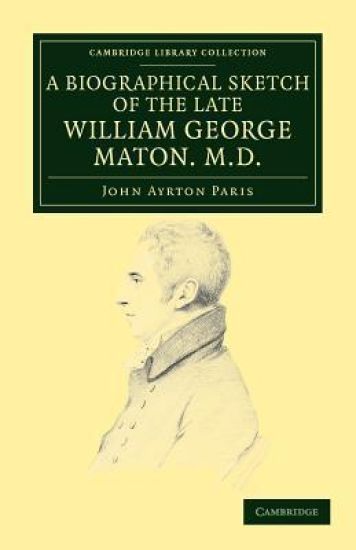
A Biographical Sketch of the Late William George Maton M.D.
John Ayrton Paris; William George Maton
Cambridge University Press
2011
pokkari
English physician William George Maton (1774–1835) was a polymath who had a special interest in botany: a shell and a parrot were among species named in his honour. His writings on natural history included a catalogue of the plant and animal life around Salisbury, Wiltshire, which was published posthumously in 1843 and is reissued as the second part of this composite work. The first part contains a sketch of Maton's life and work by fellow physician and writer John Ayrton Paris (c. 1785–1856), first presented to the Royal College of Physicians, and subsequently published in 1838. Paris discusses Maton's early life, his contributions to the growing field of botany, his other scientific and antiquarian interests, and his distinguished medical career, during which he was appointed physician-extraordinary to Queen Charlotte, wife of George III, and later physician-in-ordinary to the duchess of Kent and the young Princess (later Queen) Victoria.
A Biographical Sketch of the Late William George Maton, M. D.
John Ayrton Paris
Outlook Verlag
2024
pokkari
Reprint of the original, first published in 1838.

A Biographical Sketch of the Late William George Maton, M. D.
John Ayrton Paris
Antigonos Verlag
2025
nidottu