The 18th century was a wealth of knowledge, exploration and rapidly growing technology and expanding record-keeping made possible by advances in the printing press. In its determination to preserve the century of revolution, Gale initiated a revolution of its own: digitization of epic proportions to preserve these invaluable works in the largest archive of its kind. Now for the first time these high-quality digital copies of original 18th century manuscripts are available in print, making them highly accessible to libraries, undergraduate students, and independent scholars.Western literary study flows out of eighteenth-century works by Alexander Pope, Daniel Defoe, Henry Fielding, Frances Burney, Denis Diderot, Johann Gottfried Herder, Johann Wolfgang von Goethe, and others. Experience the birth of the modern novel, or compare the development of language using dictionaries and grammar discourses. ++++The below data was compiled from various identification fields in the bibliographic record of this title. This data is provided as an additional tool in helping to insure edition identification: ++++Harvard University Houghton LibraryN000747Waymouth: printed for J. Love, by S. Powell, and W. Holloway, 1792. 2], vi,119p.; 8
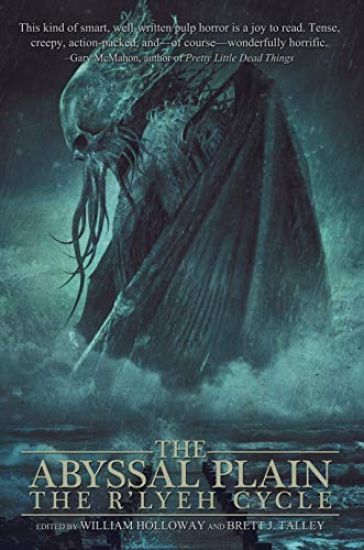
With The Abyssal Plain, Holloway and Talley have managed to transform the Cthulhu Mythos into something with a more modern flavor, drawing not just from the well of cosmic horror, but from technothrillers, survival horror, and splatterpunk, with just a dash of the lost sensibilities of the shudder pulps. A cup full of tentacles mixed with existential nihilism and sprinkled with liberal quantities of gore, this is Lovecraftian horror with a bloody bent that few others have dared to explore. --Peter Rawlik, author of Reanimators They called it the Event.The Event changed everything. The earthquakes came first, including the Big One, shattering the Pacific Rim and plunging the world into chaos. Then the seas came, the skies opened, and the never-ending rain began. But as bad as that was, there is something worse.The Rising has begun. A lone man who abandoned the world for his addictions searches a waterlogged Austin for something, anything to cling to. Little does he know that something else searches for him.In the Sonoran Desert, the downtrodden of the world search for a better life north of the border, only to see the desert become an ocean: an ocean that takes life and gives death. In the woods of Alabama, survivors escape to Fort Resistance, but soon discover that it isn't just the horrors of the deep places of the world that they need to fear; but rather a new and more deadly pestilence that has grown in their own ranks. In England, it's too late to fight, and all that's left is to survive. One man reaches for his own humanity, but what to do when humanity is an endangered species?And in the Pacific, He is rising.In The Abyssal Plain: The R'lyeh Cycle, authors William Holloway, Michelle Garza and Melissa Lason, Brett J. Talley, and Rich Hawkins have created a timely and uniquely modern reimagining of the Cthulhu Mythos. The Abyssal Plain documents the apocalypse as inspired by H. P. Lovecraft, worsening swiftly from its creepy, suggestive origins to an all-out nightmarish hellscape. Told in the varied voices of its multiple writers--which lends to the feeling of a widespread event--this mosaic novel is a gripping, cinematic roller-coaster ride of action and suspense. Enough with zombies, already...I'd pay to watch a TV show based on this book. "The Walking Squid," anyone? --Jeffrey Thomas, author of Punktown
With The Abyssal Plain, Holloway and Talley have managed to transform the Cthulhu Mythos into something with a more modern flavor, drawing not just from the well of cosmic horror, but from technothrillers, survival horror, and splatterpunk, with just a dash of the lost sensibilities of the shudder pulps. A cup full of tentacles mixed with existential nihilism and sprinkled with liberal quantities of gore, this is Lovecraftian horror with a bloody bent that few others have dared to explore. --Peter Rawlik, author of Reanimators They called it the Event.The Event changed everything. The earthquakes came first, including the Big One, shattering the Pacific Rim and plunging the world into chaos. Then the seas came, the skies opened, and the never-ending rain began. But as bad as that was, there is something worse.The Rising has begun. A lone man who abandoned the world for his addictions searches a waterlogged Austin for something, anything to cling to. Little does he know that something else searches for him.In the Sonoran Desert, the downtrodden of the world search for a better life north of the border, only to see the desert become an ocean: an ocean that takes life and gives death. In the woods of Alabama, survivors escape to Fort Resistance, but soon discover that it isn't just the horrors of the deep places of the world that they need to fear; but rather a new and more deadly pestilence that has grown in their own ranks. In England, it's too late to fight, and all that's left is to survive. One man reaches for his own humanity, but what to do when humanity is an endangered species?And in the Pacific, He is rising.In The Abyssal Plain: The R'lyeh Cycle, authors William Holloway, Michelle Garza and Melissa Lason, Brett J. Talley, and Rich Hawkins have created a timely and uniquely modern reimagining of the Cthulhu Mythos. The Abyssal Plain documents the apocalypse as inspired by H. P. Lovecraft, worsening swiftly from its creepy, suggestive origins to an all-out nightmarish hellscape. Told in the varied voices of its multiple writers--which lends to the feeling of a widespread event--this mosaic novel is a gripping, cinematic roller-coaster ride of action and suspense. Enough with zombies, already...I'd pay to watch a TV show based on this book. "The Walking Squid," anyone? --Jeffrey Thomas, author of Punktown
This book comprehensively describes the biological underpinnings of red meat production, discussing the current state of the science in the context of the provision of red meat products perceived by consumers to offer a quality eating experience. Covering advances in the science of red meat production, it focuses on production system elements that affect product quality. The chapters explore the latest developments in the determination of consumer preferences, and interpret of these preferences in terms of quality characteristics of red meat, investigating the science-based orchestration of red meat production to achieve product consistency. The book highlights topics such as consumer preferences, the biological and production system elements affecting red meat safety, and the intrinsic (appearance, aroma, and sensory quality) and extrinsic (humane animal and environmentally friendly production) characteristics of red meat. For each characteristic, it discusses the underlying biological and biochemical processes and examines means of altering production systems to impact consumer eating experiences. The book also features a perspective on creating holistic integrated systems for producing red meats to meet consumers’ expectations around the globe. Written by leading authorities in the area of global red meat production systems, it is a comprehensive resource for consumer-oriented red meat producers.


![SententiÃ] Juris](/covers/9781024168242.jpg)
![SententiÃ] Juris](/covers/9781024172720.jpg)