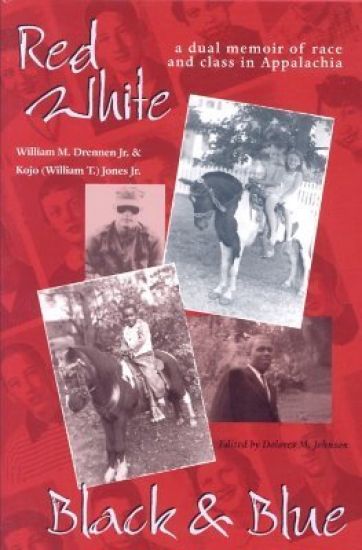
Red, White, Black, and Blue began as a collaborative memoir by William M. "Bill" Drennen, a European American, and Kojo (William T.) Jones, an African American. These Appalachian men grew up in the South Hills section of Charleston, West Virginia. As boys they played on the same Little League baseball team and experienced just one year together as schoolmates after the all-white Thomas Jefferson Junior High School was desegregated in 1955. After that, class, race, and choice separated their life experiences for forty-five years. In 1992 both had returned to Charleston from lives mostly lived elsewhere. They decided to work together on a memoir of growing up through the trauma of desegregation. Their aim was to foster understanding between their distinct cultures for themselves and for their own and future generations. Dolores Johnson, in editing the two texts, observed two very different modes of expression: Bill Drennen's narrative is threaded with references that connote wealth, status, and personal privilege; Kojo Jones's memoir is interwoven with African American signification, protest, and moral outrage. The stories of their Appalachian upbringing in homes less than a mile apart are anecdotal in nature, but their diverse uses of the English language as they endeavor to communicate shared memories and common meanings reveal significant cultural connotations that transform standard American English into two different languages, rendering interracial communication problematic. Dr. Johnson's analysis is to the point. Red, White, Black, and Blue is a groundbreaking approach to studying not only cultural linguistics but also the cultural heritage of a historic time and place in America. It gives witness to the issues of race and class inherent in the way we write, speak, and think.
Red, White, Black, and Blue began as a collaborative memoir by William M. "Bill" Drennen, a European American, and Kojo (William T.) Jones, an African American. These Appalachian men grew up in the South Hills section of Charleston, West Virginia. As boys they played on the same Little League baseball team and experienced just one year together as schoolmates after the all-white Thomas Jefferson Junior High School was desegregated in 1955. After that, class, race, and choice separated their life experiences for forty-five years. In 1992 both had returned to Charleston from lives mostly lived elsewhere. They decided to work together on a memoir of growing up through the trauma of desegregation. Their aim was to foster understanding between their distinct cultures for themselves and for their own and future generations. Dolores Johnson, in editing the two texts, observed two very different modes of expression: Bill Drennen's narrative is threaded with references that connote wealth, status, and personal privilege; Kojo Jones's memoir is interwoven with African American signification, protest, and moral outrage. The stories of their Appalachian upbringing in homes less than a mile apart are anecdotal in nature, but their diverse uses of the English language as they endeavor to communicate shared memories and common meanings reveal significant cultural connotations that transform standard American English into two different languages, rendering interracial communication problematic. Dr. Johnson's analysis is to the point. Red, White, Black, and Blue is a groundbreaking approach to studying not only cultural linguistics but also the cultural heritage of a historic time and place in America. It gives witness to the issues of race and class inherent in the way we write, speak, and think.
This book is part of the TREDITION CLASSICS series. The creators of this series are united by passion for literature and driven by the intention of making all public domain books available in printed format again - worldwide. At tredition we believe that a great book never goes out of style. Several mostly non-profit literature projects provide content to tredition. To support their good work, tredition donates a portion of the proceeds from each sold copy. As a reader of a TREDITION CLASSICS book, you support our mission to save many of the amazing works of world literature from oblivion.
This book "" From Farm House to the White House: The life of George Washington, his boyhood, youth, manhood, public and private life and services "", has been considered important throughout the human history, and so that this work is never forgotten we have made efforts in its preservation by republishing this book in a modern format for present and future generations. This whole book has been reformatted, retyped and designed. These books are not made of scanned copies and hence the text is clear and readable.