This work has been selected by scholars as being culturally important, and is part of the knowledge base of civilization as we know it. This work was reproduced from the original artifact, and remains as true to the original work as possible. Therefore, you will see the original copyright references, library stamps (as most of these works have been housed in our most important libraries around the world), and other notations in the work.This work is in the public domain in the United States of America, and possibly other nations. Within the United States, you may freely copy and distribute this work, as no entity (individual or corporate) has a copyright on the body of the work.As a reproduction of a historical artifact, this work may contain missing or blurred pages, poor pictures, errant marks, etc. Scholars believe, and we concur, that this work is important enough to be preserved, reproduced, and made generally available to the public. We appreciate your support of the preservation process, and thank you for being an important part of keeping this knowledge alive and relevant.
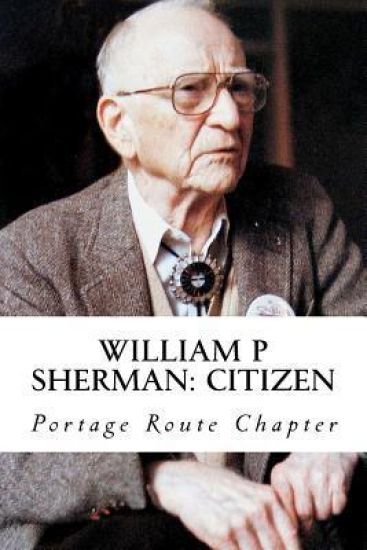
Although the intent of this book is to put the spotlight on William P. Sherman, it is not the the purpose of this book to do so for his glory. He specifically requrested that any writing undertaken was to influence those who might think favorably of his life's work to follow suit.If he had wanted to create a monument to himself rather than be an almost anonymous philanthropist he had the means and opportunity to do so. Instead he was more interested in the cause than who got credit for getting it done. If he could help he was there to help; if he could motivate others he was there to motivate; if direction was needed he directed.He contributed his skills, services and resources for his family and the welfare of his country, for preservation of our national heritage, the advancement of Western art, and the preservation of the history of the Catholic missionary work in the Pacific Northwest.Those were his causes. If telling about his involvement in them will influence others to do the same, this book will have served its purpose.
William Paton Mackay's greatest books are now available in one volume: Abundant Grace, Grace and Truth, and The Seeking Savior. Mackay, a Scottish physician in the late 1800s, became a believer when confronted with the gospel in an amazing way. He became a pastor and evangelist, and his life's work provides stories and examples that cause the unbeliever to consider the claims of the gospel and blesses the believer with a deeper understanding of the amazing work of God's grace. In addition to his books and work as an editor of a Christian journal, Mackay wrote many hymns, the most notable of which is "Revive Us Again." Laymen, Bible students, and theologians alike will savor the rich, complex thinking presented simply. Note that many copies of Grace and Truth are truncated, but this collection contains the entire book--all twelve aspects, not just six.
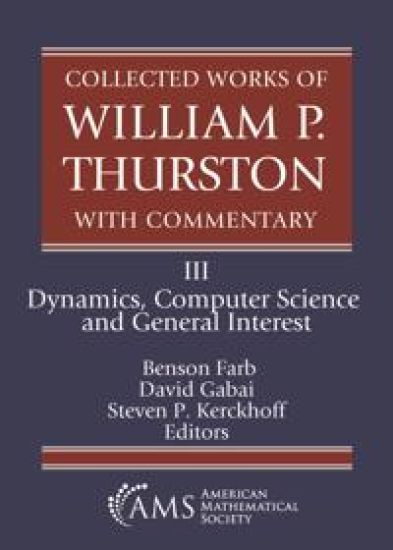
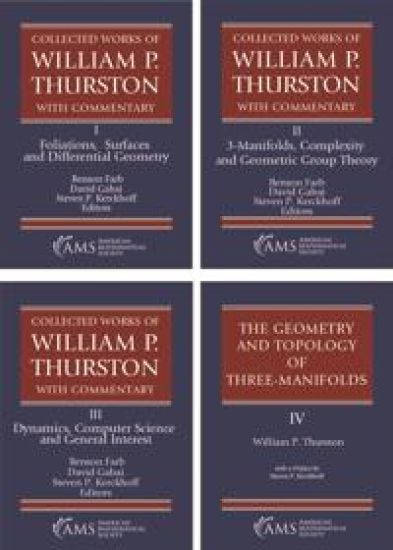
William Thurston's work has had a profound influence on mathematics. He connected whole mathematical subjects in entirely new ways and changed the way mathematicians think about geometry, topology, foliations, group theory, dynamical systems, and the way these areas interact. His emphasis on understanding and imagination in mathematical learning and thinking are integral elements of his distinctive legacy. This four-part collection brings together in one place Thurston's major writings, many of which are appearing in publication for the first time. Volumes I-III contain commentaries by the Editors. Volume IV includes a preface by Steven P. Kerckhoff. Volume III contains William Thurston's papers on dynamics and computer science, and papers written for general audiences. Additional miscellaneous papers are also included, such as his 1967 New College undergraduate thesis, which foreshadows his later work.
William Thurston's work has had a profound influence on mathematics. He connected whole mathematical subjects in entirely new ways and changed the way mathematicians think about geometry, topology, foliations, group theory, dynamical systems, and the way these areas interact. His emphasis on understanding and imagination in mathematical learning and thinking are integral elements of his distinctive legacy.This four-part collection brings together in one place Thurston's major writings, many of which are appearing in publication for the first time. Volumes I-III contain commentaries by the Editors. Volume IV includes a preface by Steven P. Kerckhoff.Volume I contains William Thurston's papers on foliations, mapping classes groups, and differential geometry.
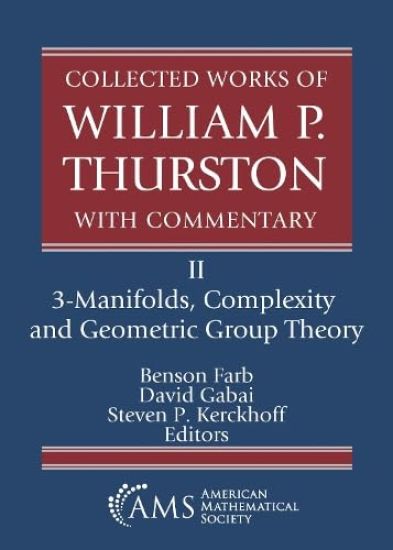
William Thurston's work has had a profound influence on mathematics. He connected whole mathematical subjects in entirely new ways and changed the way mathematicians think about geometry, topology, foliations, group theory, dynamical systems, and the way these areas interact. His emphasis on understanding and imagination in mathematical learning and thinking are integral elements of his distinctive legacy.This four-part collection brings together in one place Thurston's major writings, many of which are appearing in publication for the first time. Volumes I-III contain commentaries by the Editors. Volume IV includes a preface by Steven P. Kerckhoff.Volume II contains William Thurston's papers on the geometry and topology of 3-manifolds, on complexity, constructions and computers, and on geometric group theory.
This set contains the Collected Works of William P. Thurston with Commentary, Volumes I-III, and The Geometry and Topology of Three-Manifolds.William Thurston's work has had a profound influence on mathematics. He connected whole mathematical subjects in entirely new ways and changed the way mathematicians think about geometry, topology, foliations, group theory, dynamical systems, and the way these areas interact. His emphasis on understanding and imagination in mathematical learning and thinking are integral elements of his distinctive legacy.This four-part collection brings together in one place Thurston's major writings, many of which are appearing in publication for the first time. Volumes I-III contain commentaries by the Editors. Volume IV includes a preface by Steven P. Kerckhoff.
Each day thousands of revelers trudge down DuVal Street in Florida’s Key West, but few know for whom the street is named. In Florida Founder William P. DuVal, James M. Denham provides the first full-length biography of the well-connected, but nearly forgotten frontier politician of antebellum America. The scion of a well-to-do Richmond, Virginia, family, William Pope DuVal (1784–1854) migrated to the Kentucky frontier as a youth in 1800. Settling in Bardstown, DuVal read law, served in Congress, and fought in the War of 1812.In 1822, largely because of the influence of his lifelong friend John C. Calhoun, President James Monroe appointed DuVal the first civil governor of the newly acquired Territory of Florida. Enjoying successive appointments from the Adams and Jackson administrations, DuVal founded Tallahassee and presided over the territory’s first twelve territorial legislative sessions, years that witnessed Middle Florida’s development into one of the Old Southwest’s most prosperous slave-based economies. Beginning with his personal confrontation with Miccosukee chief Neamathla in 1824 (an episode commemorated by Washington Irving), DuVal worked closely with Washington officials and oversaw the initial negotiations with the Seminoles.A perennial political appointee, DuVal was closely linked to national and territorial politics in antebellum America. Like other “Calhounites” who supported Andrew Jackson’s rise to the White House, DuVal became a casualty of the Peggy Eaton Affair and the Nullification Crisis. In fact he was replaced as Florida governor by Mrs. Eaton’s husband, John Eaton. After leaving the governor’s chair, DuVal migrated to Kentucky, lent his efforts to the cause of Texas Independence, and eventually returned to practice law and local politics in Florida. Throughout his career DuVal cultivated the arts of oratory and story-telling - skills essential to success in the courtrooms and free-for-all politics of the American South. Part frontiersman and part sophisticate, DuVal was at home in the wilds of Kentucky, Florida, Texas, and Washington City. He delighted in telling tall tales, jests, and anecdotes that epitomized America’s expansive, democratic vistas. Among those captivated by DuVal’s life and yarns were Washington Irving, who used DuVal’s tall tales as inspiration for his “The Early Experiences of Ralph Ringwood,” and James Kirke Paulding, whose “Nimrod Wildfire” shared Du Val’s brashness and bonhommie.
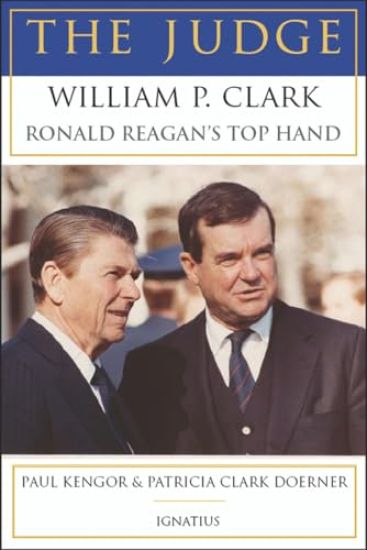
The most important biographical record of the Reagan years--from the Reagan governorship to the 40th president's period in the White House--has not been written, until now: it is the story of Ronald Reagan's indispensable man, confidant, and single most important adviser: William P. Clark, known to many as simply "The Judge." With his record, resume, and the respect he earned from so many quarters, why did Bill Clark never pen an autobiography? Why did he never write memoirs, even while less influential advisers advanced their stories in the 1980s, proclaiming theirs to be the authoritative insider's account of the Reagan presidency? And why did Clark not write that story as everyone--from top Reagan officials such as Cap Weinberger to authoritative Reagan biographers such as Lou Cannon--urged him to do so? Bill Clark's reluctance to promote himself stopped him from picking up pen and paper. Instead, at long last, he acquiesced to the writing of this biography. Paul Kengor did the convincing, and Pat Clark Doerner worked with Clark to painstakingly review the manuscript--after Kengor and Doerner together wrote this fascinating account of one man's life, from a ranch house to the White House and then, again, back to the ranch--to what Ronald Reagan called the sunset of life. Reagan biographers such as Edmund Morris and major publications like the New York Times Magazine and Time all agree: Bill Clark was Ronald Reagan's single most trusted aide, perhaps the most powerful national security advisor in American history. His close relationship with Reagan allows special insight into the President as well as other close friends from the earliest Reagan years: Lyn Nofziger, Cap Weinberger and Bill Casey. Also featured are the exquisite Clare Boothe Luce; the elegant Nancy Reagan; the mercurial Alexander Haig; Britain's "Iron Lady," Margaret Thatcher; France's wily Frantois Mitterrand, the saintly Pope John Paul II, and an anxious Saddam Hussein, among others. With Reagan, Clark accomplished many things, but none more profound than the track they laid to undermine Soviet communism, to win the Cold War. As this book shows, Ronald Reagan and Bill Clark, two ranchers, a president and his top hand, truly changed history. At long last, over two decades after that significant accomplishment, Bill Clark shares the details of that extraordinary effort, many of which--as readers of this book will learn--have never been reported.
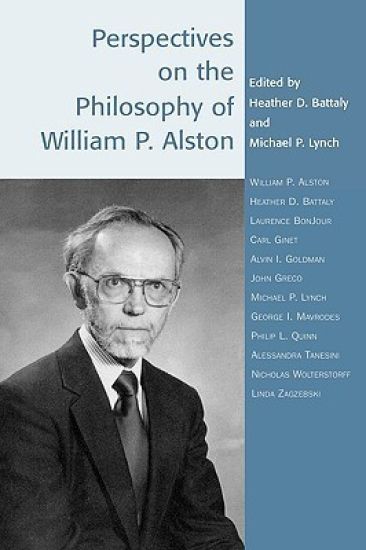
One of the most influential analytic philosophers of the late twentieth century, William P. Alston is a leading light in epistemology, philosophy of religion, and the philosophy of language. In this volume, twelve leading philosophers critically discuss the central topics of his work in these areas, including perception, epistemic circularity, justification, the problem of religious diversity, and truth. Together with Alston's vigorous responses, these articles make significant new contributions to the literature and will be of interest to a wide range of philosophers and students. In addition, the volume contains a comprehensive introduction and overview of Alston's work and a complete bibliography of his publications
This work has been selected by scholars as being culturally important and is part of the knowledge base of civilization as we know it.This work is in the public domain in the United States of America, and possibly other nations. Within the United States, you may freely copy and distribute this work, as no entity (individual or corporate) has a copyright on the body of the work.Scholars believe, and we concur, that this work is important enough to be preserved, reproduced, and made generally available to the public. To ensure a quality reading experience, this work has been proofread and republished using a format that seamlessly blends the original graphical elements with text in an easy-to-read typeface.We appreciate your support of the preservation process, and thank you for being an important part of keeping this knowledge alive and relevant.
This memoir reveals a great deal about the character and personality of an individual who lived his life with a thoroughgoing sense of honor. As a midshipman he was a leader in devising the Naval Academy’s honor concept. During his five and a half years as a prisoner of war in Vietnam, he was stalwart in his resistance to his captors. His achievement has been honored by the naming of the guided missile destroyer USS William P. Lawrence (DDG-110). His oral history is a treasure trove of material on the Naval Academy, both during Lawrence’s midshipman years and in his tenure as superintendent, during which the first women graduated. Throughout the volume, the values of his native Tennessee come through. dmiral Lawrence told his story with integrity and candor. After his graduation from Annapolis in 1951, Lawrence took flight training and became a member of Fighter Squadron 193 (VF-193), 1952-55, during a time of pioneering work in night carrier operations by jets. Among his shipmates was future astronaut Alan Shepard. Lawrence was subsequently a test pilot for the F8U-3 Crusader III and, on the staff of Commander Carrier Division Six, served as flag lieutenant to future Chief of Naval Operations Thomas H. Moorer. After duty in 1960-61 in Fighter Squadron 101 (VF-101) to prepare for the fleet introduction of the F-4 Phantom II, Lawrence took a break from naval aviation to serve as navigator of the heavy cruiser USS Newport News (CA-148). While he was in Fighter Squadron 14 (VF-14), 1962-64, it transitioned from the F3H Demon to the F-4. He served 1964-66 as executive assistant to Commander in Chief Strike Command, Army General Paul D. Adams. Lawrence was XO and then CO of Fighter Squadron 143 (VF-143) from 1966 until he was shot down over North Vietnam in 1967, then was a POW until his release in March 1973. After being repatriated, he spent a year at the National War College, was selected for flag rank, and in 1974-75 commanded Light Attack Wing Pacific Fleet. From 1975 to 1978 he was in OP-05, the office of the DCNO (Air Warfare) in the Pentagon. From 1978 to 1981, as a vice admiral, Lawrence was superintendent of the Naval Academy. He commanded the Third Fleet, 1981-83, including running two multi-carrier exercises in the North Pacific. His final tour of active duty, 1983-85, was as Chief of Naval Personnel when John F. Lehman Jr. was Secretary of the Navy. Lawrence retired on disability because of a case of depression that lasted until his cure in 1989. The oral history discusses his illness openly. His post-retirement activities included writing, teaching, speaking, and serving as president of the Association of Naval Aviation.
This memoir reveals a great deal about the character and personality of an individual who lived his life with a thoroughgoing sense of honor. As a midshipman he was a leader in devising the Naval Academy’s honor concept. During his five and a half years as a prisoner of war in Vietnam, he was stalwart in his resistance to his captors. His achievement has been honored by the naming of the guided missile destroyer USS William P. Lawrence (DDG-110). His oral history is a treasure trove of material on the Naval Academy, both during Lawrence’s midshipman years and in his tenure as superintendent, during which the first women graduated. Throughout the volume, the values of his native Tennessee come through. dmiral Lawrence told his story with integrity and candor. After his graduation from Annapolis in 1951, Lawrence took flight training and became a member of Fighter Squadron 193 (VF-193), 1952-55, during a time of pioneering work in night carrier operations by jets. Among his shipmates was future astronaut Alan Shepard. Lawrence was subsequently a test pilot for the F8U-3 Crusader III and, on the staff of Commander Carrier Division Six, served as flag lieutenant to future Chief of Naval Operations Thomas H. Moorer. After duty in 1960-61 in Fighter Squadron 101 (VF-101) to prepare for the fleet introduction of the F-4 Phantom II, Lawrence took a break from naval aviation to serve as navigator of the heavy cruiser USS Newport News (CA-148). While he was in Fighter Squadron 14 (VF-14), 1962-64, it transitioned from the F3H Demon to the F-4. He served 1964-66 as executive assistant to Commander in Chief Strike Command, Army General Paul D. Adams. Lawrence was XO and then CO of Fighter Squadron 143 (VF-143) from 1966 until he was shot down over North Vietnam in 1967, then was a POW until his release in March 1973. After being repatriated, he spent a year at the National War College, was selected for flag rank, and in 1974-75 commanded Light Attack Wing Pacific Fleet. From 1975 to 1978 he was in OP-05, the office of the DCNO (Air Warfare) in the Pentagon. From 1978 to 1981, as a vice admiral, Lawrence was superintendent of the Naval Academy. He commanded the Third Fleet, 1981-83, including running two multi-carrier exercises in the North Pacific. His final tour of active duty, 1983-85, was as Chief of Naval Personnel when John F. Lehman Jr. was Secretary of the Navy. Lawrence retired on disability because of a case of depression that lasted until his cure in 1989. The oral history discusses his illness openly. His post-retirement activities included writing, teaching, speaking, and serving as president of the Association of Naval Aviation.