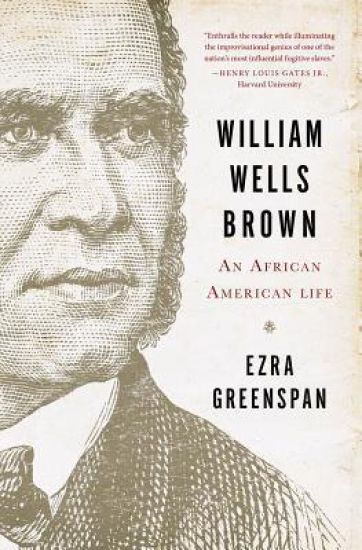
Elegantly written and painstakingly researched, Ezra Greenspan’s masterful work sets William Wells Brown’s life in the richly rendered context of his times, creating a fascinating portrait of a writer, born into slavery, who dared to live and explore the racial complexities of nineteenth-century America.
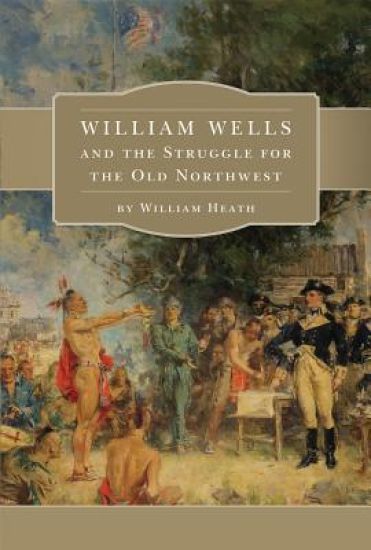
Born to Anglo-American parents on the Appalachian frontier, captured by the Miami Indians at the age of thirteen, and adopted into the tribe, William Wells (1770-1812) moved between two cultures all his life but was comfortable in neither. Vilified by some historians for his divided loyalties, he remains relatively unknown even though he is worthy of comparison with such famous frontiersmen as Daniel Boone and Davy Crockett. William Heath's thoroughly researched book is the first biography of this man-in-the-middle. A servant of empire with deep sympathies for the people his country sought to dispossess, Wells married Chief Little Turtle's daughter and distinguished himself as a Miami warrior, as an American spy, and as an Indian agent whose multilingual skills made him a valuable interpreter. Heath examines pioneer life in the Ohio Valley from both white and Indian perspectives, yielding rich insights into Wells's career as well as broader events on the post-revolutionary American frontier, where Anglo-Americans pushing westward competed with the Indian nations of the Old Northwest for control of territory. Wells's unusual career, Heath emphasizes, earned him a great deal of ill will. Because he warned the U.S. government against Tecumseh's confederacy and the Tenskwatawa's ""religiously mad"" followers, he was hated by those who supported the Shawnee leaders. Because he came to question treaties he had helped bring about, and cautioned the Indians about their harmful effects, he was distrusted by Americans. Wells is a complicated hero, and his conflicted position reflects the decline of coexistence and cooperation between two cultures.
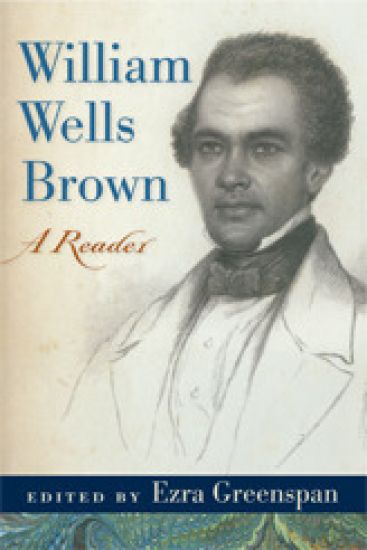
Born into slavery in Kentucky, William Wells Brown (1814-1884) was kept functionally illiterate until after his escape at the age of nineteen. Remarkably, he became the most widely published and versatile African American writer of the nineteenth century as well as an important leader in the abolitionist and temperance movements.Brown wrote extensively as a journalist but was also a pioneer in other literary genres. His many groundbreaking works include Clotel, the first African American novel; The Escape: or, A Leap for Freedom, the first published African American play; Three Years in Europe, the first African American European travelogue; and The Negro in the American Rebellion, the first history of African American military service in the Civil War. Brown also wrote one of the most important fugitive slave narratives and a striking array of subsequent self-narratives so inventively shifting in content, form, and textual presentation as to place him second only to Frederick Douglass among nineteenth-century African American autobiographers.Ezra Greenspan has selected the best of Brown's work in a range of fields including fiction, drama, history, politics, autobiography, and travel. The volume opens with an introductory essay that places Brown and his work in a cultural and political context. Each chapter begins with a detailed introductory headnote, and the contents are closely annotated; there is also a selected bibliography. This reader offers an introduction to the work of a major African American writer who was engaged in many of the important debates of his time.
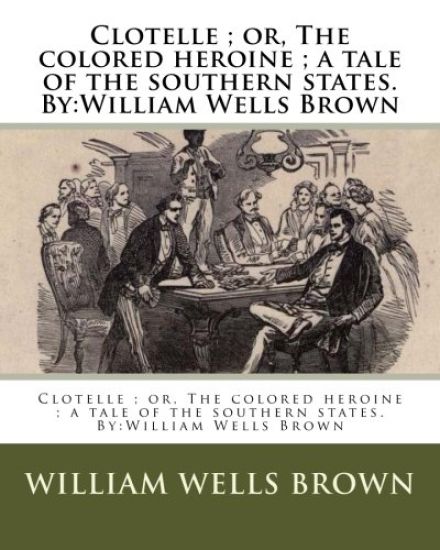
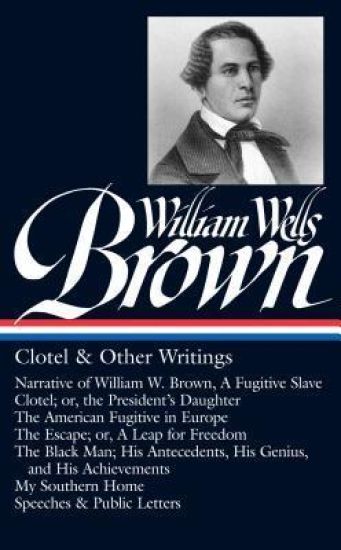
Born a slave and kept functionally illiterate until he escaped at age nineteen, William Wells Brown (1814–1884) refashioned himself first as an agent of the Underground Railroad, then as an antislavery activist and self-taught orator, and finally as the author of a series of landmark works that made him, like Frederick Douglass, a foundational figure of African American literature. His controversial novel Clotel; or, the President’s Daughter (1853), a fictionalized account of the lives and struggles of Thomas Jefferson’s black daughters and granddaughters, is the first novel written by an African American. This Library of America volume brings it together with Brown’s other groundbreaking works: Narrative of William W. Brown: A Fugitive Slave, Written by Himself (1847), his first published book and an immediate bestseller, which describes his childhood, life in slavery, and eventual escape; later memoirs charting his life during the Civil War and Reconstruction; the first play (The Escape; or, A Leap for Freedom, 1858), travelogue (The American Fugitive in Europe, 1855), and history (The Black Man, His Antecedents, His Genius, and His Achievements, 1862) written by an African American; and eighteen speeches and public letters from the 1840s, 50s, and 60s, many collected here for the first time.LIBRARY OF AMERICA is an independent nonprofit cultural organization founded in 1979 to preserve our nation’s literary heritage by publishing, and keeping permanently in print, America’s best and most significant writing. The Library of America series includes more than 300 volumes to date, authoritative editions that average 1,000 pages in length, feature cloth covers, sewn bindings, and ribbon markers, and are printed on premium acid-free paper that will last for centuries.
William Wells Brown (circa 1814 - November 6, 1884) was a prominent African-American abolitionist lecturer, novelist, playwright, and historian in the United States. Born into slavery in Montgomery County, Kentucky, near the town of Mount Sterling, Brown escaped to Ohio in 1834 at the age of 20. He settled in Boston, Massachusetts, where he worked for abolitionist causes and became a prolific writer. While working for abolition, Brown also supported causes including: temperance, women's suffrage, pacifism, prison reform, and an anti-tobacco movement. His novel Clotel (1853), considered the first novel written by an African American, was published in London, England, where he resided at the time; it was later published in the United States. Brown was a pioneer in several different literary genres, including travel writing, fiction, and drama. In 1858 he became the first published African-American playwright, and often read from this work on the lecture circuit. Following the Civil War, in 1867 he published what is considered the first history of African Americans in the Revolutionary War. He was among the first writers inducted to the Kentucky Writers Hall of Fame, established in 2013. A public school was named for him in Lexington, Kentucky. Brown was lecturing in England when the 1850 Fugitive Slave Law was passed in the US; as its provisions increased the risk of capture and re-enslavement, he stayed overseas for several years. He traveled throughout Europe. After his freedom was purchased in 1854 by a British couple, he and his two daughters returned to the US, where he rejoined the abolitionist lecture circuit in the North. A contemporary of Frederick Douglass, Brown was overshadowed by the charismatic orator and the two feuded publicly.William was born into slavery in 1814 (or March 15, 1815) near Lexington, Kentucky, where his mother Elizabeth was a slave (she was of Native American and Black ancestry). She was held by Dr. John Young and had seven children, each by different fathers. (In addition to William, her children were Solomon, Leander, Benjamin, Joseph, Milford, and Elizabeth.) William was of mixed race; his father was George W. Higgins, a white planter and half brother of his master Dr. Young. Higgins formally acknowledged William as his son and made Young promise not to sell him.But Young did sell the boy and his mother. In the end, William was sold several times before he was twenty years old. William spent the majority of his youth in St. Louis. His masters hired him out to work on steamboats on the Missouri River, then a major thoroughfare for steamships and the slave trade. His work allowed him to see many new places. In 1833, he and his mother escaped together across the Mississippi River, but they were captured in Illinois. In 1834, Brown made a second escape attempt, successfully slipping away from a steamboat when it docked in Cincinnati, Ohio, a free state. In freedom, he took the names of Wells Brown, a Quaker friend who helped him after his escape by providing food, clothes and some money. He learned to read and write, and eagerly sought more education, reading extensively to make up for what he had been deprived. Around this time he was hired by Elijah Lovejoy and worked with the famed abolitionist in his printing office.....
William Wells Brown (circa 1814 - November 6, 1884) was a prominent African-American abolitionist lecturer, novelist, playwright, and historian in the United States. Born into slavery in Montgomery County, Kentucky, near the town of Mount Sterling, Brown escaped to Ohio in 1834 at the age of 20. He settled in Boston, Massachusetts, where he worked for abolitionist causes and became a prolific writer. While working for abolition, Brown also supported causes including: temperance, women's suffrage, pacifism, prison reform, and an anti-tobacco movement. His novel Clotel (1853), considered the first novel written by an African American, was published in London, England, where he resided at the time; it was later published in the United States. Brown was a pioneer in several different literary genres, including travel writing, fiction, and drama. In 1858 he became the first published African-American playwright, and often read from this work on the lecture circuit. Following the Civil War, in 1867 he published what is considered the first history of African Americans in the Revolutionary War. He was among the first writers inducted to the Kentucky Writers Hall of Fame, established in 2013. A public school was named for him in Lexington, Kentucky. Brown was lecturing in England when the 1850 Fugitive Slave Law was passed in the US; as its provisions increased the risk of capture and re-enslavement, he stayed overseas for several years. He traveled throughout Europe. After his freedom was purchased in 1854 by a British couple, he and his two daughters returned to the US, where he rejoined the abolitionist lecture circuit in the North. A contemporary of Frederick Douglass, Brown was overshadowed by the charismatic orator and the two feuded publicly... Brown stayed abroad until 1854. Passage of the 1850 Fugitive Slave Law had increased his risk of capture even in the free states. Only after the Richardson family of Britain purchased his freedom in 1854 (they had done the same for Frederick Douglass), did Brown return to the United States. He quickly rejoined the anti-slavery lecture circuit. Perhaps because of the rising social tensions in the 1850s, Brown became a proponent of African-American emigration to Haiti, an independent black republic in the Caribbean since 1804. He decided that more militant actions clarification needed] were needed to help the abolitionist cause. During the American Civil War and in the decades that followed, Brown continued to publish fiction and non-fiction books, securing his reputation as one of the most prolific African-American writers of his time. He also helped recruit blacks to fight for the Union in the Civil War. He introduced Robert John Simmons from Bermuda to the abolitionist Francis George Shaw, father of Colonel Robert Gould Shaw, the commanding officer of the 54th Massachusetts Volunteer Infantry Regiment. While continuing to write, Brown was active in the Temperance movement as a lecturer. After studying homeopathic medicine, he opened a medical practice in Boston's South End while keeping a residence in Cambridge. In 1882 he moved to the nearby city of Chelsea. William Wells Brown died on November 6, 1884 in Chelsea, Massachusetts at the age of 70.....
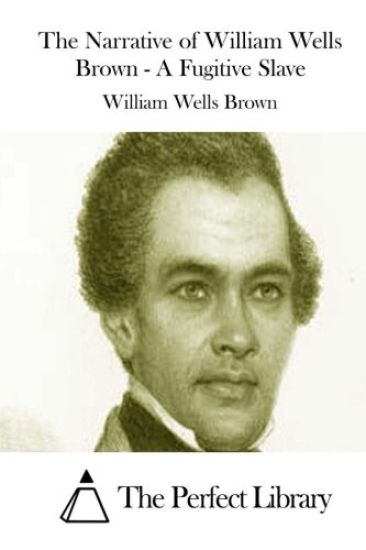
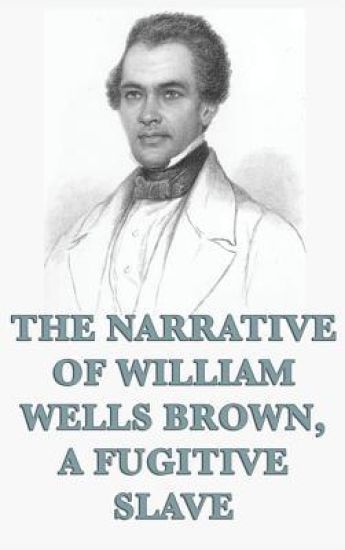
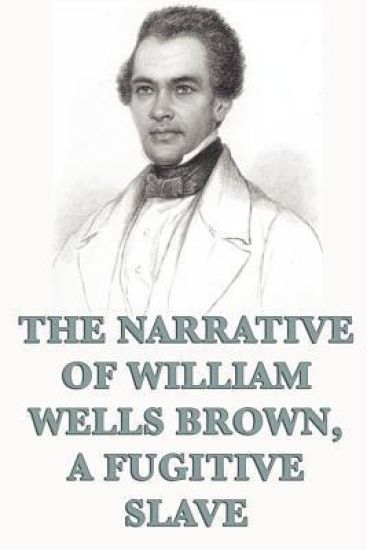
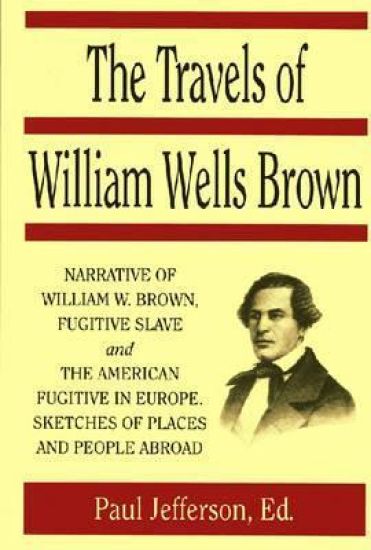
This is the remarkable story of two trips by a fugitive slave. One is the dramatic and poignant journey of a humiliated slave up the Mississippi to the North, into freedom. The second is a glorious voyage to Europe of the same man, now an elegant and eloquent ambassador of the abolitionists, who hobnobs with writers like Victor Hugo, and moves freely in high society. His autobiography, The Narrative of William Wells Brown, A Fugitive Slave (1845), chronicles Brown's life in bondage -- disclosing aspects of slavery more various and disturbing than even the narrative of his contemporary Frederick Douglass -- and his pilgrim's progress north to freedom. This book is one of the most significant works of slave literature. Ten years later Brown published The American Fugitive in Europe: Sketches of Places and People Abroad, a travel report written in the style of the best European journalism. Both are included in this volume. Both the autobiography and the travel account are classic examples of nineteenth-century first-person prose narratives. Printing the two in one volume allows the reader to experience the richness and variety of nineteenth-century literature at its best.
This book has been considered by academicians and scholars of great significance and value to literature. This forms a part of the knowledge base for future generations. We have represented this book in the same form as it was first published. Hence any marks seen are left intentionally to preserve its true nature.