Kirjojen hintavertailu. Mukana 11 244 527 kirjaa ja 12 kauppaa.

Kirjahaku

Etsi kirjoja tekijän nimen, kirjan nimen tai ISBN:n perusteella.

1000 tulosta hakusanalla William Whewell

William Whewell

William Whewell

Clarendon Press
1991
sidottu
William Whewell was a giant of Victorian intellectual culture. His influence, whether recognized or forgotten, is palpable in areas as diverse as moral philosophy, mineralogy, architecture, the politics of education, physics, engineering, and theology. Recent studies of the place of the sciences in nineteenth-century Britain have repeatedly indicated the significance of Whewell's sweeping and critical proposals for a reformed account of scientific knowledge and moral values. However, until now there has been no detailed study of the context and impact of his project. This collection of essays by recognized authorities in the fields of history, history of science, and philosophy thus represents the first attempt to do justice to a magisterial nineteenth-century intellectual. More generally, it makes an important contribution to our understanding of Victorian intellectual life and its aftermath.
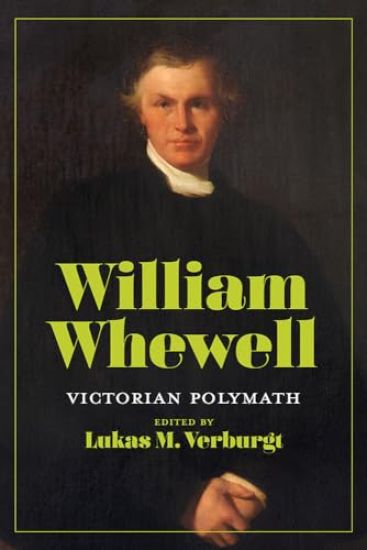
William Whewell

William Whewell

UNIVERSITY OF PITTSBURGH PRESS
2025
sidottu
William Whewell, the famous master of Trinity College in Cambridge, was a central figure in nineteenth-century British scientific culture and one of the last great polymaths. His influential work ranged from history and philosophy of science, education, architecture, mineralogy, and political economy to mathematics, engineering, natural theology, metaphysics, and moral philosophy. Among his many gifts to science was his role as cofounder and president of the British Association for the Advancement of Science and his wordsmithing, he coined the terms scientist, physicist, linguistics, and electrode. While he was himself an opponent of evolution through natural selection, Whewell’s most famous works, including his Bridgewater Treatise (1833) and Philosophy of the Inductive Sciences (1840), played a formative role in Charles Darwin’s creation of the theory of evolution. William Whewell: Victorian Polymath reexamines the whole of Whewell’s oeuvre, as well as the wide range and internal unity of his many polymathic endeavors, placing him within the early Victorian intellectual landscape and highlighting his exchanges with other important figures of the period, such as John Herschel, Charles Lyell, and Robert Peel. Bringing together a group of eminent and emergent scholars, the volume explores all major aspects of Whewell’s reform project and its legacy, both in the sciences and the humanities, in the Victorian era and beyond.
William Whewell, D.D., Master of Trinity College, Cambridge

William Whewell, D.D., Master of Trinity College, Cambridge

William Whewell

Cambridge University Press
2011
pokkari
William Whewell (1794–1866) was born the son of a Lancaster carpenter, but his precocious intellect soon delivered him into a different social sphere. Educated at a local grammar school, he won a scholarship to Cambridge, and began his career at Trinity College in 1812; he went on to be elected a fellow of Trinity in 1817 and Master in 1841. An acquaintance of William Wordsworth and a friend of Adam Sedgwick, his professional interests reflected a typically nineteenth-century fusion of religion and science, ethics and empiricism. Published in 1876, and written by the mathematician and fellow of St John's College, Isaac Todhunter (1820–84), this biography combines a narrative account of Whewell's life and achievements with extracts taken from his personal correspondence. Volume 1 covers his sermons and early poetry, as well as his work on tides, moral philosophy and mechanics, and his celebrated study of the inductive sciences.
William Whewell, D.D., Master of Trinity College, Cambridge

William Whewell, D.D., Master of Trinity College, Cambridge

William Whewell

Cambridge University Press
2011
pokkari
William Whewell (1794–1866) was born the son of a Lancaster carpenter, but his precocious intellect soon delivered him into a different social sphere. Educated at a local grammar school, he won a scholarship to Cambridge, and began his career at Trinity College in 1812; he went on to be elected a fellow of Trinity in 1817 and Master in 1841. An acquaintance of William Wordsworth and a friend of Adam Sedgwick, his professional interests reflected a typically nineteenth-century fusion of religion and science, ethics and empiricism. Published in 1876, and written by the mathematician and fellow of St John's College, Isaac Todhunter (1820–84), this biography combines a narrative account of Whewell's life and achievements with extracts taken from his personal correspondence. Volume 2 contains a selection of his correspondence with scholars including Herschel and Lyell, revealing much about the conflicts, debates and friendships that shaped nineteenth-century academic life.
William Whewell (1794–1866), Dionysius Lardner (1793–1859) and Charles Babbage (1792–1871)
The importance of Whewell, Lardner and Babbage to the history of economic thought is as dependent upon the retrospective reading of their work as it is upon their contemporary significance. However, their individual reactions to the industrial and technological revolutions of the early nineteenth century are also of particular interest to us.William Whewell was known in his own times as a historian and philosopher of science, however, more recently he has been hailed as one of the founders of British mathematical economics. Dionysius Lardner, Professor of Natural Philosophy and Astronomy at University College, London, was both an early railway economist and a precursor of modern theories of profit maximalization. Charles Babbage may legitimately be regarded as the father of the modern computer, yet his most popular book, On the Economics of Machinery and Manufacturers (1832), was an unprecedented study of what we would now call operational research and had a significant effect upon both John Stuart Mill and Karl Marx. These were the 'also ran' but they are no less important than the forerunners for understanding the development of economic thought in the first half of the nineteenth century.
The Analysis of Knowledge of John Stuart Mill and William Whewell
This work has been selected by scholars as being culturally important, and is part of the knowledge base of civilization as we know it. This work was reproduced from the original artifact, and remains as true to the original work as possible. Therefore, you will see the original copyright references, library stamps (as most of these works have been housed in our most important libraries around the world), and other notations in the work.This work is in the public domain in the United States of America, and possibly other nations. Within the United States, you may freely copy and distribute this work, as no entity (individual or corporate) has a copyright on the body of the work.As a reproduction of a historical artifact, this work may contain missing or blurred pages, poor pictures, errant marks, etc. Scholars believe, and we concur, that this work is important enough to be preserved, reproduced, and made generally available to the public. We appreciate your support of the preservation process, and thank you for being an important part of keeping this knowledge alive and relevant.
Of the Plurality of Worlds

Of the Plurality of Worlds

William Whewell

University of Chicago Press
2001
sidottu
Is there intelligent life on other worlds? William Whewell, one of the most influential British intellectuals of the nineteenth century, weighed in on this question with Of the Plurality of Worlds. Writing anonymously, Whewell argued that there was no life anywhere else in the universe. Admitting such a possibility, he feared, would threaten humanity's special relationship with God, and open the door to supporters of evolution.The publication of Plurality in 1853 ignited a bitter Victorian debate on science and religion. This book reprints the first edition in facsimile, together with a vigorous response to his critics that Whewell added later and new introductory and bibliographic material by noted Darwin scholar Michael Ruse. This edition also includes 84 typeset pages—never before published—that Whewell cut from the original book at the last moment. Showing clearly the theological underpinnings of Whewell's thinking, these chapters also reveal the difficulties facing any Victorian who tried to reconcile traditional Christian thought with the findings of modern science.