Kirjojen hintavertailu. Mukana 11 244 527 kirjaa ja 12 kauppaa.

Kirjahaku

Etsi kirjoja tekijän nimen, kirjan nimen tai ISBN:n perusteella.

165 tulosta hakusanalla Xiaofei Tian

Tao Yuanming and Manuscript Culture

Tao Yuanming and Manuscript Culture

Xiaofei Tian

University of Washington Press
2005
sidottu
Winner of a 2006 Choice Magazine Outstanding Academic Title AwardAs medieval Chinese manuscripts were copied and recopied through the centuries, both mistakes and deliberate editorial changes were introduced, thereby affecting readers' impressions of the author's intent. In Tao Yuanming and Manuscript Culture, Xiaofei Tian shows how readers not only experience authors but produce them by shaping texts to their interpretation. Tian examines the mechanics and history of textual transmission in China by focusing on the evolution over the centuries of the reclusive poet Tao Yuanming into a figure of epic stature.Considered emblematic of the national character, Tao Yuanming (also known as Tao Qian, 365?-427 c.e.) is admired for having turned his back on active government service and city life to live a simple rural life of voluntary poverty. The artlessness of his poetic style is held as the highest literary and moral ideal, and literary critics have taken great pains to demonstrate perfect consistency between Tao Yuanming's life and poetry. Earlier work on Tao Yuanming has tended to accept this image, interpreting the poems to confirm the image.Tao Yuanming and Manuscript Culture is a study of how this cultural icon was produced and of the elusive traces of another, historical Tao Yuanming behind the icon. By comparing four early biographies of the poet, Tian shows how these are in large measure constructed out of Tao Yuanming's self-image as projected in his poetry and prose. Drawing on work in European medieval literature, she demonstrates the fluidity of the Chinese medieval textual world and how its materials were historically reconfigured for later purposes.Tian finds in Tao's poetic corpus not one essentialized Tao Yuanming, but multiple texts continuously produced long after the author's physical demise. Her provocative look at the influence of manuscript culture on literary perceptions transcends its immediate subject and has special resonance today, when the transition from print to electronic media is shaking the literary world in a way not unlike the transition from handwritten to print media in medieval China.
Tao Yuanming and Manuscript Culture

Tao Yuanming and Manuscript Culture

Xiaofei Tian

University of Washington Press
2013
pokkari
Winner of a 2006 Choice Magazine Outstanding Academic Title AwardAs medieval Chinese manuscripts were copied and recopied through the centuries, both mistakes and deliberate editorial changes were introduced, thereby affecting readers' impressions of the author's intent. In Tao Yuanming and Manuscript Culture, Xiaofei Tian shows how readers not only experience authors but produce them by shaping texts to their interpretation. Tian examines the mechanics and history of textual transmission in China by focusing on the evolution over the centuries of the reclusive poet Tao Yuanming into a figure of epic stature.Considered emblematic of the national character, Tao Yuanming (also known as Tao Qian, 365?-427 c.e.) is admired for having turned his back on active government service and city life to live a simple rural life of voluntary poverty. The artlessness of his poetic style is held as the highest literary and moral ideal, and literary critics have taken great pains to demonstrate perfect consistency between Tao Yuanming's life and poetry. Earlier work on Tao Yuanming has tended to accept this image, interpreting the poems to confirm the image.Tao Yuanming and Manuscript Culture is a study of how this cultural icon was produced and of the elusive traces of another, historical Tao Yuanming behind the icon. By comparing four early biographies of the poet, Tian shows how these are in large measure constructed out of Tao Yuanming's self-image as projected in his poetry and prose. Drawing on work in European medieval literature, she demonstrates the fluidity of the Chinese medieval textual world and how its materials were historically reconfigured for later purposes.Tian finds in Tao's poetic corpus not one essentialized Tao Yuanming, but multiple texts continuously produced long after the author's physical demise. Her provocative look at the influence of manuscript culture on literary perceptions transcends its immediate subject and has special resonance today, when the transition from print to electronic media is shaking the literary world in a way not unlike the transition from handwritten to print media in medieval China.
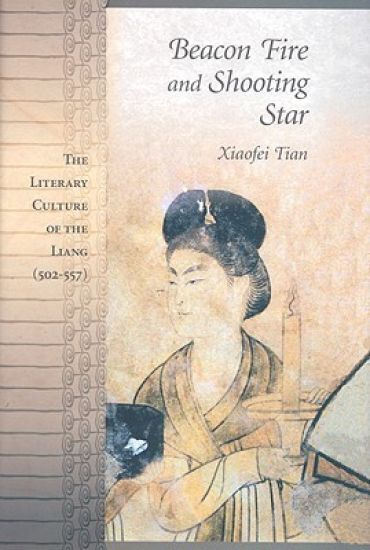
Beacon Fire and Shooting Star

Beacon Fire and Shooting Star

Xiaofei Tian

Harvard University, Asia Center
2007
sidottu
The Liang dynasty (502–557) is one of the most brilliant and creative periods in Chinese history and one of the most underestimated and misunderstood. Under the Liang, literary activities, such as writing, editing, anthologizing, and cataloguing, were pursued on an unprecedented scale, yet the works of this era are often dismissed as “decadent” and no more than a shallow prelude to the glories of the Tang.This book is devoted to contextualizing the literary culture of this era—not only the literary works themselves but also the physical process of literary production such as the copying and transmitting of texts; activities such as book collecting, anthologizing, cataloguing, and various forms of literary scholarship; and the intricate interaction of religion, particularly Buddhism, and literature. Its aim is to explore the impact of social and political structure on the literary world.
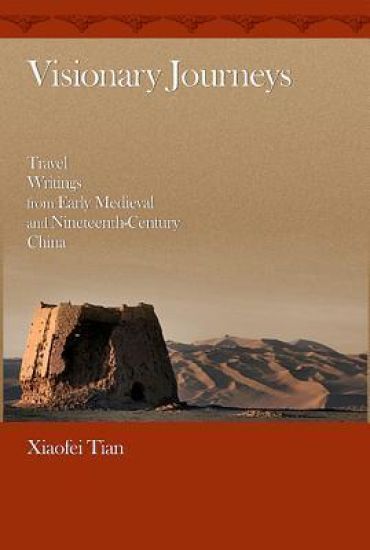
Visionary Journeys

Visionary Journeys

Xiaofei Tian

Harvard University, Asia Center
2012
sidottu
This book explores the parallel and yet profoundly different ways of seeing the outside world and engaging with the foreign at two important moments of dislocation in Chinese history, namely, the early medieval period commonly known as the Northern and Southern Dynasties (317–589 CE), and the nineteenth century. Xiaofei Tian juxtaposes literary, historical, and religious materials from these two periods in comparative study, bringing them together in their unprecedentedly large-scale interactions, and their intense fascination, with foreign cultures.By examining various cultural forms of representation from the two periods, Tian attempts to sort out modes of seeing the world that inform these writings. These modes, Tian argues, were established in early medieval times and resurfaced, in permutations and metamorphoses, in nineteenth-century writings on encountering the Other. This book is for readers who are interested not only in early medieval or nineteenth-century China but also in issues of representation, travel, visualization, and modernity.
The Halberd at Red Cliff

The Halberd at Red Cliff

Xiaofei Tian

Harvard University, Asia Center
2018
sidottu
The turn of the third century CE—known as the Jian’an era or Three Kingdoms period—holds double significance for the Chinese cultural tradition. Its writings laid the foundation of classical poetry and literary criticism. Its historical personages and events have also inspired works of poetry, fiction, drama, film, and art throughout Chinese history, including Internet fantasy literature today. There is a vast body of secondary literature on these two subjects individually, but very little on their interface.The image of the Jian’an era, with its feasting, drinking, heroism, and literary panache, as well as intense male friendship, was to return time and again in the romanticized narrative of the Three Kingdoms. How did Jian’an bifurcate into two distinct nostalgias, one of which was the first paradigmatic embodiment of wen (literary graces, cultural patterning), and the other of wu (heroic martial virtue)? How did these largely segregated nostalgias negotiate with one another? And how is the predominantly male world of the Three Kingdoms appropriated by young women in contemporary China? The Halberd at Red Cliff investigates how these associations were closely related in their complex origins and then came to be divergent in their later metamorphoses.
Family Instructions for the Yan Clan and Other Works by Yan Zhitui (531–590s)
Yan Zhitui (531–590s) was a courtier and cultural luminary who lived a colourful life during one of the most chaotic periods, known as the Northern and Southern Dynasties, in Chinese history. Beginning his career in the southern Liang court, he was taken captive to the north after the Liang capital fell, and served several northern dynasties. Today he remains one of the best-known medieval writers for his book-length “family instructions” (jiaxun), the earliest surviving and the most influential of its kind. Completed in his last years, the work resembles a long letter addressed to his sons, in which he discusses a wide range of topics from family relations and remarriage to religious faith, philology, cultural arts, and codes of conduct in public and private life. It is filled with vivid details of contemporary social life, and with the author’s keen observations of the mores of north and south China. This is a new, complete translation into English, with critical notes and introduction, and based on recent scholarship, of Yan Zhitui’s Family Instructions, and of all of his extant literary works, including his self-annotated poetic autobiography and a never-before-translated fragmentary rhapsody, as well as of his biographies in dynastic histories.
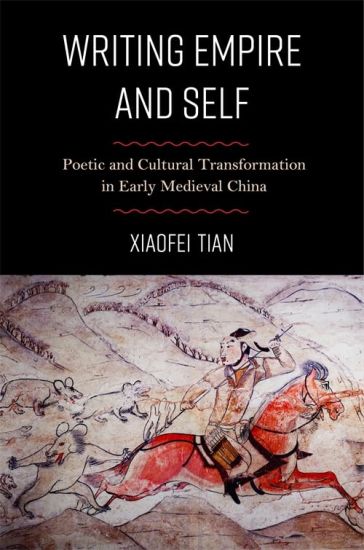
Writing Empire and Self

Writing Empire and Self

Xiaofei Tian

Columbia University Press
2026
sidottu
China’s early medieval period, from the fifth through the early seventh century, from the Northern and Southern Dynasties through the unified Sui, was a time of political fragmentation, military strife, and ethnic conflict. It also witnessed brilliant artistic creations as well as a full flowering of court culture, with poetry at its heart. How did poetry come to be regarded as the most potent form of cultural capital, a privileged literary genre, and a foundational skill for members of the elite? How was poetry transformed from an instrument of empire building to a venue for articulating personal trauma and voicing critique of the state? Tracing the evolution of poetry’s role in Chinese society, Writing Empire and Self uncovers the profound cultural changes that took place in the early medieval era. Xiaofei Tian argues that in this period, a social community, eventually known as the “scholar elite” and treated as if it had always been a permanent fixture of the Chinese social order, came into being. She investigates the formation of this community, which left its mark on all later Chinese arts and letters, through a careful account of its history and textual production. Combining meticulous readings of numerous previously untranslated texts with a long-term, large-scale view of social and cultural history, Writing Empire and Self offers a fresh perspective on poetry’s intricate relationship with the state.
Writing Empire and Self

Writing Empire and Self

Xiaofei Tian

Columbia University Press
2026
pokkari
China’s early medieval period, from the fifth through the early seventh century, from the Northern and Southern Dynasties through the unified Sui, was a time of political fragmentation, military strife, and ethnic conflict. It also witnessed brilliant artistic creations as well as a full flowering of court culture, with poetry at its heart. How did poetry come to be regarded as the most potent form of cultural capital, a privileged literary genre, and a foundational skill for members of the elite? How was poetry transformed from an instrument of empire building to a venue for articulating personal trauma and voicing critique of the state? Tracing the evolution of poetry’s role in Chinese society, Writing Empire and Self uncovers the profound cultural changes that took place in the early medieval era. Xiaofei Tian argues that in this period, a social community, eventually known as the “scholar elite” and treated as if it had always been a permanent fixture of the Chinese social order, came into being. She investigates the formation of this community, which left its mark on all later Chinese arts and letters, through a careful account of its history and textual production. Combining meticulous readings of numerous previously untranslated texts with a long-term, large-scale view of social and cultural history, Writing Empire and Self offers a fresh perspective on poetry’s intricate relationship with the state.
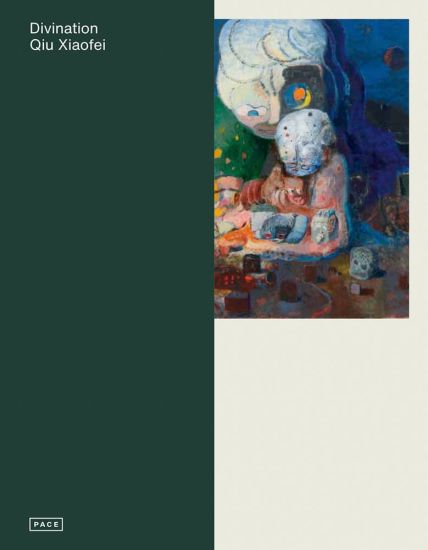
Qiu Xiaofei: Divination
In a new series, Qiu combines research into human consciousness and synesthesia with an intimate literary and fantastical visual experience This publication focuses on the rich historical, political and spiritual allusions in the paintings of Qiu Xiaofei (born 1977). Writings by writer and artist Travis Jeppesen, critic Yan Chi and Qiu himself are accompanied by images of the artist’s fantastical compositions, with details recorded on foldouts.
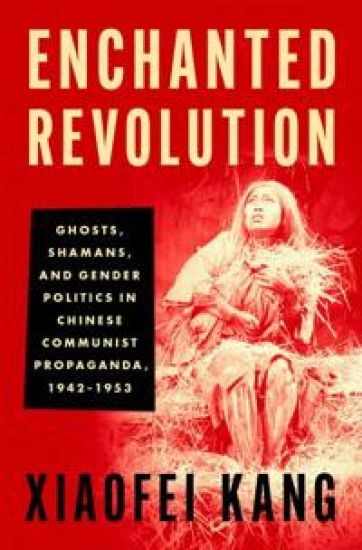
Enchanted Revolution

Enchanted Revolution

Xiaofei Kang

OXFORD UNIVERSITY PRESS INC
2023
sidottu
Enchanted Revolution moves religion and gender to center stage in the Chinese Communist revolution, examining the mobilizational dynamics of anti-superstition propaganda in support of the Communist Party's rise from rural backwaters to national dominance. Xiaofei Kang argues that religion was not merely adversary for the revolutionaries-it also served as a model for the ways in which the Party mobilized support and constructed legitimacy. In this parallel and often paradoxical process, the Party attacked “superstitions” that had long supported the foundations of Chinese religious life. At the same time, Party propaganda co-opted these same religious resources for its own political ends. Kang demonstrates that the persuasive power of Party propaganda relied heavily on recasting the cosmic forces of yin and yang that sustained the traditional gender hierarchy and ritual order. Moreover, revolutionary art and literature revamped old narratives of female ghosts and ritual exorcism to inject the people with a new masculinist vision of the Party-state endowed with both scientific potency and the heavenly mandate. Gendered language and symbolism in Chinese religion thus remained central to inspiring pathos, ethos, and logos for the revolution. Enchanted Revolution sheds light on the contemporary significance of the Maoist legacy in China through a deft exploration of the complex interplay of religion, gender, and revolution.
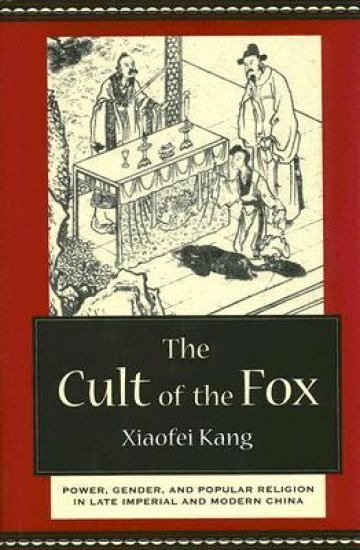
The Cult of the Fox

The Cult of the Fox

Xiaofei Kang

Columbia University Press
2005
sidottu
For more than five centuries the shamanistic fox cult has attracted large portions of the Chinese population and appealed to a wide range of social classes. Deemed illicit by imperial rulers and clerics and officially banned by republican and communist leaders, the fox cult has managed to survive and flourish in individual homes and community shrines throughout northern China. In this new work, the first to examine the fox cult as a vibrant popular religion, Xiaofei Kang explores the manifold meanings of the fox spirit in Chinese society. Kang describes various cult practices, activities of worship, and the exorcising of fox spirits to reveal how the Chinese people constructed their cultural and social values outside the gaze of offical power and morality.
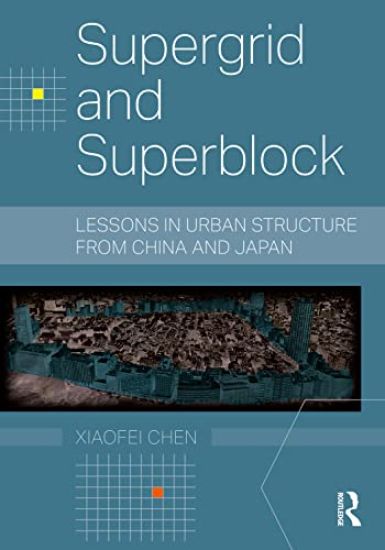
Supergrid and Superblock

Supergrid and Superblock

Xiaofei Chen

TAYLOR FRANCIS LTD
2022
sidottu
In this superbly illustrated book Xiaofei Chen presents the first analysis in English of a ubiquitous East Asian urban phenomenon: the supergrid and superblock urban structure. The book opens with an introductory essay by Barrie Shelton in which he sets the scene for what is to follow, emphasizing how alien this structure was to Western urban design culture where radial patterns of development were the norm. Then, in her first chapter, Chen explains the make-up of the supergrid and superblock urban structure and its contrasting Chinese and Japanese forms. In the following three chapters she digs deep into the history, cultural origins, and underlying design philosophy of the supergrid and superblock to show how, under different cultural influences, the model has developed into two distinct forms. Two further chapters (5 and 6) provide detailed analysis of two sample superblocks in China (in Xi’an and Nanjing) and two in Japan (in Kyoto and Osaka) to reveal the relative advantages and disadvantages of how the structure is manifest in the two countries. In her conclusion she discusses her findings to show how and why the supergrid and superblock structure is a valuable urban design model which, with regional adjustments, can be used effectively in cities other than those of East Asia.
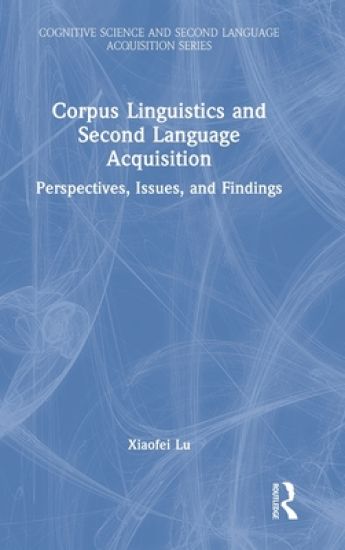
Corpus Linguistics and Second Language Acquisition
In Corpus Linguistics and Second Language Acquisition, Xiaofei Lu comprehensively reviews empirical studies that employ corpus linguistic methods to investigate issues in second language variation, processing, production, and development. These methods enable advanced students and researchers to:Examine learner and task variables that condition variation in second language useUnderstand the effects of various input factors on second language processing and productionTrack group longitudinal trajectories of second language development and the input, learner, and task factors that affect such trajectoriesProfile inter- and intra-learner variability and individual variation in second language longitudinal developmentThis book will serve as an excellent resource for students and researchers with interests in corpus linguistics and second language acquisition.
Corpus Linguistics and Second Language Acquisition
In Corpus Linguistics and Second Language Acquisition, Xiaofei Lu comprehensively reviews empirical studies that employ corpus linguistic methods to investigate issues in second language variation, processing, production, and development. These methods enable advanced students and researchers to:Examine learner and task variables that condition variation in second language useUnderstand the effects of various input factors on second language processing and productionTrack group longitudinal trajectories of second language development and the input, learner, and task factors that affect such trajectoriesProfile inter- and intra-learner variability and individual variation in second language longitudinal developmentThis book will serve as an excellent resource for students and researchers with interests in corpus linguistics and second language acquisition.
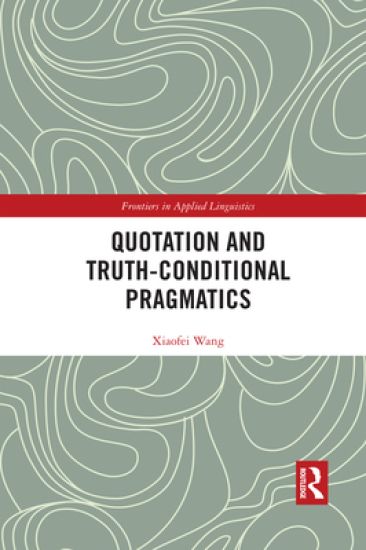
Quotation and Truth-Conditional Pragmatics
In the past decades, quotation theories have developed roughly along three lines—quotation types, meaning effects, and theoretical orientations toward the semantics/pragmatics distinction. Currently, whether the quoted expression is truth-conditionally relevant to the quotational sentence, and if there is a truth-conditional impact, whether it is generated via semantic or pragmatic processes, have become the central concerns of quotation studies.In this book, quotation is clearly defined for the first time as a constituent embedded within yet distinctive from the quotational sentence. Also, as the first monograph to address the semantics/pragmatics boundary dispute over quotation, it argues that the semantic content of quotation amounts to its contribution to the intuitive truth-conditional content of the quotational utterance via two modes of presentation, which are incarnated in the functioning of quotation marks and manifested as use and mention. The use/mention-based analysis in this book can shed light on the semantic theorizing of other metalinguistic phenomena, while the semantics/pragmatics perspective will provide methodological implications for other relevant studies.The new conception of quotation and thought-provoking analysis on use/mention, truth-conditional pragmatics, and the semantics/pragmatics boundary in this book will appeal to scholars and students in philosophy of language and linguistics. It will also serve as a clear guide to the current state of quotation studies and how to formulate a semantic theory of quotation.
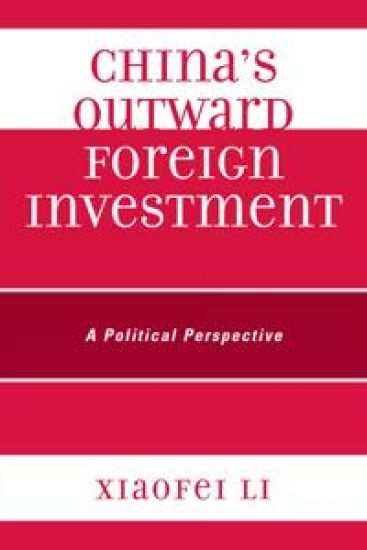
China's Outward Foreign Investment

China's Outward Foreign Investment

Xiaofei Li

University Press of America
2010
nidottu
This book explores the characteristics of China's outward foreign investment, its motivation, its sector distribution, and its geographical distribution in order to illustrate the current pattern of 'merchant-state dualism' in China's overseas foreign direct investment. Merchant-state dualism is a hybrid relationship between the state and society that maintains state control over merchants, while giving them some autonomy. By investigating the interactions between business and government elites to determine Chinese outward foreign investment, and by exploring the reasons for selecting certain foreign investments in light of internal political and economic concerns and the external effect of investing in politically sensitive countries, the book highlights the political underpinnings and calculations of China's foreign investment. It thus sheds light on current merchant-state dualism by concluding that merchant-state dualism is the most suitable model for explaining contemporary Chinese government-business relations.
Supergrid and Superblock

Supergrid and Superblock

Xiaofei Chen

TAYLOR FRANCIS LTD
2024
nidottu
In this superbly illustrated book Xiaofei Chen presents the first analysis in English of a ubiquitous East Asian urban phenomenon: the supergrid and superblock urban structure. The book opens with an introductory essay by Barrie Shelton in which he sets the scene for what is to follow, emphasizing how alien this structure was to Western urban design culture where radial patterns of development were the norm. Then, in her first chapter, Chen explains the make-up of the supergrid and superblock urban structure and its contrasting Chinese and Japanese forms. In the following three chapters she digs deep into the history, cultural origins, and underlying design philosophy of the supergrid and superblock to show how, under different cultural influences, the model has developed into two distinct forms. Two further chapters (5 and 6) provide detailed analysis of two sample superblocks in China (in Xi’an and Nanjing) and two in Japan (in Kyoto and Osaka) to reveal the relative advantages and disadvantages of how the structure is manifest in the two countries. In her conclusion she discusses her findings to show how and why the supergrid and superblock structure is a valuable urban design model which, with regional adjustments, can be used effectively in cities other than those of East Asia.
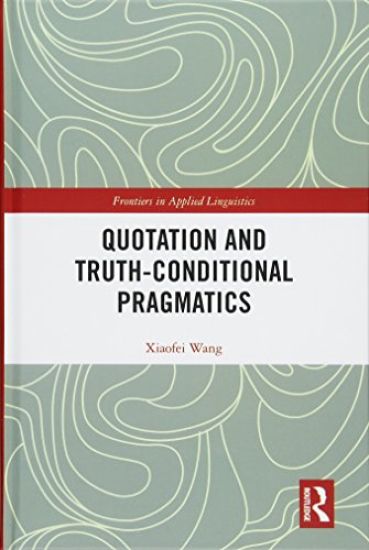
Quotation and Truth-Conditional Pragmatics
In the past decades, quotation theories have developed roughly along three lines—quotation types, meaning effects, and theoretical orientations toward the semantics/pragmatics distinction. Currently, whether the quoted expression is truth-conditionally relevant to the quotational sentence, and if there is a truth-conditional impact, whether it is generated via semantic or pragmatic processes, have become the central concerns of quotation studies.In this book, quotation is clearly defined for the first time as a constituent embedded within yet distinctive from the quotational sentence. Also, as the first monograph to address the semantics/pragmatics boundary dispute over quotation, it argues that the semantic content of quotation amounts to its contribution to the intuitive truth-conditional content of the quotational utterance via two modes of presentation, which are incarnated in the functioning of quotation marks and manifested as use and mention. The use/mention-based analysis in this book can shed light on the semantic theorizing of other metalinguistic phenomena, while the semantics/pragmatics perspective will provide methodological implications for other relevant studies.The new conception of quotation and thought-provoking analysis on use/mention, truth-conditional pragmatics, and the semantics/pragmatics boundary in this book will appeal to scholars and students in philosophy of language and linguistics. It will also serve as a clear guide to the current state of quotation studies and how to formulate a semantic theory of quotation.
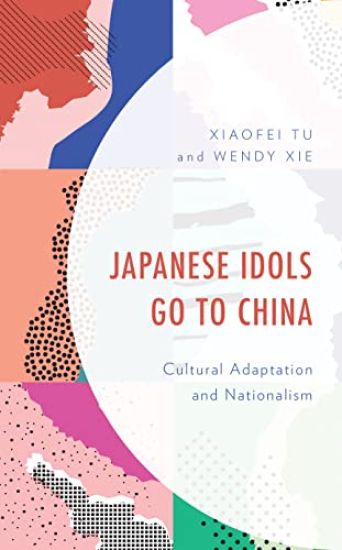
Japanese Idols Go to China

Japanese Idols Go to China

Xiaofei Tu; Wendy Xie

BLOOMSBURY PUBLISHING PLC
2022
sidottu
This book situates the Chinese acceptance of Japanese popular culture, specifically the intriguing and sometimes awkward relationship between the “idol” groups AKB48 and SNH48, within the broad context of nationalist ideology and international relations in East Asia. It aims to enhance the knowledge and understanding of the reader about contemporary East Asian cultural exchanges and nationalist expressions in concrete forms. Additionally, this book attempts to discover heretofore overlooked aspects of nationalism’s metamorphosis in both China and Japan and challenge the existing scholarly and popular understandings of nationalism. By interrogating the nationalism factor in popular culture in Chinese and Japanese contexts, this books concludes that popular culture fandom can both be a culprit in promoting hegemonic political ideologies and serve as a potential antidote.
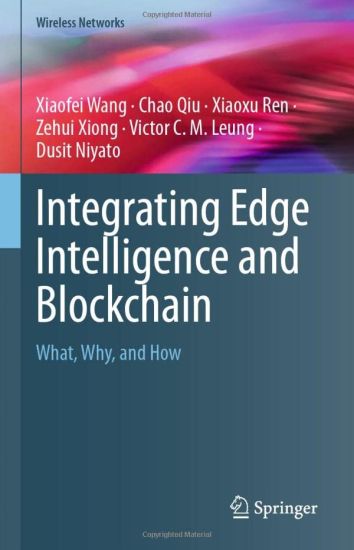
Integrating Edge Intelligence and Blockchain

Integrating Edge Intelligence and Blockchain

Xiaofei Wang; Chao Qiu; Xiaoxu Ren; Zehui Xiong; Victor C. M. Leung; Dusit Niyato

Springer International Publishing AG
2022
sidottu
This book examines whether the integration of edge intelligence (EI) and blockchain (BC) can open up new horizons for providing ubiquitous intelligent services. Accordingly, the authors conduct a summarization of the recent research efforts on the existing works for EI and BC, further painting a comprehensive picture of the limitation of EI and why BC could benefit EI. To examine how to integrate EI and BC, the authors discuss the BC-driven EI and tailoring BC to EI, including an overview, motivations, and integrated frameworks. Finally, some challenges and future directions are explored. The book explores the technologies associated with the integrated system between EI and BC, and further bridges the gap between immature BC and EI-amicable BC.Explores the integration of edge intelligence (EI) and blockchain (BC), including their integrated motivations, frameworks and challenges;Presents how BC-driven EI can realize computing-power management, data administration, and model optimization;Describes how to tailor BC to better support EI, including flexible consensus protocol, effective incentive mechanism, intellectuality smart contract, and scalable BC system tailoring;Presents some key research challenges and future directions for the integrated system.