Kirjojen hintavertailu. Mukana 11 244 527 kirjaa ja 12 kauppaa.

Kirjahaku

Etsi kirjoja tekijän nimen, kirjan nimen tai ISBN:n perusteella.

670 tulosta hakusanalla Yogesh C. Sharma

A Guide to the Economic Removal of Metals from Aqueous Solutions
Provides public health, sanitary and water engineers baseline data for designing plants for the treatment of industrial effluents rich in the metallic species in general and that of nickel and chromium in particular. DescriptionWater pollution is a topic of immense and common concern throughout the world. With a rapidly escalating global population and increased industrial development in a growing number of countries, the world's freshwater resources have become stressed. One way to get more out of less is 'treatment and reuse'. Nickel and chromium are toxic metals and they are used extensively in numerous industries such as textiles, beverages, steel, pulp and paper, and electroplating. Their industrial effluent contains large measures of non-biodegradable traces that are harmful to flora, fauna, and human beings. Although there are a number of methodologies used for treatment of metal-containing industrial effluents and waste water, there is not one up to now that offers a high capacity removal rate at an economical cost. This book presents the results and data from research and adsorption experiments carried out on the removal of nickel and chromium (as well as other metals) from aqueous solutions using modified silica sand. The data resulting from detailed kinetic, equilibrium and thermodynamic studies, show that the removal capacity is increased so the treated water has a higher quality or purity. It also demonstrates that the extraction of metals is achieved at a significant lower cost because the treated water adsorption is a simple process with less maintenance, and because silica is a nontoxic natural material widely available in all parts of the world.
The CEO Mindset- Leading with Skills, Living with Soul (Volume 1)

The CEO Mindset- Leading with Skills, Living with Soul (Volume 1)

Yogesh J Deshmukh (H C )

Blue Rose Publishers
2025
nidottu
The CEO Mindset: Leading with Skill, Living with Soul by Dr. Yogesh Jayant Deshmukh (h.c.) redefines leadership as purpose-driven, authentic, and human-centered. Drawing on nearly three decades of leading India's largest infrastructure and Metro rail projects, Dr. Deshmukh blends executive insight with neuroscience, reflective tools, and real-world stories to offer a roadmap that is both strategic and soulful. From building trust-based cultures and mastering decision-making under uncertainty to aligning values with vision and sustaining resilience, this book speaks to CEOs, founders, professionals, and next-gen leaders alike. It is a practical yet profound guide to leading with clarity, integrity, and impact.
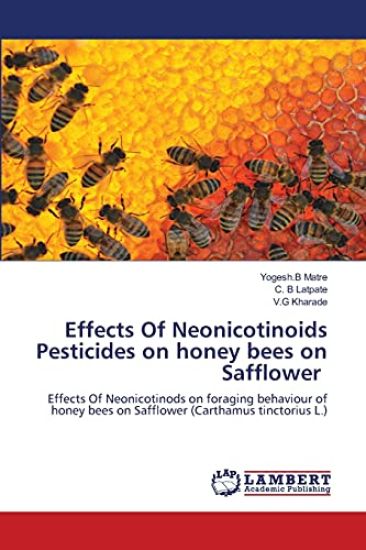
Effects Of Neonicotinoids Pesticides on honey bees on Safflower

Effects Of Neonicotinoids Pesticides on honey bees on Safflower

Yogesh B Matre; C B Latpate; V G Kharade

Lap Lambert Academic Publishing
2021
pokkari
The present investigation was carried out for the Effect of Neonicotinoids on foraging behaviour of honey bees on safflower at Department of Agriculture Entomology, College of Agriculture, Parbhani. The visit of honey was initially high on 14th day after spraying and found at par (in the range of 3.33 to 4.00 bees/m2) with honey bees observed before spraying of imidacloprid 17.8 SL followed by 10th day after spraying (in the range of 2.00 to 3.00 bees/m2). results revealed that the comparison of full dose and half dose of acetamiprid among which at that half dose of acetamiprid has found more visits of honey bees than the full dose of acetamiprid spraying on safflower.However results revealed that comparison between Imidacloprid and Acetamiprid were found that Acetamiprid was safest to honey bees as compared to Imidacloprid insecticide.The intensity of Apis indica, Apis florea, Apis mellifera, Apis dorsata, Trigona spp. and other pollinators were reached at its peak 10.00 - 12.00 hrs. The intensity of all the bees was found to be highest at 7th day after 10 per cent flowering.
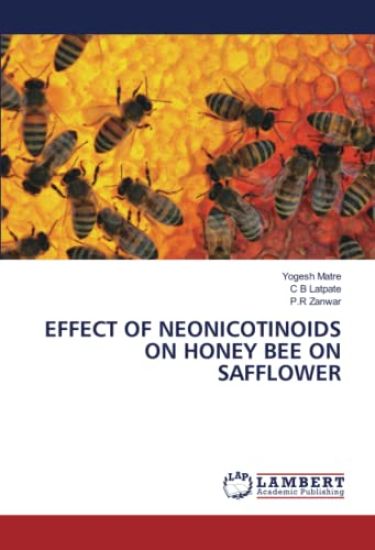
Effect of Neonicotinoids on Honey Bee on Safflower

Effect of Neonicotinoids on Honey Bee on Safflower

Yogesh Matre; C B Latpate; P R Zanwar

Lap Lambert Academic Publishing
2023
pokkari
The present investigation was carried out for the Effect of Neonicotinoids on foraging behaviour of honey bees on safflower at Department of Agriculture Entomology, College of Agriculture, Parbhani during rabi 2016-17.However results revealed that comparison between Imidacloprid and Acetamiprid were found that Acetamiprid was safest to honey bees as compared to Imidacloprid insecticide.The intensity of Apis indica, Apis florea, Apis mellifera, Apis dorsata, Trigona spp. and other pollinators were reached at its peak 10.00 - 12.00 hrs. The intensity of all the bees was found to be highest at 7th day after 10 per cent flowering.19 species of pollinators were recorded on safflower out of these, 8 species belong to order Hymenoptera, 5 species from Lepidoptera, 4 species from Diptera and 2 species from Coleoptera Among the total pollinators A. florae was predominant pollinator and constituted 34.40 per cent followed by Trigona spp. which constituted 62 per cent and Apis mellifera constituted 23.55 per cent.