Kirjojen hintavertailu. Mukana 11 244 527 kirjaa ja 12 kauppaa.

Kirjahaku

Etsi kirjoja tekijän nimen, kirjan nimen tai ISBN:n perusteella.

329 tulosta hakusanalla Yoram Dinstein

The Defence of 'Obedience to Superior Orders' in International Law
The first comprehensive monograph on the defence of superior orders after the second world war, which remains pre-eminent in the field, the republication of this highly-sophisticated work once again makes this book available to scholars and students in the field. First published in 1965, Yoram Dinstein set the standard for future analysis of this issue, providing a ground-breaking interpretation that integrated domestic and international law to provide a subtle and nuanced challenge to the countervailing perceptions of the time, shaped as they were by the Nuremburg and Eichmann trials. The recent jurisprudence of the ad hoc Tribunals has shown remarkably similar analyses to those offered by Dinstein in this book, demonstrating that this key work remains relevant today. Reviewing the relevant precedents that existed at the time, this book shows that superior orders were not, in and of themselves, a defence, but that orders were relevant to other defences, and therefore should not be entirely ignored. Assessing the issue on a conceptual and practical level, and offering an extraordinary level of detail, this is a is a seminal work in international criminal law. It makes required reading for scholars, students, and practitioners of international criminal law.
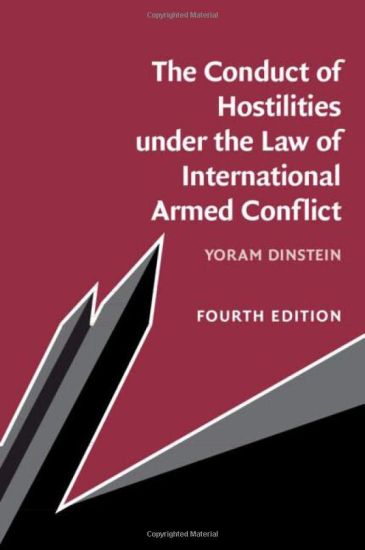
The Conduct of Hostilities under the Law of International Armed Conflict
The book serves as a companion to three other volumes published by Cambridge University Press, dealing respectively with the jus ad bellum, the law of belligerent occupation, and non-international armed conflicts. It is devoted to the core of the jus in bello - that is, the conduct of hostilities on land, at sea and in the air in inter-State armed conflicts - analyzed against the background of customary international law and treaties in force. The book deals with both means and methods of modern warfare. It addresses issues of general non-combatant protection, the principle of proportionality in collateral damage to civilians, and special protection, especially of the environment and cultural property. It also considers the relevant dimensions of international criminal law and deals with controversial matters such as unlawful combatancy, direct participation of civilians in hostilities and the use of 'human shields'. Case law and legal literature are cited throughout.
The Conduct of Hostilities under the Law of International Armed Conflict
The book serves as a companion to three other volumes published by Cambridge University Press, dealing respectively with the jus ad bellum, the law of belligerent occupation, and non-international armed conflicts. It is devoted to the core of the jus in bello - that is, the conduct of hostilities on land, at sea and in the air in inter-State armed conflicts - analyzed against the background of customary international law and treaties in force. The book deals with both means and methods of modern warfare. It addresses issues of general non-combatant protection, the principle of proportionality in collateral damage to civilians, and special protection, especially of the environment and cultural property. It also considers the relevant dimensions of international criminal law and deals with controversial matters such as unlawful combatancy, direct participation of civilians in hostilities and the use of 'human shields'. Case law and legal literature are cited throughout.
The Conduct of Hostilities under the Law of International Armed Conflict
Written by the leading commentator on the subject, this is the seminal textbook on the law of international armed conflict. Focusing on recent issues arising in the course of hostilities between States, it explores the dividing line between lawful and unlawful combatants, the meaning of war crimes and command responsibility, the range of prohibited weapons, the distinction between combatants and civilians, the parameters of targeting and proportionality, the loss of protection from attack (including 'direct participation in hostilities') and special protection (granted, pre-eminently, to the environment and to cultural property). In a completely revised and updated text, the author expertly covers the key principles and includes important new issues, including the use of autonomous weapons and the complexities of urban warfare. The subtleties and nuances of the international law of armed conflict are made accessible to the student and practitioner alike, whilst retaining the academic rigour of previous editions.
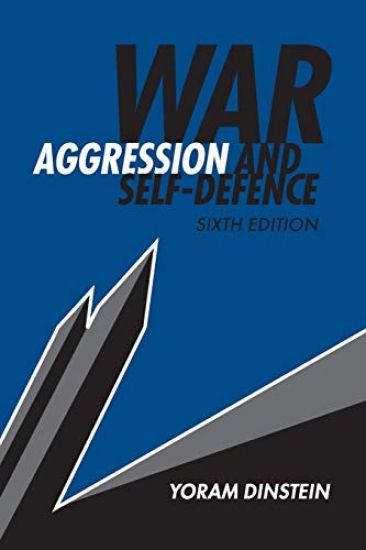
War, Aggression and Self-Defence

War, Aggression and Self-Defence

Yoram Dinstein

Cambridge University Press
2017
sidottu
War, Aggression and Self-Defence is an indispensable guide to international legal issues of war and peace, the crime of aggression, self-defence and its trigger, armed attack, and the different modalities of self-defence, as well as enforcement measures taken under the aegis of a binding decision of the Security Council. This new and fully updated 6th edition focuses on the key issues at the forefront of the contemporary international legal debate, as well as analysing the new armed conflicts in Syria, Ukraine and Georgia, re-examining the Kampala amendments on the crime of aggression and considering the phenomenon of 'robust' mandates of a peacekeeping force. Suitable for graduate and advanced undergraduate students, this market-leading book offers a wide-ranging and highly readable introduction to the legal issues surrounding war and self-defence.
The Conduct of Hostilities under the Law of International Armed Conflict
Written by the leading commentator on the subject, this is the seminal textbook on the law of international armed conflict. Focusing on recent issues arising in the course of hostilities between States, it explores the dividing line between lawful and unlawful combatants, the meaning of war crimes and command responsibility, the range of prohibited weapons, the distinction between combatants and civilians, the parameters of targeting and proportionality, the loss of protection from attack (including 'direct participation in hostilities') and special protection (granted, pre-eminently, to the environment and to cultural property). In a completely revised and updated text, the author expertly covers the key principles and includes important new issues, including the use of autonomous weapons and the complexities of urban warfare. The subtleties and nuances of the international law of armed conflict are made accessible to the student and practitioner alike, whilst retaining the academic rigour of previous editions.
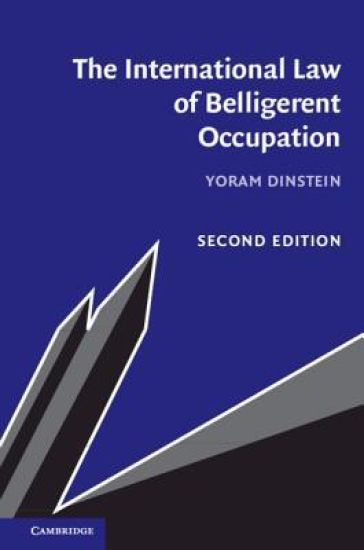
The International Law of Belligerent Occupation

The International Law of Belligerent Occupation

Yoram Dinstein

Cambridge University Press
2019
sidottu
Belligerent occupations existed in both World Wars and have occurred more recently in all parts of the world (including Iraq, Afghanistan, the former Yugoslavia, Congo, Northern Cyprus, Nagorno-Karabakh, Georgia, Eritrea and Ethiopia). Owing to its special length – exceeding half a century and still in progress – and the unprecedented flow of judicial decisions, a special focus is called for as regards to the occupation of Palestinian territories by Israel. International law addresses the subject of belligerent occupation in some detail. This second, revised edition updates the text (originally published in 2009) in terms of both State practice and doctrinal discourse. The emphasis is put on decisions of the Security Council; legislation adopted by the Coalition Provisional Authority in Iraq; and predominantly case law: international (Judgments of the International Court of Justice, the International Criminal Tribunal for the Former Yugoslavia and the European Court of Human Rights; Advisory Opinions and Arbitral Awards) as well as domestic courts.
The International Law of Belligerent Occupation

The International Law of Belligerent Occupation

Yoram Dinstein

Cambridge University Press
2019
pokkari
Belligerent occupations existed in both World Wars and have occurred more recently in all parts of the world (including Iraq, Afghanistan, the former Yugoslavia, Congo, Northern Cyprus, Nagorno-Karabakh, Georgia, Eritrea and Ethiopia). Owing to its special length – exceeding half a century and still in progress – and the unprecedented flow of judicial decisions, a special focus is called for as regards to the occupation of Palestinian territories by Israel. International law addresses the subject of belligerent occupation in some detail. This second, revised edition updates the text (originally published in 2009) in terms of both State practice and doctrinal discourse. The emphasis is put on decisions of the Security Council; legislation adopted by the Coalition Provisional Authority in Iraq; and predominantly case law: international (Judgments of the International Court of Justice, the International Criminal Tribunal for the Former Yugoslavia and the European Court of Human Rights; Advisory Opinions and Arbitral Awards) as well as domestic courts.
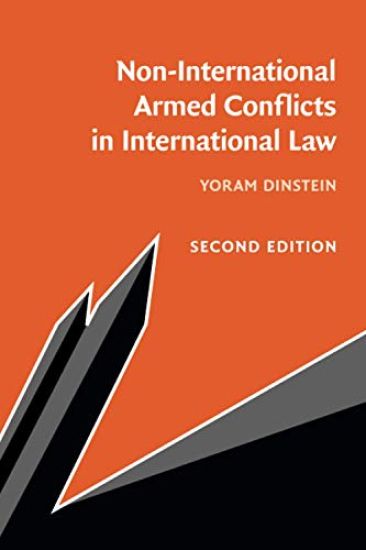
Non-International Armed Conflicts in International Law

Non-International Armed Conflicts in International Law

Yoram Dinstein

Cambridge University Press
2021
pokkari
This dispassionate analysis of the legal implications of non-international armed conflicts explores the rules regulating the conduct of internal hostilities, as well as the consequences of intervention by foreign States, the role of the UN Security Council, the effects of recognition, State responsibility for wrongdoing by both Governments and insurgents, the interface with the law of human rights and the notion of war crimes. The author addresses both conceptual and specific issues, such as the complexities of 'failing' States or the recruitment and use of child soldiers. He makes use of the extensive case law of international courts and tribunals, in order to identify and set out customary international law. Much attention is also given to the contents of available treaty texts. This new updated edition takes into account the latest events in terms of the practice of States, judicial pronouncements and UN Security Council resolutions.
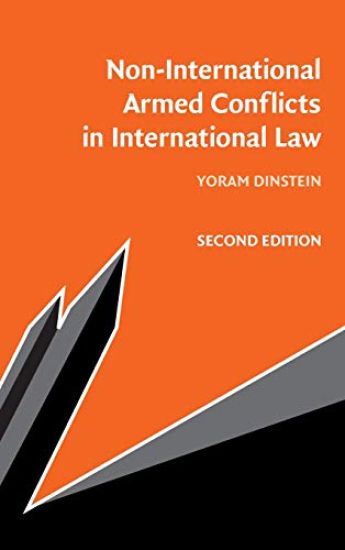
Non-International Armed Conflicts in International Law

Non-International Armed Conflicts in International Law

Yoram Dinstein

Cambridge University Press
2021
sidottu
This dispassionate analysis of the legal implications of non-international armed conflicts explores the rules regulating the conduct of internal hostilities, as well as the consequences of intervention by foreign States, the role of the UN Security Council, the effects of recognition, State responsibility for wrongdoing by both Governments and insurgents, the interface with the law of human rights and the notion of war crimes. The author addresses both conceptual and specific issues, such as the complexities of 'failing' States or the recruitment and use of child soldiers. He makes use of the extensive case law of international courts and tribunals, in order to identify and set out customary international law. Much attention is also given to the contents of available treaty texts. This new updated edition takes into account the latest events in terms of the practice of States, judicial pronouncements and UN Security Council resolutions.
War, Aggression and Self-Defence

War, Aggression and Self-Defence

Yoram Dinstein

Cambridge University Press
2017
pokkari
War, Aggression and Self-Defence is an indispensable guide to international legal issues of war and peace, the crime of aggression, self-defence and its trigger, armed attack, and the different modalities of self-defence, as well as enforcement measures taken under the aegis of a binding decision of the Security Council. This new and fully updated 6th edition focuses on the key issues at the forefront of the contemporary international legal debate, as well as analysing the new armed conflicts in Syria, Ukraine and Georgia, re-examining the Kampala amendments on the crime of aggression and considering the phenomenon of 'robust' mandates of a peacekeeping force. Suitable for graduate and advanced undergraduate students, this market-leading book offers a wide-ranging and highly readable introduction to the legal issues surrounding war and self-defence.
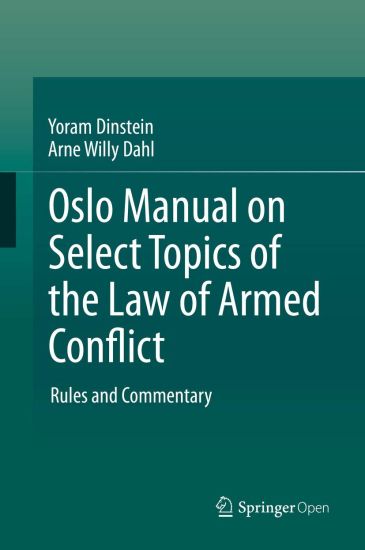
Oslo Manual on Select Topics of the Law of Armed Conflict

Oslo Manual on Select Topics of the Law of Armed Conflict

Yoram Dinstein; Arne Willy Dahl

Springer Nature Switzerland AG
2020
sidottu
This new open access book provides a valuable restatement of the current law of armed conflict regarding hostilities in a diverse range of contexts: outer space, cyber operations, remote and autonomous weapons, undersea systems and devices, submarine cables, civilians participating in unmanned operations, military objectives by nature, civilian airliners, destruction of property, surrender, search and rescue, humanitarian assistance, cultural property, the natural environment, and more. The book was prepared by a group of experts after consultation with a number of key governments. It is intended to offer guidance for practitioners (mainly commanding officers); facilitate training at military colleges; and inform both instructors and graduate students of international law on the current state of the law.
Oslo Manual on Select Topics of the Law of Armed Conflict

Oslo Manual on Select Topics of the Law of Armed Conflict

Yoram Dinstein; Arne Willy Dahl

Springer Nature Switzerland AG
2020
nidottu
This new open access book provides a valuable restatement of the current law of armed conflict regarding hostilities in a diverse range of contexts: outer space, cyber operations, remote and autonomous weapons, undersea systems and devices, submarine cables, civilians participating in unmanned operations, military objectives by nature, civilian airliners, destruction of property, surrender, search and rescue, humanitarian assistance, cultural property, the natural environment, and more. The book was prepared by a group of experts after consultation with a number of key governments. It is intended to offer guidance for practitioners (mainly commanding officers); facilitate training at military colleges; and inform both instructors and graduate students of international law on the current state of the law.
Translational Systems Biology

Translational Systems Biology

Yoram Vodovotz; Gary An

Academic Press Inc
2014
sidottu
Are we satisfied with the rate of drug development? Are we happy with the drugs that come to market? Are we getting our money’s worth in spending for basic biomedical research? In Translational Systems Biology, Drs. Yoram Vodovotz and Gary An address these questions by providing a foundational description the barriers facing biomedical research today and the immediate future, and how these barriers could be overcome through the adoption of a robust and scalable approach that will form the underpinning of biomedical research for the future. By using a combination of essays providing the intellectual basis of the Translational Dilemma and reports of examples in the study of inflammation, the content of Translational Systems Biology will remain relevant as technology and knowledge advances bring broad translational applicability to other diseases. Translational systems biology is an integrated, multi-scale, evidence-based approach that combines laboratory, clinical and computational methods with an explicit goal of developing effective means of control of biological processes for improving human health and rapid clinical application. This comprehensive approach to date has been utilized for in silico studies of sepsis, trauma, hemorrhage, and traumatic brain injury, acute liver failure, wound healing, and inflammation.
Revolutionary Justice

Revolutionary Justice

Yoram Meital

Oxford University Press Inc
2016
sidottu
Revolutionary Justice narrates the power struggle between the Free Officers and their adversaries in the aftermath of Egypt's July Revolution of 1952 by studying trials held at the Revolution's Court and the People's Court. The establishment of these tribunals coincided with the most serious political crisis between the new regime and the opposition-primarily the Muslim Brothers and the Wafd party, but also senior officials in the previous government. By this point, the initial euphoria and the unbridled adoration for the Free Officers had worn off, and the focus of the public debate shifted to the legitimacy of the army's continued rule. Yoram Meital charts the crucial events of Egyptian Revolution both within and outside the courtroom. The tribunals' transcripts, which constitute the prime source of his study, offer a rare glimpse of the dialogue between parties that held conflicting views. While "show trials" against political dissidents are generally considered of little historical value, Revolutionary Justice lucidly shows that the rhetoric generated by Egypt's special courts played a crucial role in the denouement of political struggles, the creation of new historical trends, and the shaping of both the regime and the opposition's public image. The deliberations at the courtroom reinforced the prevailing emergency atmosphere, helping the junta advance its plans for a new dispensation. On the other hand, the responses of defendants and witnesses during the trial exposed weaknesses in the official hegemonic narrative. Paradoxically, oppositional views that the regime tirelessly endeavored to silence were tolerated and recorded in the courtroom.
Applied Stochastic Hydrogeology

Applied Stochastic Hydrogeology

Yoram Rubin

Oxford University Press Inc
2003
sidottu
Stochastic hydrogeology, which emerged as a research area in the late 1970s, involves the study of subsurface, geological variability on flow and transport processes and the interpretation of observations using existing theories. Lacking, however, has been a rational framework for modeling the impact of the processes that take place in heterogeneous media and for incorporating it in predictions and decision-making. This book provides this important framework. It covers the fundamental and practical aspects of stochastic hydrogeology, coupling theoretical aspects with examples, case studies, and guidelines for applications.
Cold Peace

Cold Peace

Yoram Gorlizki; Oleg Khlevniuk

Oxford University Press Inc
2006
nidottu
Following his country's victory over Nazi Germany, Joseph Stalin was widely hailed as a great wartime leader and international statesman. Unchallenged on the domestic front, he headed one of the most powerful nations in the world. Yet, in the period from the end of World War II until his death, Stalin remained a man possessed by his fears. In order to reinforce his despotic rule in the face of old age and uncertain health, he habitually humiliated and terrorized members of his inner circle. He had their telephones bugged and even forced his deputy, Viacheslav Molotov, to betray his own spouse as a token of his allegiance. Often dismissed as paranoid and irrational, Stalin's behavior followed a clear political logic, contend Yoram Gorlizki and Oleg Khlevniuk. Stalin's consistent and overriding goal after the war was to consolidate the Soviet Union's status as a superpower and, in the face of growing decrepitude, to maintain his own hold as leader of that power. To that end, he fashioned a system of leadership that was at once patrimonial-repressive and quite modern. While maintaining informal relations based on personal loyalty at the apex of the system, in the postwar period Stalin also vested authority in committees, elevated younger specialists, and initiated key institutional innovations with lasting consequences. Close scrutiny of Stalin's relationships with his most intimate colleagues also shows how, in the teeth of periodic persecution, Stalin's deputies cultivated informal norms and mutual understandings which provided the foundations for collective rule after his death. Based on newly released archival documents, including personal correspondence, drafts of Central Committee paperwork, new memoirs, and interviews with former functionaries and the families of Politburo members, this book will appeal to all those interested in Soviet history, political history, and the lives of dictators.
Substate Dictatorship

Substate Dictatorship

Yoram Gorlizki; Oleg Khlevniuk

Yale University Press
2020
sidottu
An essential exploration of how authoritarian regimes operate at the local level “Gorlizki and Khlevniuk have produced an impressive study. . . . A must for scholars of Stalinism and Soviet politics more generally.”—Gerald Easter, Russian Review How do local leaders govern in a large dictatorship? What resources do they draw on? Building on recent innovations in the theory of dictatorship, Yoram Gorlizki and Oleg Khlevniuk examine these questions by looking at one of the most important authoritarian regimes of the twentieth century. They show how Soviet regional leaders, lacking Stalin’s direct access to the means of repression, resorted to alternative strategies—especially through political exclusion and control of information—to build the local networks they needed to rule. The authors suggest that making sense of these networks is key to understanding how the dictatorship as a whole operated. Analytical scrutiny provides important clues to how the institutions of dictatorship changed over time, how conflicts within it were resolved, and how certain central policies, such as on the management of ethnic diversity, were implemented.