Drawing on literary manuscripts and the history of cinema, Evelyn Waugh’s Exterior Modernism examines systematically for the first time Waugh’s relationship with cinema in the context of modernism, a relationship crucial to the emergence and development of his strand of modernism. The term ‘exterior modernism’ refers to the work of a group of younger writers, such as Evelyn Waugh, Ernest Hemingway, Henry Green, Christopher Isherwood, Anthony Powell, Elizabeth Bowen, and Patrick Hamilton, whose departure from high modernism took the form of an ‘outward turn’ privileging exteriority over the interiority of consciousness through foregrounding talk and drawing on cinema, comedy, and satire. Relating to other exterior modernists, Evelyn Waugh’s Exterior Modernism focuses on Waugh by way of exemplification, considering his oeuvre, non-fiction as well as fiction. To illuminate Waugh’s exteriority, Yuexi Liu develops an interdisciplinary framework, informed primarily by distributed cognition.
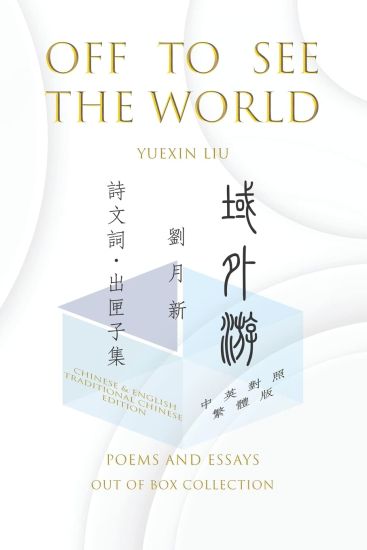
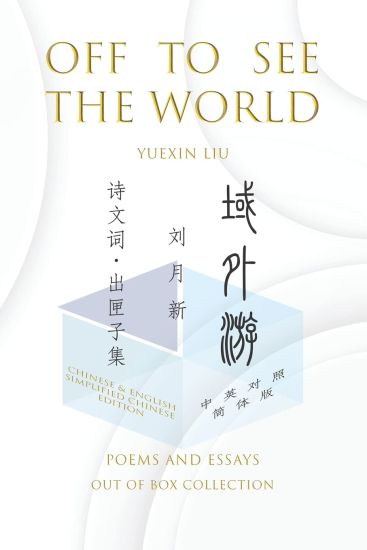
This is a collection of modern Chinese and English poems in the most popular classical Song style metrical formats, and short Chinese and English essays in the concise and sharp styles. The collection provides completely different perspectives on the world and life.There are 16 categories with total 152 pieces in this collection of literacy works. From Hometown, Youth, College, to Study Abroad and Work, it is a trajectory of life. Holidays, Travel, Foreign Culture, Living Abroad and Second Hometown describe the different ways of life in different lands. Then comes the bird view on the world and life, Philosophy, Faith, Life, See the World, History and Look into Future. It is the Out-Of-Box thinking and sharp reflection that really pull all the things together. Human beings are so used to what we see and hear every day. We are constantly confined to a domain that we are subconsciously accustomed to. That is why we need to see the outside world by going out of box. As we get comfortable with what we see and hear, it becomes clear that the outside world is not that different. The new world then becomes a box itself. We need to continuously get out of the comfort zone, find the new comfort zone and go through the iterations in a never-ending way.Growing up and spending the youth in China allows me to be deeply inherited with Chinese philosophy and the Eastern way of thinking. Thirty years of American experience provide me a completely different way to look at the world and life. It is not about having it all. It is more about experiencing it all. It is life itself, bit by bit, drop by drop, that makes it all meaningful. At a certain stage of life, it all suddenly starts to make sense. Inside out, upside down. Spiral ascending. It is the Out-Of-Box thinking and sharp reflection that traverse a truly meaningful life. Attempts have been made here to express all these in a concise and articulate manner, in the forms of metrical poems and short essays, in both Chinese and English.Some of the pieces may contain sharp personal opinions. The beauty is that you do not have to agree with me. And the essence is the thought process itself. The goal here is to inspire new thoughts and new ideas. It is the critical thinking and sharp reflection that I am aiming here. Ultimately this is an Out-Of-Box collection of literacy works after all.
This is a collection of modern Chinese and English poems in the most popular classical Song style metrical formats, and short Chinese and English essays in the concise and sharp styles. The collection provides completely different perspectives on the world and life.There are 16 categories with total 152 pieces in this collection of literacy works. From Hometown, Youth, College, to Study Abroad and Work, it is a trajectory of life. Holidays, Travel, Foreign Culture, Living Abroad and Second Hometown describe the different ways of life in different lands. Then comes the bird view on the world and life, Philosophy, Faith, Life, See the World, History and Look into Future. It is the Out-Of-Box thinking and sharp reflection that really pull all the things together. Human beings are so used to what we see and hear every day. We are constantly confined to a domain that we are subconsciously accustomed to. That is why we need to see the outside world by going out of box. As we get comfortable with what we see and hear, it becomes clear that the outside world is not that different. The new world then becomes a box itself. We need to continuously get out of the comfort zone, find the new comfort zone and go through the iterations in a never-ending way.Growing up and spending the youth in China allows me to be deeply inherited with Chinese philosophy and the Eastern way of thinking. Thirty years of American experience provide me a completely different way to look at the world and life. It is not about having it all. It is more about experiencing it all. It is life itself, bit by bit, drop by drop, that makes it all meaningful. At a certain stage of life, it all suddenly starts to make sense. Inside out, upside down. Spiral ascending. It is the Out-Of-Box thinking and sharp reflection that traverse a truly meaningful life. Attempts have been made here to express all these in a concise and articulate manner, in the forms of metrical poems and short essays, in both Chinese and English.Some of the pieces may contain sharp personal opinions. The beauty is that you do not have to agree with me. And the essence is the thought process itself. The goal here is to inspire new thoughts and new ideas. It is the critical thinking and sharp reflection that I am aiming here. Ultimately this is an Out-Of-Box collection of literacy works after all.
Take tiny steps to enter the big world of data science through this interesting guide About This Book • Learn the fundamentals of machine learning and build your own intelligent applications • Master the art of building your own machine learning systems with this example-based practical guide • Work with important classification and regression algorithms and other machine learning techniques Who This Book Is For This book is for anyone interested in entering the data science stream with machine learning. Basic familiarity with Python is assumed. What You Will Learn • Exploit the power of Python to handle data extraction, manipulation, and exploration techniques • Use Python to visualize data spread across multiple dimensions and extract useful features • Dive deep into the world of analytics to predict situations correctly • Implement machine learning classification and regression algorithms from scratch in Python • Be amazed to see the algorithms in action • Evaluate the performance of a machine learning model and optimize it • Solve interesting real-world problems using machine learning and Python as the journey unfolds In Detail Data science and machine learning are some of the top buzzwords in the technical world today. A resurging interest in machine learning is due to the same factors that have made data mining and Bayesian analysis more popular than ever. This book is your entry point to machine learning. This book starts with an introduction to machine learning and the Python language and shows you how to complete the setup. Moving ahead, you will learn all the important concepts such as, exploratory data analysis, data preprocessing, feature extraction, data visualization and clustering, classification, regression and model performance evaluation. With the help of various projects included, you will find it intriguing to acquire the mechanics of several important machine learning algorithms – they are no more obscure as they thought. Also, you will be guided step by step to build your own models from scratch. Toward the end, you will gather a broad picture of the machine learning ecosystem and best practices of applying machine learning techniques. Through this book, you will learn to tackle data-driven problems and implement your solutions with the powerful yet simple language, Python. Interesting and easy-to-follow examples, to name some, news topic classification, spam email detection, online ad click-through prediction, stock prices forecast, will keep you glued till you reach your goal. Style and approach This book is an enticing journey that starts from the very basics and gradually picks up pace as the story unfolds. Each concept is first succinctly defined in the larger context of things, followed by a detailed explanation of their application. Every concept is explained with the help of a project that solves a real-world problem, and involves hands-on work—giving you a deep insight into the world of machine learning. With simple yet rich language—Python—you will understand and be able to implement the examples with ease.
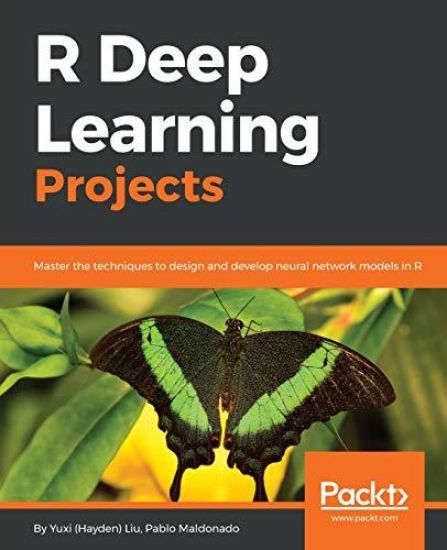
5 real-world projects to help you master deep learning concepts About This Book • Master the different deep learning paradigms and build real-world projects related to text generation, sentiment analysis, fraud detection, and more • Get to grips with R's impressive range of Deep Learning libraries and frameworks such as deepnet, MXNetR, Tensorflow, H2O, Keras, and text2vec • Practical projects that show you how to implement different neural networks with helpful tips, tricks, and best practices Who This Book Is For Machine learning professionals and data scientists looking to master deep learning by implementing practical projects in R will find this book a useful resource. A knowledge of R programming and the basic concepts of deep learning is required to get the best out of this book. What You Will Learn • Instrument Deep Learning models with packages such as deepnet, MXNetR, Tensorflow, H2O, Keras, and text2vec • Apply neural networks to perform handwritten digit recognition using MXNet • Get the knack of CNN models, Neural Network API, Keras, and TensorFlow for traffic sign classification • Implement credit card fraud detection with Autoencoders • Master reconstructing images using variational autoencoders • Wade through sentiment analysis from movie reviews • Run from past to future and vice versa with bidirectional Long Short-Term Memory (LSTM) networks • Understand the applications of Autoencoder Neural Networks in clustering and dimensionality reduction In Detail R is a popular programming language used by statisticians and mathematicians for statistical analysis, and is popularly used for deep learning. Deep Learning, as we all know, is one of the trending topics today, and is finding practical applications in a lot of domains. This book demonstrates end-to-end implementations of five real-world projects on popular topics in deep learning such as handwritten digit recognition, traffic light detection, fraud detection, text generation, and sentiment analysis. You'll learn how to train effective neural networks in R—including convolutional neural networks, recurrent neural networks, and LSTMs—and apply them in practical scenarios. The book also highlights how neural networks can be trained using GPU capabilities. You will use popular R libraries and packages—such as MXNetR, H2O, deepnet, and more—to implement the projects. By the end of this book, you will have a better understanding of deep learning concepts and techniques and how to use them in a practical setting. Style and approach This book's unique, learn-as-you-do approach ensures the reader builds on his understanding of deep learning progressively with each project. This book is designed in such a way that implementing each project will empower you with a unique skillset and enable you to implement the next project more confidently.
Concepts, tools, and techniques to explore deep learning architectures and methodologiesKey FeaturesExplore advanced deep learning architectures using various datasets and frameworksImplement deep architectures for neural network models such as CNN, RNN, GAN, and many moreDiscover design patterns and different challenges for various deep learning architecturesBook DescriptionDeep learning architectures are composed of multilevel nonlinear operations that represent high-level abstractions; this allows you to learn useful feature representations from the data. This book will help you learn and implement deep learning architectures to resolve various deep learning research problems.Hands-On Deep Learning Architectures with Python explains the essential learning algorithms used for deep and shallow architectures. Packed with practical implementations and ideas to help you build efficient artificial intelligence systems (AI), this book will help you learn how neural networks play a major role in building deep architectures. You will understand various deep learning architectures (such as AlexNet, VGG Net, GoogleNet) with easy-to-follow code and diagrams. In addition to this, the book will also guide you in building and training various deep architectures such as the Boltzmann mechanism, autoencoders, convolutional neural networks (CNNs), recurrent neural networks (RNNs), natural language processing (NLP), GAN, and more—all with practical implementations.By the end of this book, you will be able to construct deep models using popular frameworks and datasets with the required design patterns for each architecture. You will be ready to explore the potential of deep architectures in today's world.What you will learnImplement CNNs, RNNs, and other commonly used architectures with PythonExplore architectures such as VGGNet, AlexNet, and GoogLeNetBuild deep learning architectures for AI applications such as face and image recognition, fraud detection, and many moreUnderstand the architectures and applications of Boltzmann machines and autoencoders with concrete examples Master artificial intelligence and neural network concepts and apply them to your architectureUnderstand deep learning architectures for mobile and embedded systemsWho this book is forIf you’re a data scientist, machine learning developer/engineer, or deep learning practitioner, or are curious about AI and want to upgrade your knowledge of various deep learning architectures, this book will appeal to you. You are expected to have some knowledge of statistics and machine learning algorithms to get the best out of this book
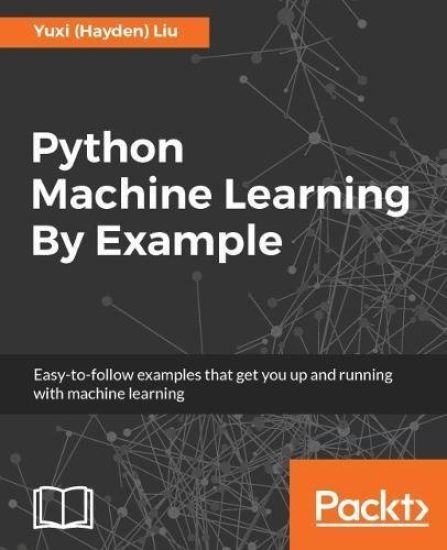
Grasp machine learning concepts, techniques, and algorithms with the help of real-world examples using Python libraries such as TensorFlow and scikit-learnKey FeaturesExploit the power of Python to explore the world of data mining and data analyticsDiscover machine learning algorithms to solve complex challenges faced by data scientists todayUse Python libraries such as TensorFlow and Keras to create smart cognitive actions for your projectsBook DescriptionThe surge in interest in machine learning (ML) is due to the fact that it revolutionizes automation by learning patterns in data and using them to make predictions and decisions. If you’re interested in ML, this book will serve as your entry point to ML.Python Machine Learning By Example begins with an introduction to important ML concepts and implementations using Python libraries. Each chapter of the book walks you through an industry adopted application. You’ll implement ML techniques in areas such as exploratory data analysis, feature engineering, and natural language processing (NLP) in a clear and easy-to-follow way.With the help of this extended and updated edition, you’ll understand how to tackle data-driven problems and implement your solutions with the powerful yet simple Python language and popular Python packages and tools such as TensorFlow, scikit-learn, gensim, and Keras. To aid your understanding of popular ML algorithms, the book covers interesting and easy-to-follow examples such as news topic modeling and classification, spam email detection, stock price forecasting, and more.By the end of the book, you’ll have put together a broad picture of the ML ecosystem and will be well-versed with the best practices of applying ML techniques to make the most out of new opportunities.What you will learnUnderstand the important concepts in machine learning and data scienceUse Python to explore the world of data mining and analyticsScale up model training using varied data complexities with Apache SparkDelve deep into text and NLP using Python libraries such NLTK and gensimSelect and build an ML model and evaluate and optimize its performanceImplement ML algorithms from scratch in Python, TensorFlow, and scikit-learnWho this book is forIf you’re a machine learning aspirant, data analyst, or data engineer highly passionate about machine learning and want to begin working on ML assignments, this book is for you. Prior knowledge of Python coding is assumed and basic familiarity with statistical concepts will be beneficial although not necessary.
A comprehensive guide to get you up to speed with the latest developments of practical machine learning with Python and upgrade your understanding of machine learning (ML) algorithms and techniquesKey FeaturesDive into machine learning algorithms to solve the complex challenges faced by data scientists todayExplore cutting edge content reflecting deep learning and reinforcement learning developmentsUse updated Python libraries such as TensorFlow, PyTorch, and scikit-learn to track machine learning projects end-to-endBook DescriptionPython Machine Learning By Example, Third Edition serves as a comprehensive gateway into the world of machine learning (ML).With six new chapters, on topics including movie recommendation engine development with Naïve Bayes, recognizing faces with support vector machine, predicting stock prices with artificial neural networks, categorizing images of clothing with convolutional neural networks, predicting with sequences using recurring neural networks, and leveraging reinforcement learning for making decisions, the book has been considerably updated for the latest enterprise requirements.At the same time, this book provides actionable insights on the key fundamentals of ML with Python programming. Hayden applies his expertise to demonstrate implementations of algorithms in Python, both from scratch and with libraries.Each chapter walks through an industry-adopted application. With the help of realistic examples, you will gain an understanding of the mechanics of ML techniques in areas such as exploratory data analysis, feature engineering, classification, regression, clustering, and NLP.By the end of this ML Python book, you will have gained a broad picture of the ML ecosystem and will be well-versed in the best practices of applying ML techniques to solve problems.What you will learnUnderstand the important concepts in ML and data scienceUse Python to explore the world of data mining and analyticsScale up model training using varied data complexities with Apache SparkDelve deep into text analysis and NLP using Python libraries such NLTK and GensimSelect and build an ML model and evaluate and optimize its performanceImplement ML algorithms from scratch in Python, TensorFlow 2, PyTorch, and scikit-learnWho this book is forIf you’re a machine learning enthusiast, data analyst, or data engineer highly passionate about machine learning and want to begin working on machine learning assignments, this book is for you.Prior knowledge of Python coding is assumed and basic familiarity with statistical concepts will be beneficial, although this is not necessary.
Author Yuxi (Hayden) Liu teaches machine learning from the fundamentals to building NLP transformers and multimodal models with best practice tips and real-world examples using PyTorch, TensorFlow, scikit-learn, and pandas Key Features Discover new and updated content on NLP transformers, PyTorch, and computer vision modeling Includes a dedicated chapter on best practices and additional best practice tips throughout the book to improve your ML solutions Implement ML models, such as neural networks and linear and logistic regression, from scratch Purchase of the print or Kindle book includes a free PDF copy Book DescriptionThe fourth edition of Python Machine Learning By Example is a comprehensive guide for beginners and experienced machine learning practitioners who want to learn more advanced techniques, such as multimodal modeling. Written by experienced machine learning author and ex-Google machine learning engineer Yuxi (Hayden) Liu, this edition emphasizes best practices, providing invaluable insights for machine learning engineers, data scientists, and analysts. Explore advanced techniques, including two new chapters on natural language processing transformers with BERT and GPT, and multimodal computer vision models with PyTorch and Hugging Face. You’ll learn key modeling techniques using practical examples, such as predicting stock prices and creating an image search engine. This hands-on machine learning book navigates through complex challenges, bridging the gap between theoretical understanding and practical application. Elevate your machine learning and deep learning expertise, tackle intricate problems, and unlock the potential of advanced techniques in machine learning with this authoritative guide.What you will learn Follow machine learning best practices throughout data preparation and model development Build and improve image classifiers using convolutional neural networks (CNNs) and transfer learning Develop and fine-tune neural networks using TensorFlow and PyTorch Analyze sequence data and make predictions using recurrent neural networks (RNNs), transformers, and CLIP Build classifiers using support vector machines (SVMs) and boost performance with PCA Avoid overfitting using regularization, feature selection, and more Who this book is forThis expanded fourth edition is ideal for data scientists, ML engineers, analysts, and students with Python programming knowledge. The real-world examples, best practices, and code prepare anyone undertaking their first serious ML project.
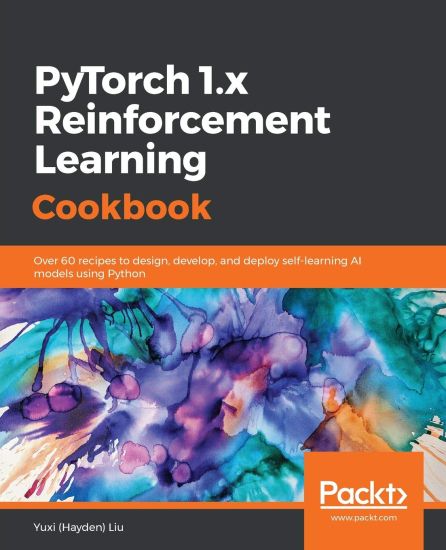
Implement reinforcement learning techniques and algorithms with the help of real-world examples and recipesKey FeaturesUse PyTorch 1.x to design and build self-learning artificial intelligence (AI) modelsImplement RL algorithms to solve control and optimization challenges faced by data scientists todayApply modern RL libraries to simulate a controlled environment for your projectsBook DescriptionReinforcement learning (RL) is a branch of machine learning that has gained popularity in recent times. It allows you to train AI models that learn from their own actions and optimize their behavior. PyTorch has also emerged as the preferred tool for training RL models because of its efficiency and ease of use.With this book, you'll explore the important RL concepts and the implementation of algorithms in PyTorch 1.x. The recipes in the book, along with real-world examples, will help you master various RL techniques, such as dynamic programming, Monte Carlo simulations, temporal difference, and Q-learning. You'll also gain insights into industry-specific applications of these techniques. Later chapters will guide you through solving problems such as the multi-armed bandit problem and the cartpole problem using the multi-armed bandit algorithm and function approximation. You'll also learn how to use Deep Q-Networks to complete Atari games, along with how to effectively implement policy gradients. Finally, you'll discover how RL techniques are applied to Blackjack, Gridworld environments, internet advertising, and the Flappy Bird game.By the end of this book, you'll have developed the skills you need to implement popular RL algorithms and use RL techniques to solve real-world problems.What you will learnUse Q-learning and the state–action–reward–state–action (SARSA) algorithm to solve various Gridworld problemsDevelop a multi-armed bandit algorithm to optimize display advertisingScale up learning and control processes using Deep Q-NetworksSimulate Markov Decision Processes, OpenAI Gym environments, and other common control problemsSelect and build RL models, evaluate their performance, and optimize and deploy themUse policy gradient methods to solve continuous RL problemsWho this book is forMachine learning engineers, data scientists and AI researchers looking for quick solutions to different reinforcement learning problems will find this book useful. Although prior knowledge of machine learning concepts is required, experience with PyTorch will be useful but not necessary.
This book of the bestselling and widely acclaimed Python Machine Learning series is a comprehensive guide to machine and deep learning using PyTorch s simple to code framework. Purchase of the print or Kindle book includes a free eBook in PDF format. Key Features Learn applied machine learning with a solid foundation in theory Clear, intuitive explanations take you deep into the theory and practice of Python machine learning Fully updated and expanded to cover PyTorch, transformers, XGBoost, graph neural networks, and best practices Book DescriptionMachine Learning with PyTorch and Scikit-Learn is a comprehensive guide to machine learning and deep learning with PyTorch. It acts as both a step-by-step tutorial and a reference you'll keep coming back to as you build your machine learning systems. Packed with clear explanations, visualizations, and examples, the book covers all the essential machine learning techniques in depth. While some books teach you only to follow instructions, with this machine learning book, we teach the principles allowing you to build models and applications for yourself. Why PyTorch? PyTorch is the Pythonic way to learn machine learning, making it easier to learn and simpler to code with. This book explains the essential parts of PyTorch and how to create models using popular libraries, such as PyTorch Lightning and PyTorch Geometric. You will also learn about generative adversarial networks (GANs) for generating new data and training intelligent agents with reinforcement learning. Finally, this new edition is expanded to cover the latest trends in deep learning, including graph neural networks and large-scale transformers used for natural language processing (NLP). This PyTorch book is your companion to machine learning with Python, whether you're a Python developer new to machine learning or want to deepen your knowledge of the latest developments.What you will learn Explore frameworks, models, and techniques for machines to learn from data Use scikit-learn for machine learning and PyTorch for deep learning Train machine learning classifiers on images, text, and more Build and train neural networks, transformers, and boosting algorithms Discover best practices for evaluating and tuning models Predict continuous target outcomes using regression analysis Dig deeper into textual and social media data using sentiment analysis Who this book is forIf you have a good grasp of Python basics and want to start learning about machine learning and deep learning, then this is the book for you. This is an essential resource written for developers and data scientists who want to create practical machine learning and deep learning applications using scikit-learn and PyTorch. Before you get started with this book, you’ll need a good understanding of calculus, as well as linear algebra.
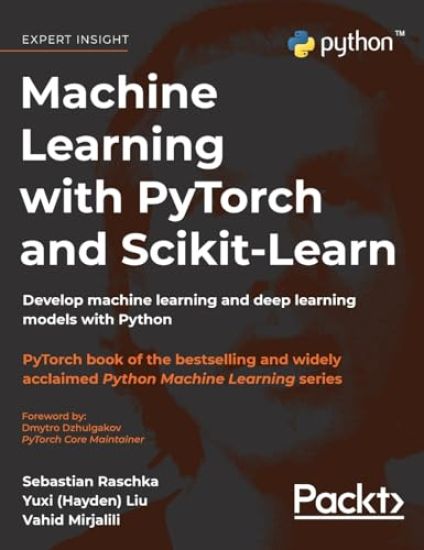
This book of the bestselling and widely acclaimed Python Machine Learning series is a comprehensive guide to machine and deep learning using PyTorch's simple to code framework.Purchase of the print or Kindle book includes a free eBook in PDF format.Key FeaturesLearn applied machine learning with a solid foundation in theoryClear, intuitive explanations take you deep into the theory and practice of Python machine learningFully updated and expanded to cover PyTorch, transformers, XGBoost, graph neural networks, and best practicesBook DescriptionMachine Learning with PyTorch and Scikit-Learn is a comprehensive guide to machine learning and deep learning with PyTorch. It acts as both a step-by-step tutorial and a reference you'll keep coming back to as you build your machine learning systems.Packed with clear explanations, visualizations, and examples, the book covers all the essential machine learning techniques in depth. While some books teach you only to follow instructions, with this machine learning book, we teach the principles allowing you to build models and applications for yourself.Why PyTorch?PyTorch is the Pythonic way to learn machine learning, making it easier to learn and simpler to code with. This book explains the essential parts of PyTorch and how to create models using popular libraries, such as PyTorch Lightning and PyTorch Geometric.You will also learn about generative adversarial networks (GANs) for generating new data and training intelligent agents with reinforcement learning. Finally, this new edition is expanded to cover the latest trends in deep learning, including graph neural networks and large-scale transformers used for natural language processing (NLP).This PyTorch book is your companion to machine learning with Python, whether you're a Python developer new to machine learning or want to deepen your knowledge of the latest developments.What you will learnExplore frameworks, models, and techniques for machines to 'learn' from dataUse scikit-learn for machine learning and PyTorch for deep learningTrain machine learning classifiers on images, text, and moreBuild and train neural networks, transformers, and boosting algorithmsDiscover best practices for evaluating and tuning modelsPredict continuous target outcomes using regression analysisDig deeper into textual and social media data using sentiment analysisWho this book is forIf you have a good grasp of Python basics and want to start learning about machine learning and deep learning, then this is the book for you. This is an essential resource written for developers and data scientists who want to create practical machine learning and deep learning applications using scikit-learn and PyTorch.Before you get started with this book, you'll need a good understanding of calculus, as well as linear algebra.Table of ContentsGiving Computers the Ability to Learn from DataTraining Simple Machine Learning Algorithms for ClassificationA Tour of Machine Learning Classifiers Using Scikit-LearnBuilding Good Training Datasets - Data PreprocessingCompressing Data via Dimensionality ReductionLearning Best Practices for Model Evaluation and Hyperparameter TuningCombining Different Models for Ensemble LearningApplying Machine Learning to Sentiment AnalysisPredicting Continuous Target Variables with Regression AnalysisWorking with Unlabeled Data - Clustering AnalysisImplementing a Multilayer Artificial Neural Network from Scratch(N.B. Please use the Look Inside option to see further chapters)
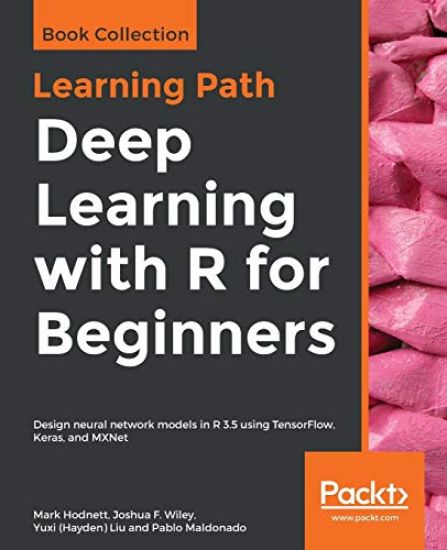
Explore the world of neural networks by building powerful deep learning models using the R ecosystemKey FeaturesGet to grips with the fundamentals of deep learning and neural networksUse R 3.5 and its libraries and APIs to build deep learning models for computer vision and text processingImplement effective deep learning systems in R with the help of end-to-end projectsBook DescriptionDeep learning finds practical applications in several domains, while R is the preferred language for designing and deploying deep learning models.This Learning Path introduces you to the basics of deep learning and even teaches you to build a neural network model from scratch. As you make your way through the chapters, you’ll explore deep learning libraries and understand how to create deep learning models for a variety of challenges, right from anomaly detection to recommendation systems. The book will then help you cover advanced topics, such as generative adversarial networks (GANs), transfer learning, and large-scale deep learning in the cloud, in addition to model optimization, overfitting, and data augmentation. Through real-world projects, you’ll also get up to speed with training convolutional neural networks (CNNs), recurrent neural networks (RNNs), and long short-term memory networks (LSTMs) in R.By the end of this Learning Path, you’ll be well versed with deep learning and have the skills you need to implement a number of deep learning concepts in your research work or projects.This Learning Path includes content from the following Packt products:R Deep Learning Essentials - Second Edition by Joshua F. Wiley and Mark HodnettR Deep Learning Projects by Yuxi (Hayden) Liu and Pablo MaldonadoWhat you will learnImplement credit card fraud detection with autoencodersTrain neural networks to perform handwritten digit recognition using MXNetReconstruct images using variational autoencodersExplore the applications of autoencoder neural networks in clustering and dimensionality reductionCreate natural language processing (NLP) models using Keras and TensorFlow in RPrevent models from overfitting the data to improve generalizabilityBuild shallow neural network prediction modelsWho this book is forThis Learning Path is for aspiring data scientists, data analysts, machine learning developers, and deep learning enthusiasts who are well versed in machine learning concepts and are looking to explore the deep learning paradigm using R. A fundamental understanding of R programming and familiarity with the basic concepts of deep learning are necessary to get the most out of this Learning Path.
Steel Corrosion Induced Concrete Cracking presents the latest advances in the origin, mechanism and development of corrosion-induced cracking in concrete. It investigates topics including expansion coefficient and elastic modulus of steel corrosion, rust layer and rust distribution, spatial distribution of corrosion products, the shape of corrosion-induced cracks and so on. This book concludes by proposing an improved corrosion-induced cracking model, which considers the phenomena of the simultaneous occurrence of corrosion layer accumulation and corrosion filling in concrete. This book will be a valuable reference book for researchers and graduate students in the field of concrete durability and concrete structure, and industry engineers who are concerned with the deterioration mechanisms and the life cycle of reinforced concrete structures.
This work is based on the lecture notes of the course M742: Topics in Partial Dif- ferential Equations, which I taught in the Spring semester of 1997 at Indiana Univer- sity. My main intention in this course was to give a concise introduction to solving two-dimensional compressibleEuler equations with Riemann data, which are special Cauchy data. This book covers new theoretical developments in the field over the past decade or so. Necessary knowledge of one-dimensional Riemann problems is reviewed and some popularnumerical schemes are presented. Multi-dimensional conservation laws are more physical and the time has come to study them. The theory onbasicone-dimensional conservation laws isfairly complete providing solid foundation for multi-dimensional problems. The rich theory on ellip- tic and parabolic partial differential equations has great potential in applications to multi-dimensional conservation laws. And faster computers make itpossible to reveal numerically more details for theoretical pursuitin multi-dimensional problems. Overview and highlights Chapter 1is an overview ofthe issues that concern us inthisbook. It lists theEulersystemandrelatedmodelssuch as theunsteady transonic small disturbance, pressure-gradient, and pressureless systems. Itdescribes Mach re- flection and the von Neumann paradox. In Chapters 2-4, which form Part I of the book, we briefly present the theory of one-dimensional conservation laws, which in- cludes solutions to the Riemann problems for the Euler system and general strictly hyperbolic and genuinely nonlinearsystems, Glimm's scheme, and large-time asymp- toties.
This work is based on the lecture notes of the course M742: Topics in Partial Dif- ferential Equations, which I taught in the Spring semester of 1997 at Indiana Univer- sity. My main intention in this course was to give a concise introduction to solving two-dimensional compressibleEuler equations with Riemann data, which are special Cauchy data. This book covers new theoretical developments in the field over the past decade or so. Necessary knowledge of one-dimensional Riemann problems is reviewed and some popularnumerical schemes are presented. Multi-dimensional conservation laws are more physical and the time has come to study them. The theory onbasicone-dimensional conservation laws isfairly complete providing solid foundation for multi-dimensional problems. The rich theory on ellip- tic and parabolic partial differential equations has great potential in applications to multi-dimensional conservation laws. And faster computers make itpossible to reveal numerically more details for theoretical pursuitin multi-dimensional problems. Overview and highlights Chapter 1is an overview ofthe issues that concern us inthisbook. It lists theEulersystemandrelatedmodelssuch as theunsteady transonic small disturbance, pressure-gradient, and pressureless systems. Itdescribes Mach re- flection and the von Neumann paradox. In Chapters 2-4, which form Part I of the book, we briefly present the theory of one-dimensional conservation laws, which in- cludes solutions to the Riemann problems for the Euler system and general strictly hyperbolic and genuinely nonlinearsystems, Glimm's scheme, and large-time asymp- toties.