Kirjojen hintavertailu. Mukana 12 595 353 kirjaa ja 12 kauppaa.
Kirjailija
A. C. Paseau
Kirjat ja teokset yhdessä paikassa: 5 kirjaa, julkaisuja vuosilta 2022-2025, suosituimpien joukossa Indispensability. Vertaile teosten hintoja ja tarkista saatavuus suomalaisista kirjakaupoista.
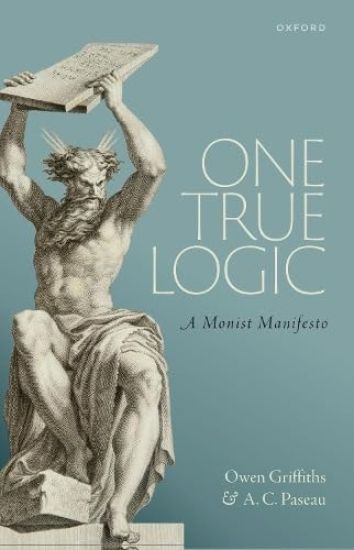
One True Logic is a major contribution to the philosophy of logic. It is the first monograph explicitly to articulate a version of logical monism, the view that there is a single correct foundational logic. Logical monism is opposed to logical pluralism, according to which there are many correct logics. One True Logic provides a critical overview of the monism vs pluralism debate and argues for the former. It defends a particular monism, based on a highly infinitary logic. Breaking new ground on a number of fronts, it offers novel arguments for the genuine logicality of infinitary logic and unifies disparate discussions in the philosophical and logical literature.
The Euclidean Programme embodies a traditional sort of epistemological foundationalism, according to which knowledge – especially mathematical knowledge – is obtained by deduction from self-evident axioms or first principles. Epistemologists have examined foundationalism extensively, but neglected its historically dominant Euclidean form. By contrast, this book offers a detailed examination of Euclidean foundationalism, which, following Lakatos, the authors call the Euclidean Programme. The book rationally reconstructs the programme's key principles, showing it to be an epistemological interpretation of the axiomatic method. It then compares the reconstructed programme with select historical sources: Euclid's Elements, Aristotle's Posterior Analytics, Descartes's Discourse on Method, Pascal's On the Geometric Mind and a twentieth-century account of axiomatisation. The second half of the book philosophically assesses the programme, exploring whether various areas of contemporary mathematics conform to it. The book concludes by outlining a replacement for the Euclidean Programme.
The Euclidean Programme embodies a traditional sort of epistemological foundationalism, according to which knowledge – especially mathematical knowledge – is obtained by deduction from self-evident axioms or first principles. Epistemologists have examined foundationalism extensively, but neglected its historically dominant Euclidean form. By contrast, this book offers a detailed examination of Euclidean foundationalism, which, following Lakatos, the authors call the Euclidean Programme. The book rationally reconstructs the programme's key principles, showing it to be an epistemological interpretation of the axiomatic method. It then compares the reconstructed programme with select historical sources: Euclid's Elements, Aristotle's Posterior Analytics, Descartes's Discourse on Method, Pascal's On the Geometric Mind and a twentieth-century account of axiomatisation. The second half of the book philosophically assesses the programme, exploring whether various areas of contemporary mathematics conform to it. The book concludes by outlining a replacement for the Euclidean Programme.
Our best scientific theories explain a wide range of empirical phenomena, make accurate predictions, and are widely believed. Since many of these theories make ample use of mathematics, it is natural to see them as confirming its truth. Perhaps the use of mathematics in science even gives us reason to believe in the existence of abstract mathematical objects such as numbers and sets. These issues lie at the heart of the Indispensability Argument, to which this Element is devoted. The Element's first half traces the evolution of the Indispensability Argument from its origins in Quine and Putnam's works, taking in naturalism, confirmational holism, Field's program, and the use of idealisations in science along the way. Its second half examines the explanatory version of the Indispensability Argument, and focuses on several more recent versions of easy-road and hard-road fictionalism respectively.
Logical monism is the claim that there is a single correct logic, the 'one true logic' of our title. The view has evident appeal, as it reflects assumptions made in ordinary reasoning as well as in mathematics, the sciences, and the law. In all these spheres, we tend to believe that there are determinate facts about the validity of arguments. Despite its evident appeal, however, logical monism must meet two challenges. The first is the challenge from logical pluralism, according to which there is more than one correct logic. The second challenge is to determine which form of logical monism is the correct one. One True Logic is the first monograph to explicitly articulate a version of logical monism and defend it against the first challenge. It provides a critical overview of the monism vs pluralism debate and argues for the former. It also responds to the second challenge by defending a particular monism, based on a highly infinitary logic. It breaks new ground on a number of fronts and unifies disparate discussions in the philosophical and logical literature. In particular, it generalises the Tarski-Sher criterion of logicality, provides a novel defence of this generalisation, offers a clear new argument for the logicality of infinitary logic and replies to recent pluralist arguments.