

Kirjailija
A. Clutton-Brock
Kirjat ja teokset yhdessä paikassa: 33 kirjaa, julkaisuja vuosilta 2006-2026, suosituimpien joukossa More Essays on Religion. Vertaile teosten hintoja ja tarkista saatavuus suomalaisista kirjakaupoista.
Mukana myös kirjoitusasut: A Clutton-Brock, A. Clutton Brock
33 kirjaa
Kirjojen julkaisuhaarukka 2006-2026.


Bell'S Cathedrals; The Cathedral Church Of York; A Description Of Its Fabric And A Brief History Of The Archi-Episcopal See
A Clutton-Brock
ALPHA EDITION
2021
pokkari
This book has been considered important throughout the human history, and so that this work is never forgotten we have made efforts in its preservation by republishing this book in a modern format for present and future generations. This whole book has been reformatted, retyped and designed. These books are not made of scanned copies of their original work and hence the text is clear and readable.
Reproduction of the original: Essays on Art by A. Clutton-Brock
Reproduction of the original: The Cathedral Church of York by A. Clutton-Brock
Reproduction of the original: The Cathedral Church of York by A. Clutton-Brock
Reproduction of the original: Essays on Art by A. Clutton-Brock

Shakespeare's “Hamlet” bound with The Problem of Hamlet
A. Clutton-Brock; J. M. Robertson
Routledge
2015
nidottu
This volume combines two classic works on Hamlet, first published in 1919 and 1922. The first book's original description says that it contains a theory which attempts to explain an everlasting problem - it insists that Hamlet is neither a failure not an accident, but a very great work of art. In a final chapter, the play is examined as an aesthetic document. It is a profoundly interesting and not unprovocative work. The second book reviews and attempts to resolve the most interesting debate of any Shakespeare play and presents proper method for investigating the genesis of the plays in this way.
First published in 1909, with a second edition in 1923, this concise and easily accessible overview of Shelley’s life and work presents the poet not as popular legend would have it, but in a more objective light. A.Clutton-Brock notes his forthright and imperious attitude to life – a life in which Shelley found himself increasingly unhappy – and critically examines many facets of his artistic career which are often overlooked or misrepresented.
This collection of brief but insightful essays, though always returning to the author’s central conviction that the quality of artistic endeavour depends not on individuals of genius but on the attitude of the public towards art itself, examines a wide variety of unique but related issues: the relationship between natural and artistic beauty; the genius of Da Vinci and Nicholas Poussin; the influence of femininity on European art; the importance of good criticism; art as a social phenomenon; the role of the passions; and a range of associated topics.First published in 1919, A. Clutton-Brock’s reflections on the nature and function of art bear the marks of the deep anxieties following the First World War, and can thus speak to a generation similarly faced with uncertainty.
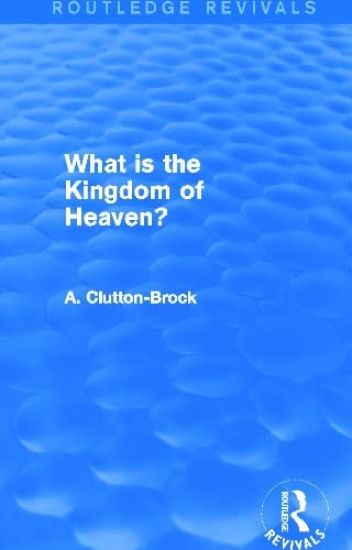
Written as the First World War was finally drawing to a close, A. Clutton-Brock’s reflections on the Kingdom of Heaven examine this challenging theological concept in light of the great religious, political and moral uncertainties thrown up by the conflict. In particular, Clutton-Brock contends that historically Christian orthodoxy has not sufficiently emphasised the role of the Kingdom in salvation, given its importance in the ministry and teaching of Christ. To preserve a religious vision capable of interacting with the modern, industrial world, Christian orthodoxy must carefully consider the scope and importance of political practice, the role of the individual in the realisation of the Kingdom, and the profound implications of reconciling the facts of the universe with the most sincerely held beliefs.

The Cathedral Church of York: A Description of Its Fabric and a Brief History of the Archi-Episcopal See
A. Clutton-Brock
Createspace Independent Publishing Platform
2014
nidottu