Kirjojen hintavertailu. Mukana 12 390 323 kirjaa ja 12 kauppaa.

Kirjailija

A. D. Cousins

Kirjat ja teokset yhdessä paikassa: 12 kirjaa, julkaisuja vuosilta 1999-2026, suosituimpien joukossa The Donna Angelica and the British Enlightenment Poets. Vertaile teosten hintoja ja tarkista saatavuus suomalaisista kirjakaupoista.

Mukana myös kirjoitusasut: A.D. Cousins

12 kirjaa

Kirjojen julkaisuhaarukka 1999-2026.

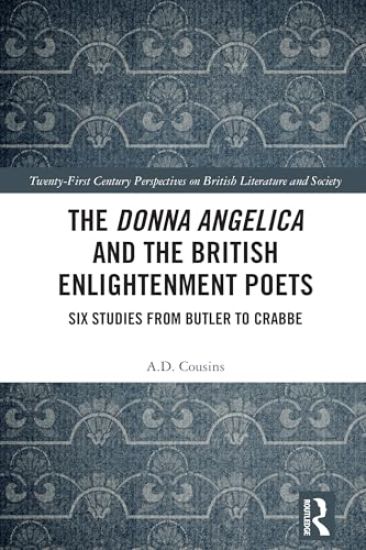
The Donna Angelica and the British Enlightenment Poets
The aim of the book is to propose new interpretations of poets who are among the most valued and discussed in the British Enlightenment. In fulfilling its aim, the book covers English poetry—and intellectual history—from the Restoration to the later eighteenth century. It examines how the myth of the donna angelica (the angelic lady), ancient in origin but given its best-known form within the medieval literature of fin’amor, lives on beyond the Middle Ages and the Renaissance into the Enlightenment. To be more precise, it studies how some major Augustan poets appropriate and recreate what, for convenience, can be called the donna angelica topos (or, the angelic lady motif). They do so for a great many reasons linked with quite diverse circumstances. Nevertheless, the myth’s intellectual richness, emotional intensity, and inherent ambiguities mean that it offers each of them a powerful way for articulating, interpreting, exploring refractions of eros—whether singly or diversely directed, concerned with sexuality or spirituality, informing personal or public experience. The myth has as many faces, so to speak, as does desire; it is one and yet many. Thus, the book pursues a particular fable of eros that appears in a multiplicity of texts in a multiplicity of guises. It studies how some of the most interesting poets from Dryden to Crabbe bring the angelic lady motif into modernity.
The Donna Angelica and the British Enlightenment Poets
The aim of the book is to propose new interpretations of poets who are among the most valued and discussed in the British Enlightenment. In fulfilling its aim, the book covers English poetry—and intellectual history—from the Restoration to the later eighteenth century. It examines how the myth of the donna angelica (the angelic lady), ancient in origin but given its best-known form within the medieval literature of fin’amor, lives on beyond the Middle Ages and the Renaissance into the Enlightenment. To be more precise, it studies how some major Augustan poets appropriate and recreate what, for convenience, can be called the donna angelica topos (or, the angelic lady motif). They do so for a great many reasons linked with quite diverse circumstances. Nevertheless, the myth’s intellectual richness, emotional intensity, and inherent ambiguities mean that it offers each of them a powerful way for articulating, interpreting, exploring refractions of eros—whether singly or diversely directed, concerned with sexuality or spirituality, informing personal or public experience. The myth has as many faces, so to speak, as does desire; it is one and yet many. Thus, the book pursues a particular fable of eros that appears in a multiplicity of texts in a multiplicity of guises. It studies how some of the most interesting poets from Dryden to Crabbe bring the angelic lady motif into modernity.
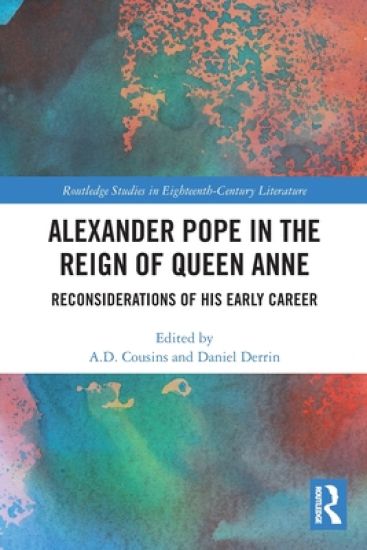
Alexander Pope in The Reign of Queen Anne

Alexander Pope in The Reign of Queen Anne

A. D. Cousins; Daniel Derrin

TAYLOR FRANCIS LTD
2023
nidottu
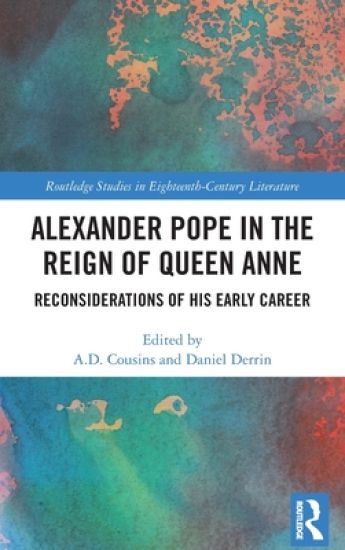
This is the first collection of essays since George Sherburn’s landmark monograph The Early Career of Alexander Pope (1934) to reconsider how the most important and influential poet of eighteenth-century Britain fashioned his early career. The volume covers Pope’s writings from across the reign of Queen Anne and just beyond. It focuses, in particular, on his interaction with the courtly culture constellated round the Queen. It examines, for instance, his representations of Queen Anne herself, his portrayals of politics and patronage under her reign, his negotiations with current literary theory, with the classical tradition, with chronologically distant yet also contemporaneous English poets, with current thought on the passions, and with membership of a religious minority. In doing so, it comprehensively reconsiders anew the ways in which Pope, increasingly supportive of Anne’s rule and mindful of the Virgilian rota, sought at first to realise his authorial aspirations.
Alexander Pope in The Reign of Queen Anne

Alexander Pope in The Reign of Queen Anne

A. D. Cousins; Daniel Derrin

Routledge
2020
sidottu
This is the first collection of essays since George Sherburn’s landmark monograph The Early Career of Alexander Pope (1934) to reconsider how the most important and influential poet of eighteenth-century Britain fashioned his early career. The volume covers Pope’s writings from across the reign of Queen Anne and just beyond. It focuses, in particular, on his interaction with the courtly culture constellated round the Queen. It examines, for instance, his representations of Queen Anne herself, his portrayals of politics and patronage under her reign, his negotiations with current literary theory, with the classical tradition, with chronologically distant yet also contemporaneous English poets, with current thought on the passions, and with membership of a religious minority. In doing so, it comprehensively reconsiders anew the ways in which Pope, increasingly supportive of Anne’s rule and mindful of the Virgilian rota, sought at first to realise his authorial aspirations.
Mythologies of Internal Exile in Elizabethan Verse
Writers of the English Renaissance, like their European contemporaries, frequently reflect on the phenomenon of exile—an experience that forces the individual to establish a new personal identity in an alien environment. Although there has been much commentary on this phenomenon as represented in English Renaissance literature, there has been nothing written at length about its counterpart, namely, internal exile: marginalization, or estrangement, within the homeland. This volume considers internal exile as a simultaneously twofold experience. It studies estrangement from one’s society and, correlatively, from one’s normative sense of self. In doing so, it focuses initially on the sonnet sequences by Sidney, Spenser, and Shakespeare (which is to say, the problematics of romance); then it examines the verse satires of Donne, Hall, and Marston (likewise, the problematics of anti-romance). This book argues that the authors of these major texts create mythologies—via the myths of (and accumulated mythographies about) Cupid, satyrs, and Proteus—through which to reflect on the doubleness of exile within one’s own community. These mythologies, at times accompanied by theologies, of alienation suggest that internal exile is a fluid and complex experience demanding multifarious reinterpretation of the incongruously expatriate self. The monograph thus establishes a new framework for understanding texts at once diverse yet central to the Elizabethan literary achievement.
SHAKESPEARES SONNETSNARRATIVE POEMS

SHAKESPEARES SONNETSNARRATIVE POEMS

A. D. COUSINS

TAYLORFRANCIS
2019
nidottu
Alongside Spenser, Sidney and the early Donne, Shakespeare is the major poet of the 16th century, largely because of the status of his remarkable sequence of sonnets. Professor Cousins new book is the first comprehensive study of the Sonnets and narrative poems for over a decade. He focuses in particular on their exploration of self-knowledge, sexuality, and death, as well as on their ambiguous figuring of gender. Throughout he provides a comparative context,nbsplooking at the work of Shakespeares contemporaries. The relation between Shakespeares non-dramatic verse and his plays is also explored.
Andrew Marvell

Andrew Marvell

A. D. Cousins

Routledge
2019
nidottu
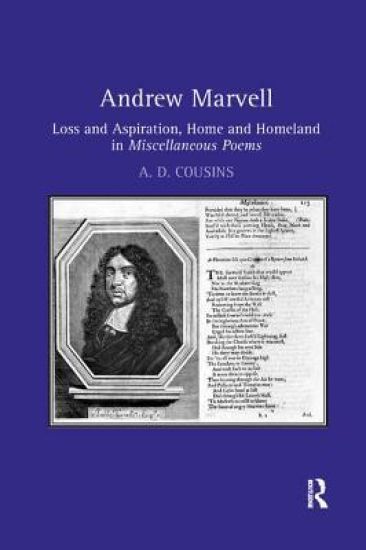
This monograph studies how, across the Folio of 1681, Marvell's poems engage not merely with different kinds of loss and aspiration, but with experiences of both that were, in mid-seventeenth-century England, disturbingly new and unfamiliar. It particularly examines Marvell's preoccupation with the search for home, and with redefining the homeland, in times of civil upheaval. In doing so it traces his progression from being a poet who plays sophisticatedly with received myth to being one who is a national mythmaker in rivalry with his poetic contemporaries such as Waller and Davenant. Although focusing primarily on poems in the Folio of 1681, this book considers those poems in relation to others from the Marvell canon, including the Latin poems and the satires from the reign of Charles II. It closely considers them as well in relation to verse by poets from the classical past and the European, especially English, present.
Mythologies of Internal Exile in Elizabethan Verse
Writers of the English Renaissance, like their European contemporaries, frequently reflect on the phenomenon of exile—an experience that forces the individual to establish a new personal identity in an alien environment. Although there has been much commentary on this phenomenon as represented in English Renaissance literature, there has been nothing written at length about its counterpart, namely, internal exile: marginalization, or estrangement, within the homeland. This volume considers internal exile as a simultaneously twofold experience. It studies estrangement from one’s society and, correlatively, from one’s normative sense of self. In doing so, it focuses initially on the sonnet sequences by Sidney, Spenser, and Shakespeare (which is to say, the problematics of romance); then it examines the verse satires of Donne, Hall, and Marston (likewise, the problematics of anti-romance). This book argues that the authors of these major texts create mythologies—via the myths of (and accumulated mythographies about) Cupid, satyrs, and Proteus—through which to reflect on the doubleness of exile within one’s own community. These mythologies, at times accompanied by theologies, of alienation suggest that internal exile is a fluid and complex experience demanding multifarious reinterpretation of the incongruously expatriate self. The monograph thus establishes a new framework for understanding texts at once diverse yet central to the Elizabethan literary achievement.
Shakespeare's Sonnets and Narrative Poems
Alongside Spenser, Sidney and the early Donne, Shakespeare is the major poet of the 16th century, largely because of the status of his remarkable sequence of sonnets. Professor Cousins' new book is the first comprehensive study of the Sonnets and narrative poems for over a decade. He focuses in particular on their exploration of self-knowledge, sexuality, and death, as well as on their ambiguous figuring of gender. Throughout he provides a comparative context, looking at the work of Shakespeare's contemporaries. The relation between Shakespeare's non-dramatic verse and his plays is also explored.
Andrew Marvell

Andrew Marvell

A. D. Cousins

Ashgate Publishing Limited
2016
sidottu
This monograph studies how, across the Folio of 1681, Marvell's poems engage not merely with different kinds of loss and aspiration, but with experiences of both that were, in mid-seventeenth-century England, disturbingly new and unfamiliar. It particularly examines Marvell's preoccupation with the search for home, and with redefining the homeland, in times of civil upheaval. In doing so it traces his progression from being a poet who plays sophisticatedly with received myth to being one who is a national mythmaker in rivalry with his poetic contemporaries such as Waller and Davenant. Although focusing primarily on poems in the Folio of 1681, this book considers those poems in relation to others from the Marvell canon, including the Latin poems and the satires from the reign of Charles II. It closely considers them as well in relation to verse by poets from the classical past and the European, especially English, present.
Pleasure and Gender in the Writings of Thomas More

Pleasure and Gender in the Writings of Thomas More

A. D. Cousins

Duquesne University Press
2010
sidottu
A prominent scholar of the life and work of Thomas More, A. D. Cousins goes beyond the scope of existing studies to focus primarily and closely on More's interpretations of the major cultural categories informing his view of the common weal, the common good, and correlatively on the (good) state. Thus, this study identifies categories that relate to the individual in civil life, categories that are pervasive and interconnected within More's nonpolemical writings most specifically, Cousins focuses on pleasure and gender, considering chance, friendship, and role-play throughout. Pleasure and Gender in the Writings of Thomas MoreExploring pleasure and gender in relation to issues of the common good and of the (good) state, More probes how people make sense of chance (and, alternatively, how they do not), how friendship works interpersonally and beyond national boundaries, and what roles people play (as well as to what roles they can aspire). As Cousins asserts, pursuing the common weal was for More both necessary and desirable, and he himself pursued this on behalf of his country, the republic of letters, and the Church Militant. argues that, from what appears to be his earliest nonpolemical work, Pageant Verses, until what we know to be his last, De Tristitia Christi, More sees the will to pleasure as central to the experience of being human: as a primary human impulse or, at the least, a compelling power within the human consciousness. In tracing how More examines the will to pleasure in our lives, Cousins also examines More's recurrent concern with gender's inflecting and expressing this desire. More clearly views gender as potentially restrictive or empowering in many respects, which is discussed in relation to several of More's texts. "
Shakespeare's Sonnets and Narrative Poems
Alongside Spenser, Sidney and the early Donne, Shakespeare is the major poet of the 16th century, largely because of the status of his remarkable sequence of sonnets. Professor Cousins' new book is the first comprehensive study of the Sonnets and narrative poems for over a decade. He focuses in particular on their exploration of self-knowledge, sexuality, and death, as well as on their ambiguous figuring of gender. Throughout he provides a comparative context, looking at the work of Shakespeare's contemporaries. The relation between Shakespeare's non-dramatic verse and his plays is also explored.