Kirjojen hintavertailu. Mukana 12 182 779 kirjaa ja 12 kauppaa.

Kirjailija

A P Chekhov

Kirjat ja teokset yhdessä paikassa: 9 kirjaa, julkaisuja vuosilta 1999-2022, suosituimpien joukossa The Lady with the Dog and Other Stories The Tales of Chekhov Vol. III. Vertaile teosten hintoja ja tarkista saatavuus suomalaisista kirjakaupoista.

Mukana myös kirjoitusasut: A. P. Chekhov, A.P. Chekhov

9 kirjaa

Kirjojen julkaisuhaarukka 1999-2022.

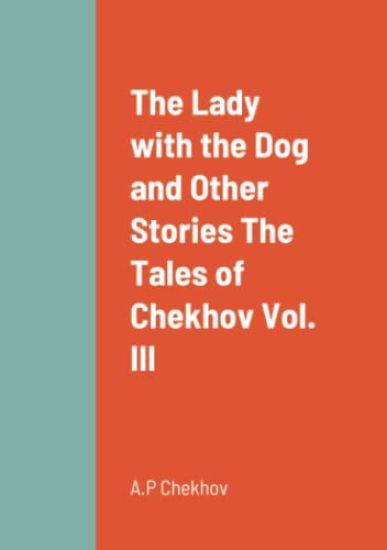
The Lady with the Dog and Other Stories The Tales of Chekhov Vol. III
The Lady with the Dog and Other Stories The Tales of Chekhov Vol. IIIGrisha, a fat, solemn little person of seven, was standing by the kitchen door listening and peeping through the keyhole. In the kitchen something extraordinary, and in his opinion never seen before, was taking place. A big, thick-set, red-haired peasant, with a beard, and a drop of perspiration on his nose, wearing a cabman's full coat, was sitting at the kitchen table on which they chopped the meat and sliced the onions. He was balancing a saucer on the five fingers of his right hand and drinking tea out of it, and crunching sugar so loudly that it sent a shiver down Grisha's back. Aksinya Stepanovna, the old nurse, was sitting on the dirty stool facing him, and she, too, was drinking tea. Her face was grave, though at the same time it beamed with a kind of triumph. Pelageya, the cook, was busy at the stove, and was apparently trying to hide her face. And on her face Grisha saw a regular illumination: it was burning and shifting through every shade of colour, beginning with a crimson purple and ending with a deathly white. She was continually catching hold of knives, forks, bits of wood, and rags with trembling hands, moving, grumbling to herself, making a clatter, but in reality doing nothing. She did not once glance at the table at which they were drinking tea, and to the questions put to her by the nurse she gave jerky, sullen answers without turning her face. "Help yourself, Danilo Semyonitch," the nurse urged him hospitably. "Why do you keep on with tea and nothing but tea? You should have a drop of vodka " And nurse put before the visitor a bottle of vodka and a wine-glass, while her face wore a very wily expression. "I never touch it.... No ..." said the cabman, declining. "Don't press me, Aksinya Stepanovna." "What a man ...A cabman and not drink ...A bachelor can't get on without drinking. Help yourself " The cabman looked askance at the bottle, then at nurse's wily face, and his own face assumed an expression no less cunning, as much as to say, "You won't catch me, you old witch " "I don't drink please excuse me. Such a weakness does not do in our calling. A man who works at a trade may drink, for he sits at home, but we cabmen are always in view of the public. Aren't we? If one goes into a pothouse one finds one's horse gone if one takes a drop too much it is worse still before you know where you are you will fall asleep or slip off the box. That's where it is."

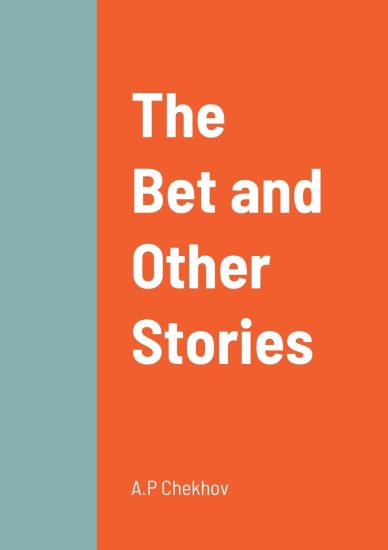
The Bet and Other Stories

The Bet and Other Stories

A P Chekhov

Lulu.com
2022
pokkari
The Bet and Other Stories By Anton Pavlovich ChekhovIt was a dark autumn night. The old banker was pacing from corner to corner of his study, recalling to his mind the party he gave in the autumn fifteen years ago. There were many clever people at the party and much interesting conversation. They talked among other things of capital punishment. The guests, among them not a few scholars and journalists, for the most part disapproved of capital punishment. They found it obsolete as a means of punishment, unfitted to a Christian State and immoral. Some of them thought that capital punishment should be replaced universally by lifeimprisonment. "I don't agree with you," said the host. "I myself have experienced neither capital punishment nor life-imprisonment, but if one may judge a priori, then in my opinion capital punishment is more moral and more humane than imprisonment. Execution kills instantly, life-imprisonment kills by degrees. Who is the more humane executioner, one who kills you in a few seconds or one who draws the life out of you incessantly, for years?" "They're both equally immoral," remarked one of the guests, "because their purpose is the same, to take away life. The State is not God. It has no right to take away that which it cannot give back, if it should so desire." Among the company was a lawyer, a young man of about twenty-five. On being asked his opinion, he said: "Capital punishment and life-imprisonment are equally immoral but if I were offered the choice between them, I would certainly choose the second. It's better to live somehow than not to live at all." There ensued a lively discussion. The banker who was then younger and more nervous suddenly lost his temper, banged his fist on the table, and turning to the young lawyer, cried out: "It's a lie. I bet you two millions you wouldn't stick in a cell even for five years." "If that's serious," replied the lawyer, "then I bet I'll stay not five but fifteen." "Fifteen Done " cried the banker. "Gentlemen, I stake two millions." "Agreed. You stake two millions, I my freedom," said the lawyer. So this wild, ridiculous bet came to pass. The banker, who at that time had too many millions to count, spoiled and capricious, was beside himself with rapture. During supper he said to the lawyer jokingly: "Come to your senses, young man, before it's too late. Two millions are nothing to me, but you stand to lose three or four of the best years of your life.
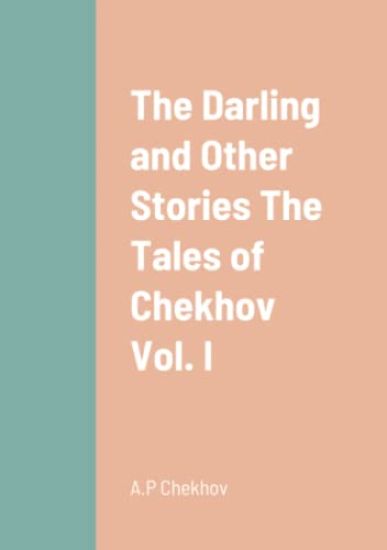
The Darling and Other Stories The Tales of Chekhov Vol. I
The Darling and Other Stories The Tales of Chekhov Vol.I By Anton Pavlovich ChekhovGrisha, a fat, solemn little person of seven, was standing by the kitchen door listening and peeping through the keyhole. In the kitchen something extraordinary, and in his opinion never seen before, was taking place. A big, thick-set, red-haired peasant, with a beard, and a drop of perspiration on his nose, wearing a cabman's full coat, was sitting at the kitchen table on which they chopped the meat and sliced the onions. He was balancing a saucer on the five fingers of his right hand and drinking tea out of it, and crunching sugar so loudly that it sent a shiver down Grisha's back. Aksinya Stepanovna, the old nurse, was sitting on the dirty stool facing him, and she, too, was drinking tea. She was continually catching hold of knives, forks, bits of wood, and rags with trembling hands, moving, grumbling to herself, making a clatter, but in reality doing nothing. She did not once glance at the table at which they were drinking tea, and to the questions put to her by the nurse she gave jerky, sullen answers without turning her face. "Help yourself, Danilo Semyonitch," the nurse urged him hospitably. "Why do you keep on with tea and nothing but tea? You should have a drop of vodka " And nurse put before the visitor a bottle of vodka and a wine-glass, while her face wore a very wily expression. "I never touch it.... No ..." said the cabman, declining. "Don't press me, Aksinya Stepanovna." "What a man ...A cabman and not drink ...A bachelor can't get on without drinking. Help yourself " The cabman looked askance at the bottle, then at nurse's wily face, and his own face assumed an expression no less cunning, as much as to say, "You won't catch me, you old witch " "I don't drink please excuse me. Such a weakness does not do in our calling. A man who works at a trade may drink, for he sits at home, but we cabmen are always in view of the public. Aren't we? If one goes into a pothouse one finds one's horse gone if one takes a drop too much it is worse still before you know where you are you will fall asleep or slip off the box. That's where it is." "And how much do you make a day, Danilo Semyonitch?" "That's according. Anton Chekhov (1860-1904) was a master of the short story. The son of a former serf in southern Russia, he attended Moscow University to study medicine, writing short stories for periodicals in order to support his family.
The Cook's Wedding and Other Stories The Tales of Chekhov Vol. VIII
The Cook's Wedding and Other Stories The Tales of Chekhov Vol. VIII By Anton Pavlovich ChekhovAnton Chekhov (1860-1904) was a master of the short story. The son of a former serf in southern Russia, he attended Moscow University to study medicine, writing short stories for periodicals in order to support his family. What began as a necessity became a legitimate career in 1886 when he was asked to write in St. Petersburg for the Novoye Vremya (New Times), owned by millionaire magnate Alexey Suvorin. Chekhov began paying more attention to his writing, revising and developing his own principles and conceptions of truth, for a time coming under the influence of Leo Tolstoy. As a result of his widespread popularity, Chekhov amassed a vast collection of short stories displaying an early use of stream-of-consciousness writing, as well as his powerful ideas concerning the individual, the tedium of life, and the beauty nature and humanity, among others "The Darling", "Ariadne", "Polinka", "Anyuta", "The Two Volodyas", "The Trousseau", "The Helpmate", "Talent", "An Artist's Story", and "Three Years".Grisha, a fat, solemn little person of seven, was standing by the kitchen door listening and peeping through the keyhole. In the kitchen something extraordinary, and in his opinion never seen before, was taking place. A big, thick-set, red-haired peasant, with a beard, and a drop of perspiration on his nose, wearing a cabman's full coat, was sitting at the kitchen table on which they chopped the meat and sliced the onions. He was balancing a saucer on the five fingers of his right hand and drinking tea out of it, and crunching sugar so loudly that it sent a shiver down Grisha's back. Aksinya Stepanovna, the old nurse, was sitting on the dirty stool facing him, and she, too, was drinking tea. Her face was grave, though at the same time it beamed with a kind of triumph. Pelageya, the cook, was busy at the stove, and was apparently trying to hide her face. And on her face Grisha saw a regular illumination: it was burning and shifting through every shade of colour, beginning with a crimson purple and ending with a deathly white. She was continually catching hold of knives, forks, bits of wood, and rags with trembling hands, moving, grumbling to herself, making a clatter, but in reality doing nothing. She did not once glance at the table at which they were drinking tea, and to the questions put to her by the nurse she gave jerky, sullen answers without turning her face.
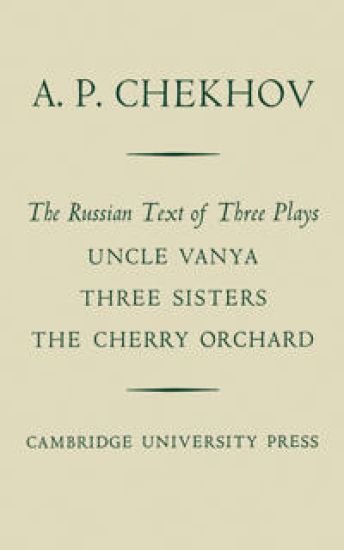
The Russian Text of Three Plays Uncle Vanya Three Sisters The Cherry Orchard
The plays of Chekhov are essential reading for anyone with an interest in Russian literature. In this volume, which was originally published in 1946, his three most important plays are reproduced by photo-offset from the Gosizdat Leningrad edition of 1935. Although the plays were available singly at the time, this was the only edition to contain the three Russian texts in one volume. It is a useful book for both libraries and students.
Uncle Vanya

Uncle Vanya

A. P. Chekhov

Dover Publications Inc.
2000
nidottu
First produced by the Moscow Art Theater in 1899, Uncle Vanya is one of Chekhov's greatest plays and a staple of the theatrical repertoire. Both structurally and psychologically compact, it is among the most expressive of the Russian playwright's dramatic works.Set on an estate in nineteenth-century Russia, this deeply emotional tale of misplaced idealism and unrequited love concerns the complex interrelationships between a retired professor, his second wife, and his brother-in-law and daughter from a previous marriage. In deceptively mundane dialogue, the characters reveal their private tragedies -- weakness and inability to communicate -- the failures that lead them to lives of frustration and despair. Nevertheless, Chekhov's delineation of human frailties elicits sympathy for even the most irresolute and deluded characters, and the play's underlying message is one of courage and hope.Essential reading for any course in modern theater, this absorbing play continues to be popular. Students, theatergoers, and all lovers of great drama will appreciate this inexpensive edition of a masterpiece.
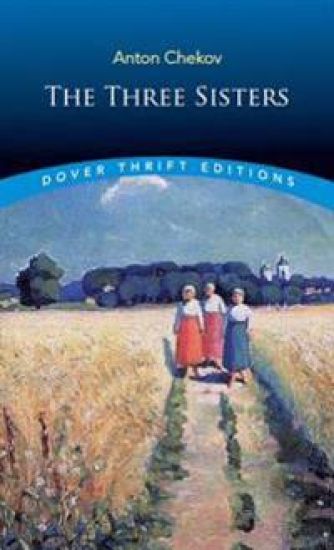
The Three Sisters

The Three Sisters

A. P. Chekhov

Dover Publications Inc.
2000
nidottu
First performed at the Moscow Art Theatre in 1901, The Three Sisters probes the lives and dreams of Olga, Masha, and Irina, former Muscovites now living in a provincial town from which they long to escape. Their hopes for a life more suited to their cultivated tastes and sensibilities provide a touching counterpoint to the relentless flow of compromising events in the real world.In this powerful play, a landmark of modern drama, Chekhov masterfully interweaves character and theme in subtle ways that make the work's climax seem as inevitable as it is deeply moving. It is reprinted here from a standard text with updated transliteration of character names and additional explanatory footnotes.
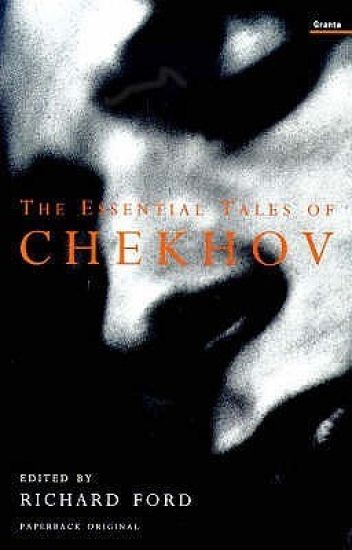
The Essential Tales Of Chekhov

The Essential Tales Of Chekhov

A.P. Chekhov

Granta Books
1999
nidottu
In this extraordinary collection of twenty tales, Richard Ford, a master short-story writer in his own right, has selected his personal favourites from among more than two hundred of Chekhov's tales and novellas. Included are the familiar masterpieces 'The Kiss', 'The Darling' and 'The Lady with the Dog' as well as several brilliant lesser-known tales such as 'A Blunder', 'Hush!' and 'Champagne'. These stories, written between 1886 and 1899, are drawn from Chekhov's most prolific years as a short-story writer. Introduced by Richard Ford's perceptive observations on 'Why We Like Chekhov', The Essential Tales of Chekhov is an indespensable anthology.