Kirjojen hintavertailu. Mukana 12 595 353 kirjaa ja 12 kauppaa.

Kirjailija

Aaron Doyle

Kirjat ja teokset yhdessä paikassa: 11 kirjaa, julkaisuja vuosilta 2003-2019, suosituimpien joukossa 57 Ways to Screw Up in Grad School. Vertaile teosten hintoja ja tarkista saatavuus suomalaisista kirjakaupoista.

11 kirjaa

Kirjojen julkaisuhaarukka 2003-2019.

Security and Risk Technologies in Criminal Justice

Security and Risk Technologies in Criminal Justice

Stacey Hannem; Carrie B. Sanders; Christopher J. Schneider; Aaron Doyle; Tony Christensen

Canadian Scholars
2019
nidottu
Security and Risk Technologies in Criminal Justice takes students through the evolution of risk technology devices, processes, and prevention. This seminal text unpacks technology’s influence on our understanding of governance and social order in areas of criminal justice, policing, and security. With a foreword by leading criminologist, Kevin Haggerty, the collection consists of three sections that explore the impact of big data, traditional risk practices, and the increased reliance on technology in criminal justice. Eight chapters offer diverse examples that are linked by themes of preventative justice, calculability of risk, the theatre and reality of technology, and the costs of justice. With both national and international appeal, this vital resource is ideal for undergraduate and graduate students in criminology, police studies, or sociology.
57 Ways to Screw Up in Grad School

57 Ways to Screw Up in Grad School

Kevin D. Haggerty; Aaron Doyle

University of Chicago Press
2015
nidottu
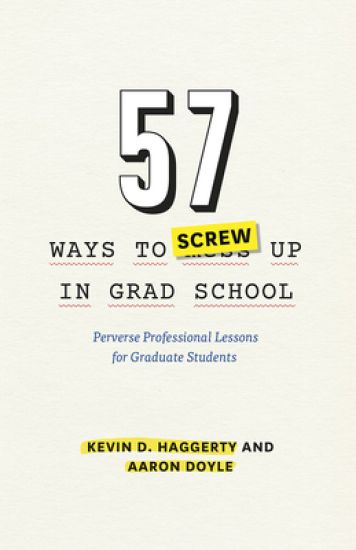
Don't think about why you're applying. Select a topic for entirely strategic reasons. Choose the coolest supervisor. Write only to deadlines. Expect people to hold your hand. Become "that" student. When it comes to a masters or PhD program, most graduate students don't deliberately set out to fail. Yet, of the nearly 500,000 people who start a graduate program each year, up to half will never complete their degree. Books abound on acing the admissions process, but there is little on what to do once the acceptance letter arrives. Veteran graduate directors Kevin D. Haggerty and Aaron Doyle have set out to demystify the world of advanced education. Taking a wry, frank approach, they explain the common mistakes that can trip up a new graduate student and lay out practical advice about how to avoid the pitfalls. Along the way they relate stories from their decades of mentorship and even share some slip-ups from their own grad experiences. The litany of foul-ups is organized by theme and covers the grad school experience from beginning to end: selecting the university and program, interacting with advisors and fellow students, balancing personal and scholarly lives, navigating a thesis, and creating a life after academia. Although the tone is engagingly tongue-in-cheek, the lessons are crucial to anyone attending or contemplating grad school. 57 Ways to Screw Up in Grad School allows you to learn from others' mistakes rather than making them yourself.
57 Ways to Screw Up in Grad School

57 Ways to Screw Up in Grad School

Kevin D. Haggerty; Aaron Doyle

University of Chicago Press
2015
sidottu
Don't think about why you're applying. Select a topic for entirely strategic reasons. Choose the coolest supervisor. Write only to deadlines. Expect people to hold your hand. Become "that" student. When it comes to a masters or PhD program, most graduate students don't deliberately set out to fail. Yet, of the nearly 500,000 people who start a graduate program each year, up to half will never complete their degree. Books abound on acing the admissions process, but there is little on what to do once the acceptance letter arrives. Veteran graduate directors Kevin D. Haggerty and Aaron Doyle have set out to demystify the world of advanced education. Taking a wry, frank approach, they explain the common mistakes that can trip up a new graduate student and lay out practical advice about how to avoid the pitfalls. Along the way they relate stories from their decades of mentorship and even share some slip-ups from their own grad experiences. The litany of foul-ups is organized by theme and covers the grad school experience from beginning to end: selecting the university and program, interacting with advisors and fellow students, balancing personal and scholarly lives, navigating a thesis, and creating a life after academia. Although the tone is engagingly tongue-in-cheek, the lessons are crucial to anyone attending or contemplating grad school. 57 Ways to Screw Up in Grad School allows you to learn from others' mistakes rather than making them yourself.
Crime, Institutional Knowledge and Power
Criminology lost a world leader with the untimely death of Richard Ericson in 2007. Ericson was one of the most prolific, influential and widely cited criminologists of his generation, producing monumental and pathbreaking works on how the criminal justice system and other key institutions attempt to control crime, manage risk and produce security. This volume, edited by three of Professor Ericson's colleagues and co-authors, presents a sampling of Ericson's acclaimed work on such topics as juvenile justice, policing, the courts, the media, the insurance industry, and national security. The book is required reading for scholars interested in understanding the dynamics of crime, risk and security and for those eager to learn more about one of the field's most important and innovative researchers and scholars.
Crime, Institutional Knowledge and Power

Crime, Institutional Knowledge and Power

Aaron Doyle

Ashgate Publishing Limited
2011
sidottu
Criminology lost a world leader with the untimely death of Richard Ericson in 2007. Ericson was one of the most prolific, influential and widely cited criminologists of his generation, producing monumental and pathbreaking works on how the criminal justice system and other key institutions attempt to control crime, manage risk and produce security. This volume, edited by three of Professor Ericson's colleagues and co-authors, presents a sampling of Ericson's acclaimed work on such topics as juvenile justice, policing, the courts, the media, the insurance industry, and national security. The book is required reading for scholars interested in understanding the dynamics of crime, risk and security and for those eager to learn more about one of the field's most important and innovative researchers and scholars.
Uncertain Business

Uncertain Business

Aaron Doyle; Richard V. Ericson

University of Toronto Press
2004
sidottu
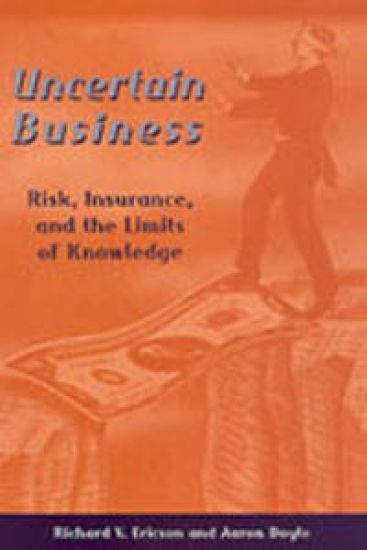
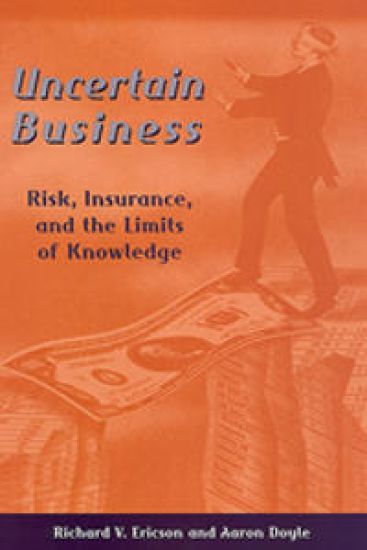
We live in an age of increasing doubt about whether our institutions and technologies can provide security against risks, many of which they themselves have created. Uncertain Business is an unprecedented inquiry into insurance industry practices and what they tell us about risks and uncertainties in contemporary society. The core of the book is ethnographic studies in distinct fields of insurance: premature death, disability, earthquake, and terrorism. These studies reveal that uncertainty pervades different fields of insurance, the very industry that is charged with transforming uncertainty into manageable risk. Scientific data on risk are variously absent, inadequate, controversial, contradictory, and ignored. Insurers impose meaning on uncertainty through non-scientific forms of knowledge that are intuitive, emotional, aesthetic, moral, and speculative. Nevertheless, the nature of uncertainty and the response to it varies substantially across the fields studied, showing how contemporary society is characterized by competing risk logics. Insurers' perceptions and decisions about uncertainty - with potential for windfall profits as well as catastrophic losses - create crises in insurance availability and provoke new forms of inequality and exclusion. Hence, while the insurance industry is a central bulwark against uncertainty, insurers also play a key role in fostering it.
Uncertain Business

Uncertain Business

Aaron Doyle; Richard V. Ericson

University of Toronto Press
2004
pokkari
We live in an age of increasing doubt about whether our institutions and technologies can provide security against risks, many of which they themselves have created. Uncertain Business is an unprecedented inquiry into insurance industry practices and what they tell us about risks and uncertainties in contemporary society. The core of the book is ethnographic studies in distinct fields of insurance: premature death, disability, earthquake, and terrorism. These studies reveal that uncertainty pervades different fields of insurance, the very industry that is charged with transforming uncertainty into manageable risk. Scientific data on risk are variously absent, inadequate, controversial, contradictory, and ignored. Insurers impose meaning on uncertainty through non-scientific forms of knowledge that are intuitive, emotional, aesthetic, moral, and speculative. Nevertheless, the nature of uncertainty and the response to it varies substantially across the fields studied, showing how contemporary society is characterized by competing risk logics. Insurers' perceptions and decisions about uncertainty - with potential for windfall profits as well as catastrophic losses - create crises in insurance availability and provoke new forms of inequality and exclusion. Hence, while the insurance industry is a central bulwark against uncertainty, insurers also play a key role in fostering it.
Arresting Images

Arresting Images

Aaron Doyle

University of Toronto Press
2004
pokkari
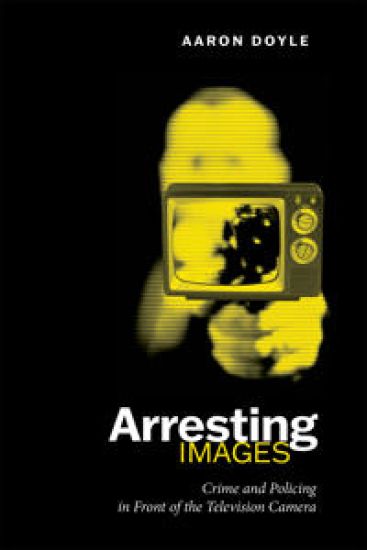
While most research on television examines its impact on viewers, Arresting Images asks instead how TV influences what is in front of the camera, and how it reshapes other institutions as it broadcasts their activities. Aaron Doyle develops his argument with four studies of televised crime and policing: the popular American 'reality-TV' series Cops; the televising of surveillance footage and home video of crime and policing; footage of Vancouver's Stanley Cup riot; and the publicity-grabbing demonstrations of the environmental group Greenpeace. Each of these studies is of significant interest in its own right, but Doyle also uses them to make a broader argument rethinking television's impacts. The four studies show how televised activities tend to become more institutionally important, tightly managed, dramatic, simplified and fitted to society's dominant values. Powerful institutions, like the police, harness television for their own legitimation and surveillance purposes, often dictating which situations are televised, and usually producing 'authorized definitions' of the situations, which allow them to control the consequences. While these institutions invoke the notion that "seeing is believing" to reinforce their positions of dominance, the book argues that many observers and researchers have long overstated and misunderstood the role of TV's visual component in shaping its influences.
Arresting Images

Arresting Images

Aaron Doyle

University of Toronto Press
2003
sidottu
While most research on television examines its impact on viewers, Arresting Images asks instead how TV influences what is in front of the camera, and how it reshapes other institutions as it broadcasts their activities. Aaron Doyle develops his argument with four studies of televised crime and policing: the popular American 'reality-TV' series Cops; the televising of surveillance footage and home video of crime and policing; footage of Vancouver's Stanley Cup riot; and the publicity-grabbing demonstrations of the environmental group Greenpeace. Each of these studies is of significant interest in its own right, but Doyle also uses them to make a broader argument rethinking television's impacts. The four studies show how televised activities tend to become more institutionally important, tightly managed, dramatic, simplified and fitted to society's dominant values. Powerful institutions, like the police, harness television for their own legitimation and surveillance purposes, often dictating which situations are televised, and usually producing 'authorized definitions' of the situations, which allow them to control the consequences. While these institutions invoke the notion that "seeing is believing" to reinforce their positions of dominance, the book argues that many observers and researchers have long overstated and misunderstood the role of TV's visual component in shaping its influences.
Insurance As Governance

Insurance As Governance

Dean Barry; Aaron Doyle; Richard V. Ericson

University of Toronto Press
2003
sidottu
Insurance as Governance is the first major sociological study of the insurance industry. It examines how the industry controls our institutions and daily lives in ways that are largely invisible, and how it thereby functions as a form of government beyond the state. Drawing on extensive ethnographic research on industry practices, the work penetrates the complexities of the insurance industry and demonstrates why it is such a powerful and pervasive institution. The authors advance the concept of moral risk as they consider how insurance companies partner with governments and corporations in the negotiation of economic policy. In effect, Insurance as Governance documents liberal theory at work. It offers a major case study of liberal governance beyond the state and explores such larger issues as how insurance is increasingly liberal rather than welfarist in orientation, and how insurance is the vanguard of liberalization in governance throughout postindustrial societies. Wide-ranging in scope and original in approach, the text provides a sophisticated integration of empirical data and theoretical approaches relating to insurance, risk, governance, and security.
Insurance As Governance

Insurance As Governance

Dean Barry; Aaron Doyle; Richard V. Ericson

University of Toronto Press
2003
pokkari
Insurance as Governance is the first major sociological study of the insurance industry. It examines how the industry controls our institutions and daily lives in ways that are largely invisible, and how it thereby functions as a form of government beyond the state. Drawing on extensive ethnographic research on industry practices, the work penetrates the complexities of the insurance industry and demonstrates why it is such a powerful and pervasive institution. The authors advance the concept of moral risk as they consider how insurance companies partner with governments and corporations in the negotiation of economic policy. In effect, Insurance as Governance documents liberal theory at work. It offers a major case study of liberal governance beyond the state and explores such larger issues as how insurance is increasingly liberal rather than welfarist in orientation, and how insurance is the vanguard of liberalization in governance throughout postindustrial societies. Wide-ranging in scope and original in approach, the text provides a sophisticated integration of empirical data and theoretical approaches relating to insurance, risk, governance, and security.