Kirjojen hintavertailu. Mukana 12 595 353 kirjaa ja 12 kauppaa.

Kirjailija

AbdouMaliq Simone

Kirjat ja teokset yhdessä paikassa: 13 kirjaa, julkaisuja vuosilta 2004-2022, suosituimpien joukossa The Surrounds. Vertaile teosten hintoja ja tarkista saatavuus suomalaisista kirjakaupoista.

13 kirjaa

Kirjojen julkaisuhaarukka 2004-2022.

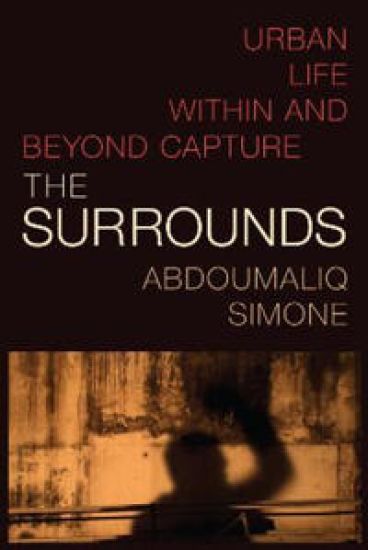
The Surrounds

The Surrounds

AbdouMaliq Simone

Duke University Press
2022
sidottu
In The Surrounds renowned urbanist AbdouMaliq Simone offers a new theorization of the interface of the urban and the political. Working at the intersection of Black studies, urban theory, and decolonial and Islamic thought, Simone centers the surrounds-those urban spaces beyond control and capture that exist as a locus of rebellion and invention. He shows that even in clearly defined city environments, whether industrial, carceral, administrative, or domestic, residents use spaces for purposes they were not designed for: schools become housing, markets turn into classrooms, tax offices transform into repair shops. The surrounds, Simone contends, are where nothing fits according to design. They are where forgotten and marginalized populations invent new relations and ways of living and being, continuously reshaping what individuals and collectives can do. Focusing less on what new worlds may come to be and more on what people are creating now, Simone shows how the surrounds are an integral part of the expansiveness of urban imagination.
The Surrounds

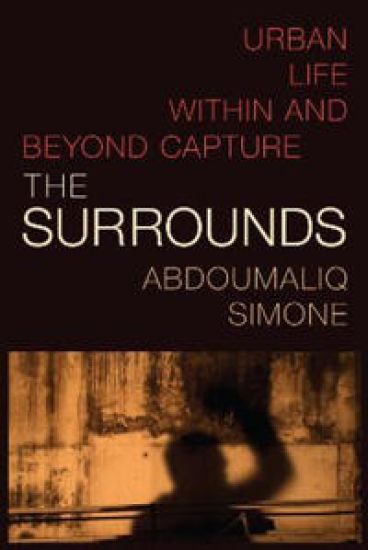
The Surrounds

AbdouMaliq Simone

Duke University Press
2022
pokkari
In The Surrounds renowned urbanist AbdouMaliq Simone offers a new theorization of the interface of the urban and the political. Working at the intersection of Black studies, urban theory, and decolonial and Islamic thought, Simone centers the surrounds-those urban spaces beyond control and capture that exist as a locus of rebellion and invention. He shows that even in clearly defined city environments, whether industrial, carceral, administrative, or domestic, residents use spaces for purposes they were not designed for: schools become housing, markets turn into classrooms, tax offices transform into repair shops. The surrounds, Simone contends, are where nothing fits according to design. They are where forgotten and marginalized populations invent new relations and ways of living and being, continuously reshaping what individuals and collectives can do. Focusing less on what new worlds may come to be and more on what people are creating now, Simone shows how the surrounds are an integral part of the expansiveness of urban imagination.
Improvised Lives

Improvised Lives

AbdouMaliq Simone

Polity Press
2018
sidottu
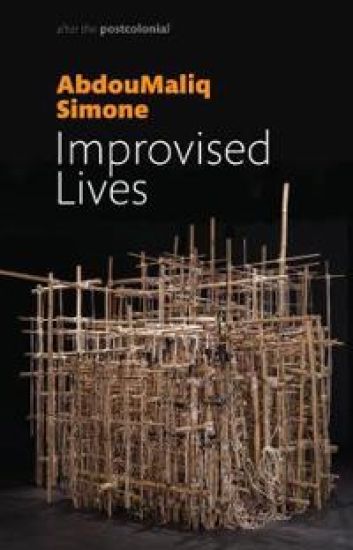
The poor and working people in cities of the South find themselves in urban spaces that are conventionally construed as places to reside or inhabit. But what if we thought of popular districts in more expansive ways that capture what really goes on within them? In such cities, popular districts are the settings of more uncertain operations that take place under the cover of darkness, generating uncanny alliances among disparate bodies, materials and things and expanding the urban sensorium and its capacities for liveliness. In this important new book AbdouMaliq Simone explores the nature of these alliances, portraying urban districts as sites of enduring transformations through rhythms that mediate between the needs of residents not to draw too much attention to themselves and their aspirations to become a small niche of exception. Here we discover an urban South that exists as dense rhythms of endurance that turn out to be vital for survival, connectivity, and becoming.
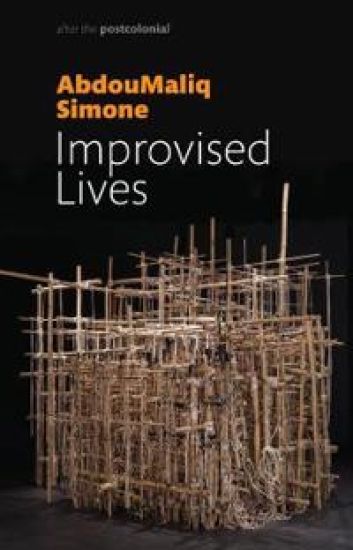
Improvised Lives

Improvised Lives

AbdouMaliq Simone

Polity Press
2018
nidottu
The poor and working people in cities of the South find themselves in urban spaces that are conventionally construed as places to reside or inhabit. But what if we thought of popular districts in more expansive ways that capture what really goes on within them? In such cities, popular districts are the settings of more uncertain operations that take place under the cover of darkness, generating uncanny alliances among disparate bodies, materials and things and expanding the urban sensorium and its capacities for liveliness. In this important new book AbdouMaliq Simone explores the nature of these alliances, portraying urban districts as sites of enduring transformations through rhythms that mediate between the needs of residents not to draw too much attention to themselves and their aspirations to become a small niche of exception. Here we discover an urban South that exists as dense rhythms of endurance that turn out to be vital for survival, connectivity, and becoming.
New Urban Worlds

New Urban Worlds

AbdouMaliq Simone; Edgar Pieterse

Polity Press
2017
sidottu
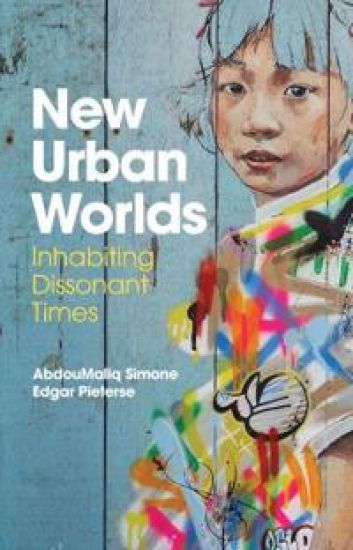
It is well known that the world is transitioning to an irrevocable urban future whose epicentre has moved into the cities of Asia and Africa. What is less clear is how this will be managed and deployed as a multi-polar world system is being born. The full implications of this challenge cry out to be understood because city building (and retrofitting) cannot but be an undertaking entangled in profound societal and cultural shifts. In this highly original account, renowned urban sociologists AbdouMaliq Simone and Edgar Pieterse offer a call for action based fundamentally on the detail of people's lives. Urban regions are replete with residents who are compelled to come up with innovative ways to maintain or extend livelihoods, whose makeshift character is rarely institutionalized into a fixed set of practices, locales or organizational forms. This novel analytical approach reveals a more complex relationship between people, the state and other agents than has previously been understood. As the authors argue, we need adequate concepts and practices to grasp the composition and intricacy of these shifting efforts to make visible new political possibilities for action and social justice in cities across Asia and Africa.
New Urban Worlds

New Urban Worlds

AbdouMaliq Simone; Edgar Pieterse

Polity Press
2017
nidottu
It is well known that the world is transitioning to an irrevocable urban future whose epicentre has moved into the cities of Asia and Africa. What is less clear is how this will be managed and deployed as a multi-polar world system is being born. The full implications of this challenge cry out to be understood because city building (and retrofitting) cannot but be an undertaking entangled in profound societal and cultural shifts. In this highly original account, renowned urban sociologists AbdouMaliq Simone and Edgar Pieterse offer a call for action based fundamentally on the detail of people's lives. Urban regions are replete with residents who are compelled to come up with innovative ways to maintain or extend livelihoods, whose makeshift character is rarely institutionalized into a fixed set of practices, locales or organizational forms. This novel analytical approach reveals a more complex relationship between people, the state and other agents than has previously been understood. As the authors argue, we need adequate concepts and practices to grasp the composition and intricacy of these shifting efforts to make visible new political possibilities for action and social justice in cities across Asia and Africa.
Jakarta, Drawing the City Near

Jakarta, Drawing the City Near

AbdouMaliq Simone

University of Minnesota Press
2014
nidottu
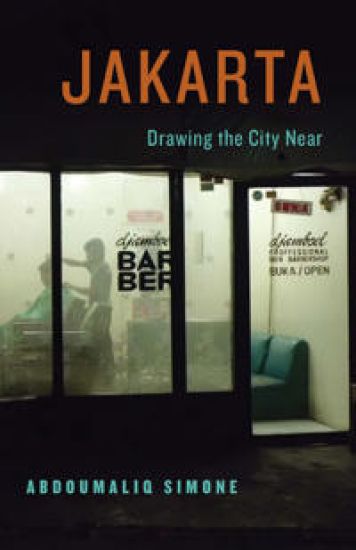
Jakarta, a city rife with disparities like many cities in the Global South, is undergoing rapid change. Alongside its megastructures, high-rise residential buildings, and franchised convenience stores, Jakarta’s massive slums and off-hour street markets foster an unsettled urban population surviving in difficult conditions. But where does the vast middle of urban life fit into this dichotomy? In Jakarta, Drawing the City Near, AbdouMaliq Simone examines how people who the largest part of the population, such as the craftsmen, shopkeepers, and public servants, navigate and affect positive developments. In a city where people of diverse occupations operate in close proximity to each other, appearance can be very deceptive. Set in a place that on the surface seems remarkably dysfunctional, Simone guides readers through urban spaces and encounters, detailing households, institutions, markets, mosques, and schools. Over five years he engaged with residents from three different districts, and now he parses out the practices, politics, and economies that form present-day Jakarta while revealing how those who face uncertainty manage to improve their lives.Simone illustrates how the majority of Jakarta’s population, caught between intense wealth and utter poverty, handle confluence and contradictions in their everyday lives. By exploring how inhabitants from different backgrounds regard each other, how they work together or keep their distance in order to make the city in which they reside endure, Jakarta, Drawing the City Near offers a powerful new way of thinking about urban life.
City Life from Jakarta to Dakar

City Life from Jakarta to Dakar

AbdouMaliq Simone

Routledge
2009
sidottu
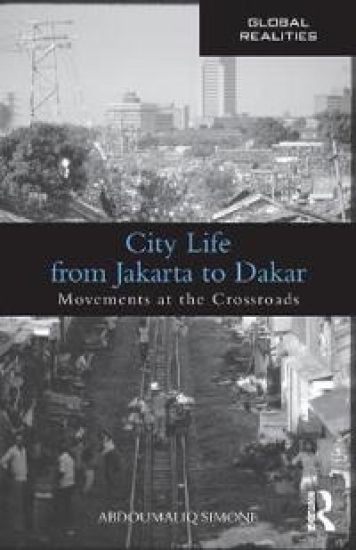
City Life from Jakarta to Dakar focuses on the politics incumbent to this process – an "anticipatory politics" – that encompasses a wide range of practices, calculations and economies. As such, the book is not a collection of case studies on a specific theme, not a review of developmental problems, nor does it marshal the focal cities as evidence of particular urban trends. Rather, it examines how possibilities, perhaps inherent in these cities all along, are materialized through the everyday projects of residents situated in the city and the larger world in very different ways.
City Life from Jakarta to Dakar

City Life from Jakarta to Dakar

AbdouMaliq Simone

Routledge
2009
nidottu
City Life from Jakarta to Dakar focuses on the politics incumbent to this process – an "anticipatory politics" – that encompasses a wide range of practices, calculations and economies. As such, the book is not a collection of case studies on a specific theme, not a review of developmental problems, nor does it marshal the focal cities as evidence of particular urban trends. Rather, it examines how possibilities, perhaps inherent in these cities all along, are materialized through the everyday projects of residents situated in the city and the larger world in very different ways.
For the City Yet to Come

For the City Yet to Come

AbdouMaliq Simone

Duke University Press
2004
pokkari
Among government officials, urban planners, and development workers, Africa’s burgeoning metropolises are frequently understood as failed cities, unable to provide even basic services. Whatever resourcefulness does exist is regarded as only temporary compensation for fundamental failure. In For the City Yet to Come, AbdouMaliq Simone argues that by overlooking all that does work in Africa’s cities, this perspective forecloses opportunities to capitalize on existing informal economies and structures in development efforts within Africa and to apply lessons drawn from them to rapidly growing urban areas around the world. Simone contends that Africa’s cities do work on some level and to the extent that they do, they function largely through fluid, makeshift collective actions running parallel to proliferating decentralized local authorities, small-scale enterprises, and community associations.Drawing on his nearly fifteen years of work in African cities-as an activist, teacher, development worker, researcher, and advisor to ngos and local governments-Simone provides a series of case studies illuminating the provisional networks through which most of Africa’s urban dwellers procure basic goods and services. He examines informal economies and social networks in Pikine, a large suburb of Dakar, Senegal; in Winterveld, a neighborhood on the edge of Pretoria, South Africa; in Douala, Cameroon; and among Africans seeking work in Jeddah, Saudi Arabia. He contextualizes these particular cases through an analysis of the broad social, economic, and historical conditions that created present-day urban Africa. For the City Yet to Come is a powerful argument that any serious attempt to reinvent African urban centers must acknowledge the particular history of these cities and incorporate the local knowledge reflected in already existing informal urban economic and social systems.
For the City Yet to Come

For the City Yet to Come

AbdouMaliq Simone

Duke University Press
2004
sidottu
Among government officials, urban planners, and development workers, Africa’s burgeoning metropolises are frequently understood as failed cities, unable to provide even basic services. Whatever resourcefulness does exist is regarded as only temporary compensation for fundamental failure. In For the City Yet to Come, AbdouMaliq Simone argues that by overlooking all that does work in Africa’s cities, this perspective forecloses opportunities to capitalize on existing informal economies and structures in development efforts within Africa and to apply lessons drawn from them to rapidly growing urban areas around the world. Simone contends that Africa’s cities do work on some level and to the extent that they do, they function largely through fluid, makeshift collective actions running parallel to proliferating decentralized local authorities, small-scale enterprises, and community associations.Drawing on his nearly fifteen years of work in African cities-as an activist, teacher, development worker, researcher, and advisor to ngos and local governments-Simone provides a series of case studies illuminating the provisional networks through which most of Africa’s urban dwellers procure basic goods and services. He examines informal economies and social networks in Pikine, a large suburb of Dakar, Senegal; in Winterveld, a neighborhood on the edge of Pretoria, South Africa; in Douala, Cameroon; and among Africans seeking work in Jeddah, Saudi Arabia. He contextualizes these particular cases through an analysis of the broad social, economic, and historical conditions that created present-day urban Africa. For the City Yet to Come is a powerful argument that any serious attempt to reinvent African urban centers must acknowledge the particular history of these cities and incorporate the local knowledge reflected in already existing informal urban economic and social systems.