Kirjojen hintavertailu. Mukana 12 657 676 kirjaa ja 12 kauppaa.

Kirjailija

Abhinav Karan

Kirjat ja teokset yhdessä paikassa: 2 kirjaa, julkaisuja vuosilta 2020-2021, suosituimpien joukossa Welding and Cutting Case Studies with Supervised Machine Learning. Vertaile teosten hintoja ja tarkista saatavuus suomalaisista kirjakaupoista.

2 kirjaa

Kirjojen julkaisuhaarukka 2020-2021.

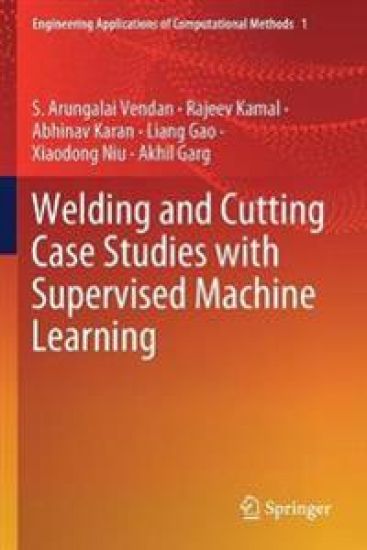
Welding and Cutting Case Studies with Supervised Machine Learning

Welding and Cutting Case Studies with Supervised Machine Learning

S. Arungalai Vendan; Rajeev Kamal; Abhinav Karan; Liang Gao; Xiaodong Niu; Akhil Garg

SPRINGER VERLAG, SINGAPORE
2021
nidottu
This book presents machine learning as a set of pre-requisites, co-requisites, and post-requisites, focusing on mathematical concepts and engineering applications in advanced welding and cutting processes. It describes a number of advanced welding and cutting processes and then assesses the parametrical interdependencies of two entities, namely the data analysis and data visualization techniques, which form the core of machine learning. Subsequently, it discusses supervised learning, highlighting Python libraries such as NumPy, Pandas and Scikit Learn programming. It also includes case studies that employ machine learning for manufacturing processes in the engineering domain. The book not only provides beginners with an introduction to machine learning for applied sciences, enabling them to address global competitiveness and work on real-time technical challenges, it is also a valuable resource for scholars with domain knowledge.
Welding and Cutting Case Studies with Supervised Machine Learning

Welding and Cutting Case Studies with Supervised Machine Learning

S. Arungalai Vendan; Rajeev Kamal; Abhinav Karan; Liang Gao; Xiaodong Niu; Akhil Garg

Springer Verlag, Singapore
2020
sidottu
This book presents machine learning as a set of pre-requisites, co-requisites, and post-requisites, focusing on mathematical concepts and engineering applications in advanced welding and cutting processes. It describes a number of advanced welding and cutting processes and then assesses the parametrical interdependencies of two entities, namely the data analysis and data visualization techniques, which form the core of machine learning. Subsequently, it discusses supervised learning, highlighting Python libraries such as NumPy, Pandas and Scikit Learn programming. It also includes case studies that employ machine learning for manufacturing processes in the engineering domain. The book not only provides beginners with an introduction to machine learning for applied sciences, enabling them to address global competitiveness and work on real-time technical challenges, it is also a valuable resource for scholars with domain knowledge.