Kirjojen hintavertailu. Mukana 12 595 353 kirjaa ja 12 kauppaa.

Kirjailija

Abraham Kandel

Kirjat ja teokset yhdessä paikassa: 16 kirjaa, julkaisuja vuosilta 1992-2019, suosituimpien joukossa Compensatory Genetic Fuzzy Neural Networks And Their Applications. Vertaile teosten hintoja ja tarkista saatavuus suomalaisista kirjakaupoista.

16 kirjaa

Kirjojen julkaisuhaarukka 1992-2019.

Fuzzy and Neuro-Fuzzy Systems in Medicine

Fuzzy and Neuro-Fuzzy Systems in Medicine

Horia-Nicolai L Teodorescu; Abraham Kandel; Lakhmi C. Jain

CRC Press
2019
nidottu
Fuzzy and Neuro-Fuzzy Systems in Medicineprovides a thorough review of state-of-the-art techniques and practices, defines and explains relevant problems, as well as provides solutions to these problems. After an introduction, the book progresses from one topic to another - with a linear development from fundamentals to applications.

Engineering Risk and Hazard Assessment
The volumes deal with the newly emerging field ofRisk and Hazard Assessment and its application to science and engineering. These volumes deal with issues such as short-and long-term hazards, setting priorities in safety, fault analysis for process plants, hazard identification and safety assessment of human- robot systems, plant fault diagnoses expert systems, knowledge based diagnostic systems, fault tree analysis, modelling of computer security systems for risk and reliability analysis, risk analysis of fatigue failure, fault evaluation of complex system, probabilistic risk analysis, and expert systems for fault detection. This volume will provide the reader not only with valuable conceptual and technical information but also with a better view of the field, its problems, accomplishments, and future potentials
Engineering Risk and Hazard Assessment
The volumes deal with the newly emerging field ofRisk and Hazard Assessment and its application to science and engineering. These volumes deal with issues such as short-and long-term hazards, setting priorities in safety, fault analysis for process plants, hazard identification and safety assessment of human- robot systems, plant fault diagnoses expert systems, knowledge based diagnostic systems, fault tree analysis, modelling of computer security systems for risk and reliability analysis, risk analysis of fatigue failure, fault evaluation of complex system, probabilistic risk analysis, and expert systems for fault detection. This volume will provide the reader not only with valuable conceptual and technical information but also with a better view of the field, its problems, accomplishments, and future potentials
Fuzzy and Neuro-Fuzzy Systems in Medicine

Fuzzy and Neuro-Fuzzy Systems in Medicine

Horia-Nicolai L Teodorescu; Abraham Kandel; Lakhmi C. Jain

CRC Press
2017
sidottu
Fuzzy and Neuro-Fuzzy Systems in Medicineprovides a thorough review of state-of-the-art techniques and practices, defines and explains relevant problems, as well as provides solutions to these problems. After an introduction, the book progresses from one topic to another - with a linear development from fundamentals to applications.

Calculus Light

Calculus Light

Menahem Friedman; Abraham Kandel

Springer-Verlag Berlin and Heidelberg GmbH Co. K
2014
nidottu
Another Calculus book? As long as students find calculus scary, the failure rate in mathematics is higher than in all other subjects, and as long as most people mistakenly believe that only geniuses can learn and understand mathematics, there will always be room for a new book of Calculus. We call it Calculus Light.This book is designed for a one semester course in "light" calculus – mostly single variable, meant to be used by undergraduate students without a wide mathematical background and who do not major in mathematics but study subjects such as engineering, biology or management information systems. The first chapter contains a historical background of calculus. Every scientific achievement involves people and therefore characterized by victories and disappointments, intrigues and hope. All of these elements exist in the story behind calculus and when you add the time dimension, starting 2400 years ago, it is a saga. We hope the reader enjoys reading this chapter as much as we enjoyed the writing.In addition to classic calculus the book provides tools for practical applications such as Fourier series, Lagrange multipliers and elementary numerical methods.
Calculus Light

Calculus Light

Menahem Friedman; Abraham Kandel

Springer-Verlag Berlin and Heidelberg GmbH Co. K
2011
sidottu
Another Calculus book? As long as students find calculus scary, the failure rate in mathematics is higher than in all other subjects, and as long as most people mistakenly believe that only geniuses can learn and understand mathematics, there will always be room for a new book of Calculus. We call it Calculus Light.This book is designed for a one semester course in "light" calculus – mostly single variable, meant to be used by undergraduate students without a wide mathematical background and who do not major in mathematics but study subjects such as engineering, biology or management information systems. The first chapter contains a historical background of calculus. Every scientific achievement involves people and therefore characterized by victories and disappointments, intrigues and hope. All of these elements exist in the story behind calculus and when you add the time dimension, starting 2400 years ago, it is a saga. We hope the reader enjoys reading this chapter as much as we enjoyed the writing.In addition to classic calculus the book provides tools for practical applications such as Fourier series, Lagrange multipliers and elementary numerical methods.
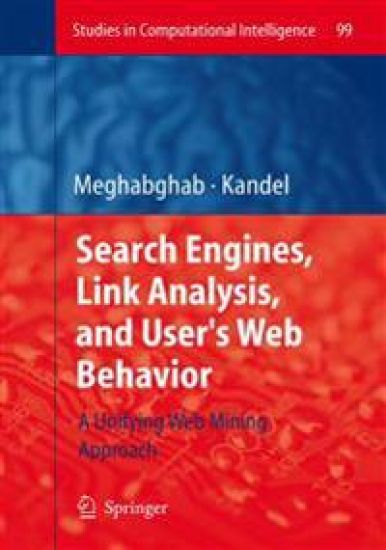
Search Engines, Link Analysis, and User's Web Behavior

Search Engines, Link Analysis, and User's Web Behavior

George Meghabghab; Abraham Kandel

Springer-Verlag Berlin and Heidelberg GmbH Co. K
2010
nidottu
WEB MINING Link Analysis Search Engines User’s Web Behavior HITS Algorithm Fuzzy Cognitive Map Radial Basis Function PageRank Algorithm Interior Point Method Fuzzy Bags Rgeression Models Rough Sets Information Theory Thisbookpresentsaspeci?cand uni?ed approach framework to three- jor components: Search Engines Performance, Link Analysis, and User’s Web Behavior. TheexplosivegrowthandthewidespreadaccessibilityoftheWWW has led to a surge of research activity in the area of information retrieval on VI Preface the WWW. The three aspects of web mining follow the taxonomy of the above diagram: Link Analysis, Search engines, and User’s web behavior are considered in the unifying approach. The book is organized in three sections as follows: 1. In section I of the book (chapters 2–4) we study Link Analysis within the hubs and authorities framework. Link Analysis is the science of hyperlink structures ranking, which are used to determine the relative authority of a Web page and produce improved algorithms for the ranking of Web search results. We use the HITS Algorithm developed by Kleinberg and we propose to study HITS in a 2-D new space: In-degree and Out Degree variables. After we categorize each web page into a speci?c toplogy we study the impact of each web topology on HITS in the new 2-D space. We describe why HITS does not fare well in almost all the di?erent topologies of web graphs. We also describe the PageRank Algorithm in this new 2-D space.
Automated Database Applications Testing: Specification Representation For Automated Reasoning

Automated Database Applications Testing: Specification Representation For Automated Reasoning

Rana Farid Mikhail; Donald J Berndt; Abraham Kandel

World Scientific Publishing Co Pte Ltd
2010
sidottu
This book introduces SpecDB, an intelligent database created to represent and host software specifications in a machine-readable format, based on the principles of artificial intelligence and unit testing database operations. SpecDB is demonstrated via two automated intelligent tools. The first automatically generates database constraints from a rule-base in SpecDB. The second is a reverse engineering tool that logs the actual execution of the program from the code.
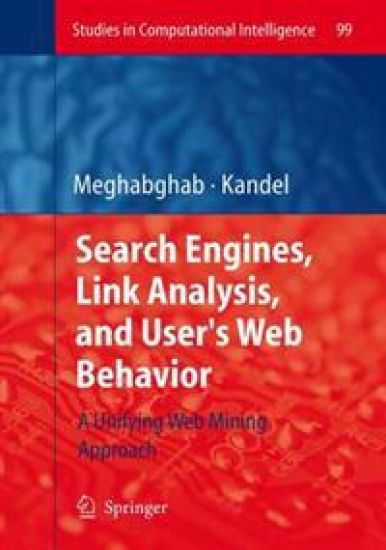
Search Engines, Link Analysis, and User's Web Behavior

Search Engines, Link Analysis, and User's Web Behavior

George Meghabghab; Abraham Kandel

Springer-Verlag Berlin and Heidelberg GmbH Co. K
2008
sidottu
WEB MINING Link Analysis Search Engines User’s Web Behavior HITS Algorithm Fuzzy Cognitive Map Radial Basis Function PageRank Algorithm Interior Point Method Fuzzy Bags Rgeression Models Rough Sets Information Theory Thisbookpresentsaspeci?cand uni?ed approach framework to three- jor components: Search Engines Performance, Link Analysis, and User’s Web Behavior. TheexplosivegrowthandthewidespreadaccessibilityoftheWWW has led to a surge of research activity in the area of information retrieval on VI Preface the WWW. The three aspects of web mining follow the taxonomy of the above diagram: Link Analysis, Search engines, and User’s web behavior are considered in the unifying approach. The book is organized in three sections as follows: 1. In section I of the book (chapters 2–4) we study Link Analysis within the hubs and authorities framework. Link Analysis is the science of hyperlink structures ranking, which are used to determine the relative authority of a Web page and produce improved algorithms for the ranking of Web search results. We use the HITS Algorithm developed by Kleinberg and we propose to study HITS in a 2-D new space: In-degree and Out Degree variables. After we categorize each web page into a speci?c toplogy we study the impact of each web topology on HITS in the new 2-D space. We describe why HITS does not fare well in almost all the di?erent topologies of web graphs. We also describe the PageRank Algorithm in this new 2-D space.
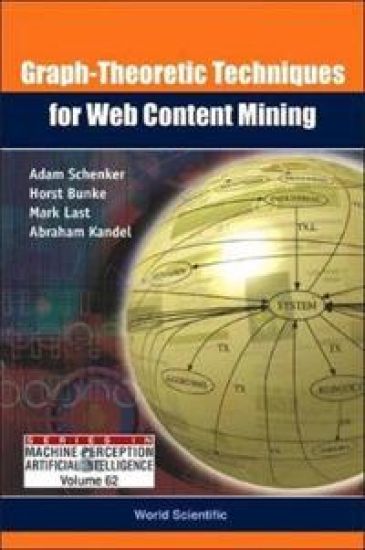
Graph-theoretic Techniques For Web Content Mining

Graph-theoretic Techniques For Web Content Mining

Adam Schenker; Horst Bunke; Mark Last; Abraham Kandel

World Scientific Publishing Co Pte Ltd
2005
sidottu
This book describes exciting new opportunities for utilizing robust graph representations of data with common machine learning algorithms. Graphs can model additional information which is often not present in commonly used data representations, such as vectors. Through the use of graph distance — a relatively new approach for determining graph similarity — the authors show how well-known algorithms, such as k-means clustering and k-nearest neighbors classification, can be easily extended to work with graphs instead of vectors. This allows for the utilization of additional information found in graph representations, while at the same time employing well-known, proven algorithms.To demonstrate and investigate these novel techniques, the authors have selected the domain of web content mining, which involves the clustering and classification of web documents based on their textual substance. Several methods of representing web document content by graphs are introduced; an interesting feature of these representations is that they allow for a polynomial time distance computation, something which is typically an NP-complete problem when using graphs. Experimental results are reported for both clustering and classification in three web document collections using a variety of graph representations, distance measures, and algorithm parameters.In addition, this book describes several other related topics, many of which provide excellent starting points for researchers and students interested in exploring this new area of machine learning further. These topics include creating graph-based multiple classifier ensembles through random node selection and visualization of graph-based data using multidimensional scaling.
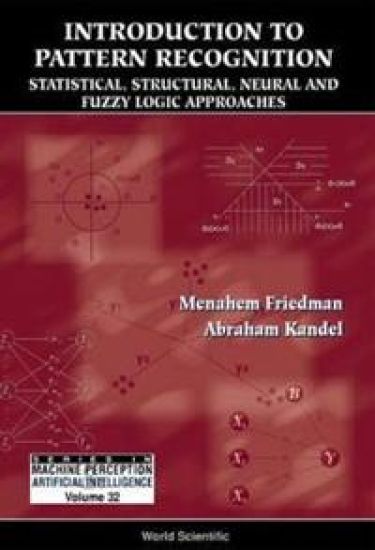
Introduction To Pattern Recognition: Statistical, Structural, Neural And Fuzzy Logic Approaches

Introduction To Pattern Recognition: Statistical, Structural, Neural And Fuzzy Logic Approaches

Menahem Friedman; Abraham Kandel

World Scientific Publishing Co Pte Ltd
1999
sidottu
This book is an introduction to pattern recognition, meant for undergraduate and graduate students in computer science and related fields in science and technology. Most of the topics are accompanied by detailed algorithms and real world applications. In addition to statistical and structural approaches, novel topics such as fuzzy pattern recognition and pattern recognition via neural networks are also reviewed. Each topic is followed by several examples solved in detail. The only prerequisites for using this book are a one-semester course in discrete mathematics and a knowledge of the basic preliminaries of calculus, linear algebra and probability theory.
Foundations Of Digital Logic Design

Foundations Of Digital Logic Design

Abraham Kandel; Gideon Langholz; Joe L Mott

World Scientific Publishing Co Pte Ltd
1998
sidottu
This text is intended for a first course in digital logic design, at the sophomore or junior level, for electrical engineering, computer engineering and computer science programs, as well as for a number of other disciplines such as physics and mathematics. The book can also be used for self-study or for review by practicing engineers and computer scientists not intimately familiar with the subject. After completing this text, the student should be prepared for a second (advanced) course in digital design, switching and automata theory, microprocessors or computer organization.
Compensatory Genetic Fuzzy Neural Networks And Their Applications

Compensatory Genetic Fuzzy Neural Networks And Their Applications

Abraham Kandel; Yan-qing Zhang

World Scientific Publishing Co Pte Ltd
1998
sidottu
This book presents a powerful hybrid intelligent system based on fuzzy logic, neural networks, genetic algorithms and related intelligent techniques. The new compensatory genetic fuzzy neural networks have been widely used in fuzzy control, nonlinear system modeling, compression of a fuzzy rule base, expansion of a sparse fuzzy rule base, fuzzy knowledge discovery, time series prediction, fuzzy games and pattern recognition. This effective soft computing system is able to perform both linguistic-word-level fuzzy reasoning and numerical-data-level information processing. The book also proposes various novel soft computing techniques.
Fuzzy Expert System Tools

Fuzzy Expert System Tools

Moti Schneider; Gideon Langholz; Abraham Kandel; Gerard Chew

John Wiley Sons Inc
1996
sidottu
Fuzzy set theory is a mathematical structure for representing uncertainty. Modern intelligent systems must combine knowledge based on techniques for gathering and processing information with methods of approximate reasoning. This enables an intelligent system to better emulate human decision-making in uncertain environments. Complimentary to the text is a software package containing executable FEST code. The text contains a detailed description of FEST and its coherent and systematic exploitation.
Verification and Validation of Rule-Based Expert Systems

Verification and Validation of Rule-Based Expert Systems

Suzanne Smith; Abraham Kandel

CRC Press Inc
1993
sidottu
This book presents an innovative approach to verifying and validating rule-based expert systems. It features a complete set of techniques and tools that provide a more formal, objective, and automated means of carrying out verification and validation procedures. Many of the concepts behind these procedures have been adapted from conventional software, while others have required that new techniques or tools be created because of the uniqueness of rule-based expert systems. Verification and Validation of Rule-Based Expert Systems is a valuable reference for electrical engineers, software engineers, artificial intelligence experts, and computer scientists involved with object-oriented development, expert systems, and programming languages.
Hybrid Architectures for Intelligent Systems

Hybrid Architectures for Intelligent Systems

Abraham Kandel; Gideon Langholz

CRC Press Inc
1992
sidottu
Hybrid architecture for intelligent systems is a new field of artificial intelligence concerned with the development of the next generation of intelligent systems. This volume is the first book to delineate current research interests in hybrid architectures for intelligent systems. The book is divided into two parts. The first part is devoted to the theory, methodologies, and algorithms of intelligent hybrid systems. The second part examines current applications of intelligent hybrid systems in areas such as data analysis, pattern classification and recognition, intelligent robot control, medical diagnosis, architecture, wastewater treatment, and flexible manufacturing systems. Hybrid Architectures for Intelligent Systems is an important reference for computer scientists and electrical engineers involved with artificial intelligence, neural networks, parallel processing, robotics, and systems architecture.