Kirjojen hintavertailu. Mukana 12 595 353 kirjaa ja 12 kauppaa.

Kirjailija

Adalbert Kerber

Kirjat ja teokset yhdessä paikassa: 8 kirjaa, julkaisuja vuosilta 1984-2014, suosituimpien joukossa Error-Correcting Linear Codes. Vertaile teosten hintoja ja tarkista saatavuus suomalaisista kirjakaupoista.

8 kirjaa

Kirjojen julkaisuhaarukka 1984-2014.

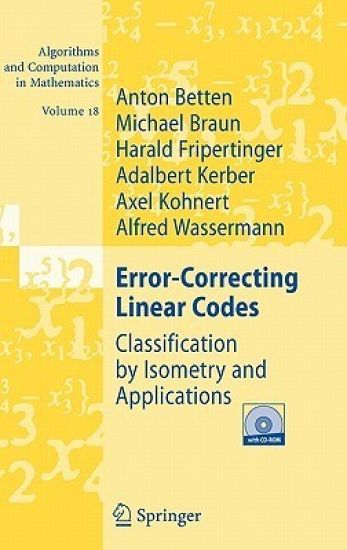
Error-Correcting Linear Codes

Error-Correcting Linear Codes

Anton Betten; Michael Braun; Harald Fripertinger; Adalbert Kerber; Axel Kohnert; Alfred Wassermann

Springer-Verlag Berlin and Heidelberg GmbH Co. K
2014
nidottu
The fascinating theory of error-correcting codes is a rather new addition to the list of mathematical disciplines. It grew out of the need to communicate information electronically, and is currently no more than 60 years old. - ing an applied discipline by de?nition, a surprisingly large number of pure mathematical areas tie into Coding Theory. If one were to name just the most important connections, one would start of course with Linear Algebra, then list Algebra and Combinatorics, and further mention Number Theory and - ometry as well as Algebraic Geometry. Being a thorough introduction to the ?eld, this book starts from the very beginning, which is the channel model of communication in the presence of noise. From there, we develop the fundamental concepts of error-correcting codes, like the Hamming metric and the maximum likelihood decoding pr- ciple. After discussing dual codes and simple decoding procedures, this book takes an unusual turn. The standard approach would be to move on from there and introduce either more theory or present standard constructions of codes. The approach taken here is different.
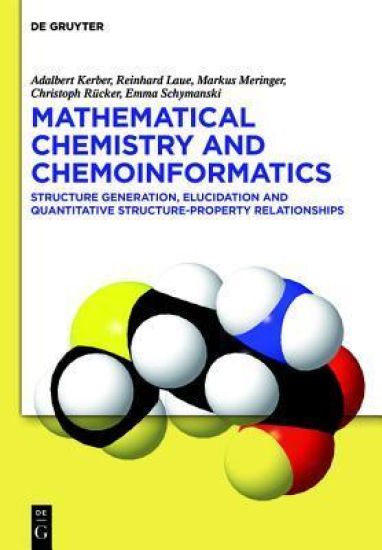
Mathematical Chemistry and Chemoinformatics

Mathematical Chemistry and Chemoinformatics

Adalbert Kerber; Reinhard Laue; Markus Meringer; Christoph Rücker; Emma Schymanski

De Gruyter
2013
sidottu
More than 20 years of experience in molecular structure generation, from conceptualization through to applications Innovative, interdisciplinary text demonstrating example queries with software packages such as MOLGEN-online Detailed explanations on establishing QSPRs and QSARs as well as structure elucidation using mass spectrometry and structure generation. Aims and Scope This work provides an introduction to mathematical modeling of molecules and the resulting applications (structure generation, structure elucidation, QSAR/QSPR etc.). Most chemists have experimented with some software that represents molecules in an electronic form, and such models and applications are of increasing interest in diverse and growing fields such as drug discovery, environmental science and metabolomics. Furthermore, structure generation remains the only way to systematically create molecules that are not (yet) present in a database. This book starts with the mathematical theory behind representing molecules, explaining chemical concepts in mathematical terms and providing exercises that can be completed online. The later chapters cover applications of the theory, with detailed explanations on QSPR and QSAR investigations and finally structure elucidation combining mass spectrometry and structure generation. This book is aimed in particular at the users of structure generation methods and corresponding techniques, but also for those interested in teaching and learning mathematical chemistry, and for software designers in chemoinformatics.
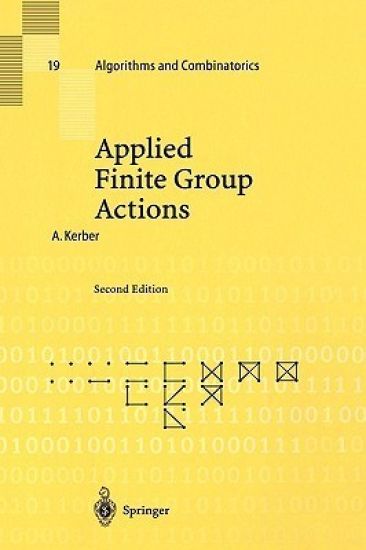
Applied Finite Group Actions

Applied Finite Group Actions

Adalbert Kerber

Springer-Verlag Berlin and Heidelberg GmbH Co. K
2010
nidottu
Also the present second edition of this book is an introduction to the theory of clas­ sification, enumeration, construction and generation of finite unlabeled structures in mathematics and sciences. Since the publication of the first edition in 1991 the constructive theory of un­ labeled finite structures has made remarkable progress. For example, the first- designs with moderate parameters were constructed, in Bayreuth, by the end of 1994 ([9]). The crucial steps were - the prescription of a suitable group of automorphisms, i. e. a stabilizer, and the corresponding use of Kramer-Mesner matrices, together with - an implementation of an improved version of the LLL-algorithm that allowed to find 0-1-solutions of a system of linear equations with the Kramer-Mesner matrix as its matrix of coefficients. of matrices of the The Kramer-Mesner matrices can be considered as submatrices form A" (see the chapter on group actions on posets, semigroups and lattices). They are associated with the action of the prescribed group G which is a permutation group on a set X of points induced on the power set of X. Hence the discovery of the first 7-designs with small parameters is due to an application of finite group actions. This method used by A. Betten, R. Laue, A. Wassermann and the present author is described in a section that was added to the manuscript of the first edi­ tion.
The Cauchy Problem

The Cauchy Problem

Hector O. Fattorini; Adalbert Kerber

Cambridge University Press
2009
pokkari
This volume deals with the Cauchy or initial value problem for linear differential equations. It treats in detail some of the applications of linear space methods to partial differential equations, especially the equations of mathematical physics such as the Maxwell, Schrödinger and Dirac equations. Background material presented in the first chapter makes the book accessible to mathematicians and physicists who are not specialists in this area as well as to graduate students.
Error-Correcting Linear Codes

Error-Correcting Linear Codes

Anton Betten; Michael Braun; Harald Fripertinger; Adalbert Kerber; Axel Kohnert; Alfred Wassermann

Springer-Verlag Berlin and Heidelberg GmbH Co. K
2006
sidottu
The fascinating theory of error-correcting codes is a rather new addition to the list of mathematical disciplines. It grew out of the need to communicate information electronically, and is currently no more than 60 years old. - ing an applied discipline by de?nition, a surprisingly large number of pure mathematical areas tie into Coding Theory. If one were to name just the most important connections, one would start of course with Linear Algebra, then list Algebra and Combinatorics, and further mention Number Theory and - ometry as well as Algebraic Geometry. Being a thorough introduction to the ?eld, this book starts from the very beginning, which is the channel model of communication in the presence of noise. From there, we develop the fundamental concepts of error-correcting codes, like the Hamming metric and the maximum likelihood decoding pr- ciple. After discussing dual codes and simple decoding procedures, this book takes an unusual turn. The standard approach would be to move on from there and introduce either more theory or present standard constructions of codes. The approach taken here is different.
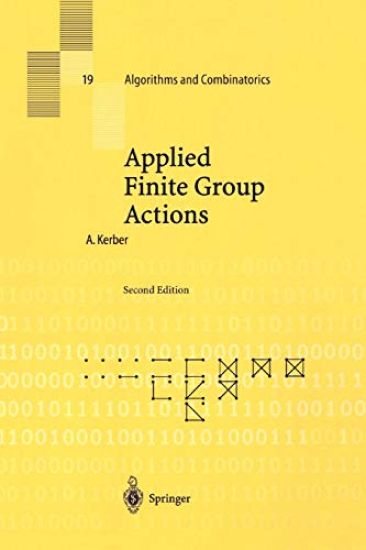
Applied Finite Group Actions

Applied Finite Group Actions

Adalbert Kerber

Springer-Verlag Berlin and Heidelberg GmbH Co. K
1999
sidottu
Also the present second edition of this book is an introduction to the theory of clas­ sification, enumeration, construction and generation of finite unlabeled structures in mathematics and sciences. Since the publication of the first edition in 1991 the constructive theory of un­ labeled finite structures has made remarkable progress. For example, the first- designs with moderate parameters were constructed, in Bayreuth, by the end of 1994 ([9]). The crucial steps were - the prescription of a suitable group of automorphisms, i. e. a stabilizer, and the corresponding use of Kramer-Mesner matrices, together with - an implementation of an improved version of the LLL-algorithm that allowed to find 0-1-solutions of a system of linear equations with the Kramer-Mesner matrix as its matrix of coefficients. of matrices of the The Kramer-Mesner matrices can be considered as submatrices form A" (see the chapter on group actions on posets, semigroups and lattices). They are associated with the action of the prescribed group G which is a permutation group on a set X of points induced on the power set of X. Hence the discovery of the first 7-designs with small parameters is due to an application of finite group actions. This method used by A. Betten, R. Laue, A. Wassermann and the present author is described in a section that was added to the manuscript of the first edi­ tion.
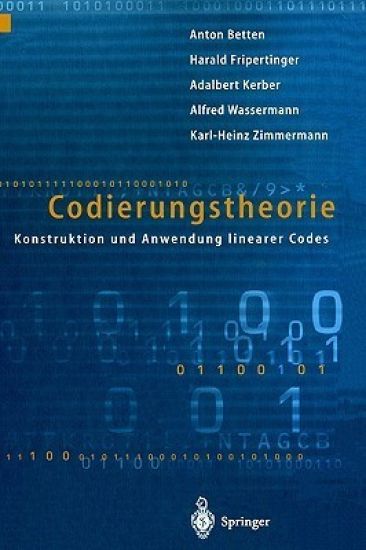
Codierungstheorie

Codierungstheorie

Anton Betten; Harald Fripertinger; Adalbert Kerber; Alfred Wassermann; Karl-Heinz Zimmermann

Springer-Verlag Berlin and Heidelberg GmbH Co. K
1998
sidottu
Eine Einführung in die Theorie der linearen Codes, in der zyklische Codes besonders ausführlich behandelt werden. Großer Wert wird auch auf computerunterstützte Methoden gelegt, insbesondere für die Bestimmung der Minimaldistanz linearer Codes, für die Abzählung der Isometrieklassen linearer Codes sowie Blockcodes und für die Erzeugung von Repräsentantensystemen dieser Klassen.Das Buch wendet sich an Studenten und Wissenschaftler der Informatik, Mathematik und Elektrotechnik sowie an Fachleute in der Praxis.
The Cauchy Problem

The Cauchy Problem

Hector O. Fattorini; Adalbert Kerber

Cambridge University Press
1984
sidottu
This volume deals with the Cauchy or initial value problem for linear differential equations. It treats in detail some of the applications of linear space methods to partial differential equations, especially the equations of mathematical physics such as the Maxwell, Schrödinger and Dirac equations. Background material presented in the first chapter makes the book accessible to mathematicians and physicists who are not specialists in this area as well as to graduate students.