

Kirjailija
Adam Przeworski
Kirjat ja teokset yhdessä paikassa: 12 kirjaa, julkaisuja vuosilta 1991-2020, suosituimpien joukossa Krisen der Demokratie. Vertaile teosten hintoja ja tarkista saatavuus suomalaisista kirjakaupoista.
12 kirjaa
Kirjojen julkaisuhaarukka 1991-2020.
Is democracy in crisis? The current threats to democracy are not just political: they are deeply embedded in the democracies of today, in current economic, social, and cultural conditions. In Crises of Democracy, Adam Przeworski presents a panorama of the political situation throughout the world of established democracies, places it in the context of past misadventures of democratic regimes, and speculates on the prospects. Our present state of knowledge does not support facile conclusions. 'We should not believe the flood of writings that have all the answers'. Avoiding technical aspects, this book is addressed not only to professional social scientists, but to everyone concerned about the prospects of democracy.
With the collapse of traditional parties around the world and with many pundits predicting a "crisis of democracy", the value of elections as a method for selecting by whom and how we are governed is being questioned. What are the virtues and weaknesses of elections? Are there limitations to what they can realistically achieve? In this deeply informed book world-renowned democratic theorist Adam Przeworski offers a warts-and-all analysis of elections and the ways in which they affect our lives. Elections, he argues, are inherently imperfect but they remain the least bad way of choosing our rulers. According to Przeworski, the greatest value of elections, by itself sufficient to cherish them, is that they process whatever conflicts may arise in society in a way that maintains relative liberty and peace. Whether they succeed in doing so in today's turbulent political climate remains to be seen.
With the collapse of traditional parties around the world and with many pundits predicting a "crisis of democracy", the value of elections as a method for selecting by whom and how we are governed is being questioned. What are the virtues and weaknesses of elections? Are there limitations to what they can realistically achieve? In this deeply informed book world-renowned democratic theorist Adam Przeworski offers a warts-and-all analysis of elections and the ways in which they affect our lives. Elections, he argues, are inherently imperfect but they remain the least bad way of choosing our rulers. According to Przeworski, the greatest value of elections, by itself sufficient to cherish them, is that they process whatever conflicts may arise in society in a way that maintains relative liberty and peace. Whether they succeed in doing so in today's turbulent political climate remains to be seen.
The political institutions under which we live today evolved from a revolutionary idea that shook the world in the second part of the eighteenth century: that a people should govern itself. Yet if we judge contemporary democracies by the ideals of self-government, equality and liberty, we find that democracy is not what it was dreamt to be. This book addresses central issues in democratic theory by analyzing the sources of widespread dissatisfaction with democracies around the world. With attention throughout to historical and cross-national variations, the focus is on the generic limits of democracy in promoting equality, effective participation, control of governments by citizens, and liberty. The conclusion is that although some of this dissatisfaction has good reasons, some is based on an erroneous understanding of how democracy functions. Hence, although the analysis identifies the limits of democracy, it also points to directions for feasible reforms.
Political economy is the study of decentralized and centralized mechanisms for allocating resources and distributing incomes: markets and states. Both markets and states can be organized and combined in a variety of ways and they jointly determine what the economy produces as well as who gets what. The purpose of this book is to introduce the reader to the concepts and tools for studying relations between states and markets. The focus is methodological. Both the economy and the state are analyzed as networks of relations between principals and agents, occupying particular places in the institutional structure. Having introduced the principal-agent framework, the book analyzes systematically the effect of the organization of the state on the functioning of the economy. The central question is under what conditions government will do what they should be doing and not do what they should not.
Democracy and Development
Adam Przeworski; Michael E. Alvarez; Jose Antonio Cheibub; Fernando Limongi
Cambridge University Press
2000
sidottu
Is economic development conducive to political democracy? Does democracy foster or hinder material welfare? These two questions are examined by looking at the experience of 135 countries between 1950 and 1990. Descriptive information, statistical analyses, and historical narratives are interwoven to gain an understanding of the dynamic of political regimes and their impact on economic development and other aspects of material welfare. The findings, several most surprising, dispel any notion of a trade-off between democracy and development. Economic development does not generate democracies but democracies are much more likely to survive in wealthy societies. Political regimes have no impact on the growth of total national incomes, while political instability affects growth only in dictatorships. Per capita incomes grow faster in democracies since population increases faster under dictatorships. In general, political regimes have more of an effect on demography than on economics.

Sustainable Democracy is a joint report of twenty-one social scientists, from eleven countries and four academic disciplines, who collaborated over the period of two years under the name of the Group on East-South Systems Transformations (ESST). Their report identifies the principal political and economic choices confronting new democracies in Southern and Eastern Europe and South America, while evaluating their merits and feasibility in the light of current social science knowledge. The scientists explore the social, political and economic conditions under which democracy is likely to generate desirable and politically desired objectives, as well as, whether it is likely to last. It is argued that the state has an essential role in promoting universal citizenship and in creating conditions for a sustained economic growth. Special emphasis is placed on the interdependence between political and economic reforms.

Sustainable Democracy is a joint report of twenty one social scientists, from eleven countries and four academic disciplines, who collaborated over the period of two years under the name of the Group on East-South Systems Transformations (ESST). Their report identifies the principal political and economic choices confronting new democracies in Southern and Eastern Europe and South America, while evaluating their merits and feasibility in the light of current social science knowledge. The scientists explore the social, political and economic conditions under which democracy is likely to generate desirable and politically desired objectives, as well as, whether it is likely to last. It is argued that the state has an essential role in promoting universal citizenship and in creating conditions for a sustained economic growth. Special emphasis is placed on the interdependence between political and economic reforms.
Economic Reforms in New Democracies
Luiz Carlos Bresser Pereira; José María Maravall; Adam Przeworski
Cambridge University Press
1993
pokkari
This book assesses differing experiences of the transition to democracy in the countries of Southern Europe, Latin America and Eastern Europe. The authors try to determine what the conditions for successful transitions are. They argue against the ‘big bang’ approach, espoused by many advisors to reforming countries, on the grounds that this approach bypasses the newly formed institutions of democracy and, ultimately, may undermine the necessary consensus to support painful economic reforms. The most successful reforms, they argue, have been those agreed upon through a process of democratic negotiation. A new democracy must offer politically important groups incentives to process their demands within the democratic institutional framework; otherwise, their support will be tenuous and the system may collapse under the strains incurred by painful economic reforms.
Economic Reforms in New Democracies
Luiz Carlos Bresser Pereira; José María Maravall; Adam Przeworski
Cambridge University Press
1993
sidottu
This 1993 book assesses differing experiences of the transition to democracy in the countries of Southern Europe, Latin America and Eastern Europe. The authors try to determine what the conditions for successful transitions are. They argue against the 'big bang' approach, espoused by many advisors to reforming countries, on the grounds that this approach bypasses the newly formed institutions of democracy and, ultimately, may undermine the necessary consensus to support painful economic reforms. The most successful reforms, they argue, have been those agreed upon through a process of democratic negotiation. A new democracy must offer politically important groups incentives to process their demands within the democratic institutional framework; otherwise, their support will be tenuous and the system may collapse under the strains incurred by painful economic reforms.
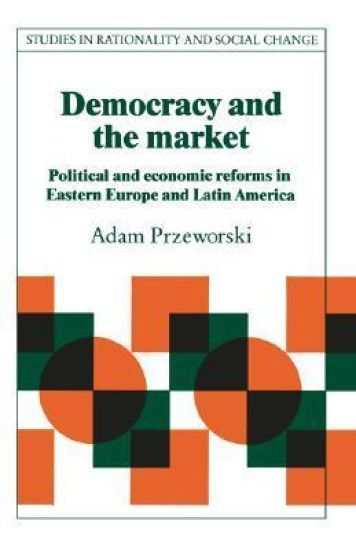
The quest for freedom from hunger and repression has triggered in recent years a dramatic, worldwide reform of political and economic systems. Never have so many people enjoyed, or at least experimented with democratic institutions. However, many strategies for economic development in Eastern Europe and Latin America have failed with the result that entire economic systems on both continents are being transformed. This major book analyzes recent transitions to democracy and market-oriented economic reforms in Eastern Europe and Latin America. Drawing in a quite distinctive way on models derived from political philosophy, economics, and game theory, Professor Przeworski also considers specific data on individual countries. Among the questions raised by the book are: What should we expect from these experiments in democracy and market economy? What new economic systems will emerge? Will these transitions result in new democracies or old dictatorships?