Kirjojen hintavertailu. Mukana 12 595 353 kirjaa ja 12 kauppaa.

Kirjailija

Adeline Masquelier

Kirjat ja teokset yhdessä paikassa: 5 kirjaa, julkaisuja vuosilta 2001-2019, suosituimpien joukossa Fada. Vertaile teosten hintoja ja tarkista saatavuus suomalaisista kirjakaupoista.

5 kirjaa

Kirjojen julkaisuhaarukka 2001-2019.

Fada

Fada

Adeline Masquelier

University of Chicago Press
2019
pokkari
Landlocked and with an economy reliant on subsistence agriculture, Niger often comes into the public eye only as example of deprivation and insecurity. Urban centers have become concentrated areas of unemployment filled with young men bored and idle, trying, against all odds, to find meaning where little is given. At the heart of Adeline Masquelier’s groundbreaking book is the fada—conversation groups where men gather to talk, play cards, listen to music, and drink tea. As a place where young men forge new forms of sociability and belonging outside the arena of work, the fada is an integral part of Niger’s urban landscape. By considering the fada as a site of experimentation, Masquelier offers a nuanced depiction of how young men in urban Niger engage in the quest for recognition and reinvent their own masculinity in the absence of conventional avenues to self-realization. In an era when fledgling and advanced economies alike are struggling to support meaningful forms of employment, this book offers a timely glimpse into how to create spaces of stability, respect, and creativity despite precarious conditions.
Fada

Fada

Adeline Masquelier

University of Chicago Press
2019
sidottu
Landlocked and with an economy reliant on subsistence agriculture, Niger often comes into the public eye only as example of deprivation and insecurity. Urban centers have become concentrated areas of unemployment filled with young men bored and idle, trying, against all odds, to find meaning where little is given. At the heart of Adeline Masquelier’s groundbreaking book is the fada—conversation groups where men gather to talk, play cards, listen to music, and drink tea. As a place where young men forge new forms of sociability and belonging outside the arena of work, the fada is an integral part of Niger’s urban landscape. By considering the fada as a site of experimentation, Masquelier offers a nuanced depiction of how young men in urban Niger engage in the quest for recognition and reinvent their own masculinity in the absence of conventional avenues to self-realization. In an era when fledgling and advanced economies alike are struggling to support meaningful forms of employment, this book offers a timely glimpse into how to create spaces of stability, respect, and creativity despite precarious conditions.
Women and Islamic Revival in a West African Town

Women and Islamic Revival in a West African Town

Adeline Masquelier

Indiana University Press
2009
pokkari
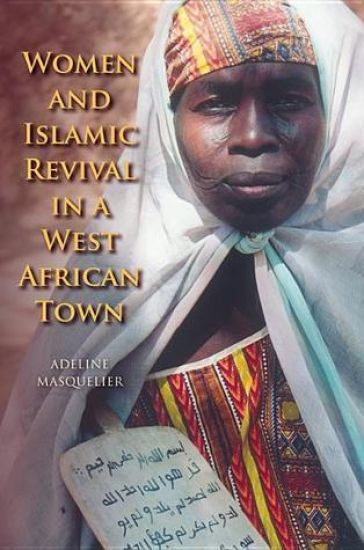
In the small town of Dogondoutchi, Niger, Malam Awal, a charismatic Sufi preacher, was recruited by local Muslim leaders to denounce the practices of reformist Muslims. Malam Awal's message has been viewed as a mixed blessing by Muslim women who have seen new definitions of Islam and Muslim practice impact their place and role in society. This study follows the career of Malam Awal and documents the engagement of women in the religious debates that are refashioning their everyday lives. Adeline Masquelier reveals how these women have had to define Islam on their own terms, especially as a practice that governs education, participation in prayer, domestic activities, wedding customs, and who wears the veil and how. Masquelier's richly detailed narrative presents new understandings of what it means to be a Muslim woman in Africa today.
Prayer Has Spoiled Everything

Prayer Has Spoiled Everything

Adeline Masquelier

Duke University Press
2001
pokkari
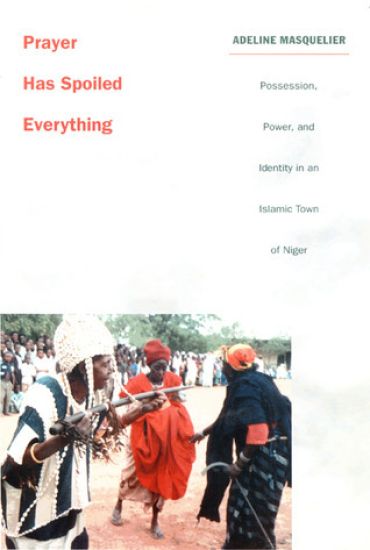
Bori, in the Mawri society of Niger, are mischievous and invisible beings that populate the bush. Bori is also the practice of taming these wild forces in the context of possession ceremonies. In Prayer Has Spoiled Everything Adeline Masquelier offers an account of how this phenomenon intervenes-sometimes subtly, sometimes dramatically-in human lives, providing a constantly renewed source of meaning for Mawri peasants confronted with cultural contradictions and socio-economic marginalization. To explore the role of bori possession in local definitions of history, power, and identity, Masquelier spent a total of two years in Niger, focusing on the diverse ways in which spirit mediums share, transform, and contest a rapidly changing reality, threatened by Muslim hegemony and financial hardship. She explains how the spread of Islam has provoked irreversible change in the area and how prayer-a conspicuous element of daily life that has become virtually synonymous with Islamic practice in this region of west Africa-has thus become equated with the loss of tradition. By focusing on some of the creative and complex ways that bori at once competes with and borrows from Islam, Masquelier reveals how possession nonetheless remains deeply embedded in Mawri culture, representing more than simple resistance to Islam, patriarchy, or the state. Despite a widening gap between former ways of life and the contradictions of the present, it maintains its place as a feature of daily life in which villagers participate with varying degrees of enthusiasm and approval. Specialists in African studies, in the anthropology of religion, and in the historical transformations of colonial and postcolonial societies will welcome this study.
Prayer Has Spoiled Everything

Prayer Has Spoiled Everything

Adeline Masquelier

Duke University Press
2001
sidottu
Bori, in the Mawri society of Niger, are mischievous and invisible beings that populate the bush. Bori is also the practice of taming these wild forces in the context of possession ceremonies. In Prayer Has Spoiled Everything Adeline Masquelier offers an account of how this phenomenon intervenes-sometimes subtly, sometimes dramatically-in human lives, providing a constantly renewed source of meaning for Mawri peasants confronted with cultural contradictions and socio-economic marginalization. To explore the role of bori possession in local definitions of history, power, and identity, Masquelier spent a total of two years in Niger, focusing on the diverse ways in which spirit mediums share, transform, and contest a rapidly changing reality, threatened by Muslim hegemony and financial hardship. She explains how the spread of Islam has provoked irreversible change in the area and how prayer-a conspicuous element of daily life that has become virtually synonymous with Islamic practice in this region of west Africa-has thus become equated with the loss of tradition. By focusing on some of the creative and complex ways that bori at once competes with and borrows from Islam, Masquelier reveals how possession nonetheless remains deeply embedded in Mawri culture, representing more than simple resistance to Islam, patriarchy, or the state. Despite a widening gap between former ways of life and the contradictions of the present, it maintains its place as a feature of daily life in which villagers participate with varying degrees of enthusiasm and approval. Specialists in African studies, in the anthropology of religion, and in the historical transformations of colonial and postcolonial societies will welcome this study.