Kirjojen hintavertailu. Mukana 12 551 326 kirjaa ja 12 kauppaa.

Kirjailija

Adi Ben-Israel

Kirjat ja teokset yhdessä paikassa: 4 kirjaa, julkaisuja vuosilta 1993-2010, suosituimpien joukossa Computer Supported Calculus. Vertaile teosten hintoja ja tarkista saatavuus suomalaisista kirjakaupoista.

4 kirjaa

Kirjojen julkaisuhaarukka 1993-2010.

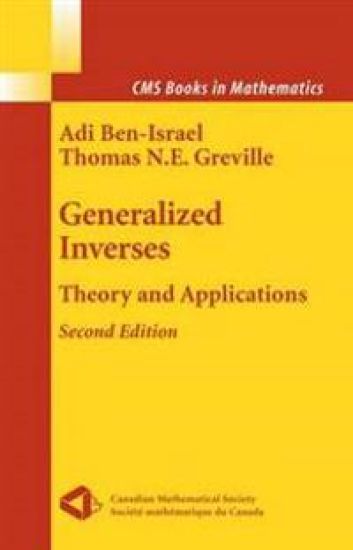
Generalized Inverses

Generalized Inverses

Adi Ben-Israel; Thomas N.E. Greville

Springer-Verlag New York Inc.
2010
nidottu
1. The Inverse of a Nonsingular Matrix It is well known that every nonsingular matrix A has a unique inverse, ?1 denoted by A , such that ?1 ?1 AA = A A =I, (1) where I is the identity matrix. Of the numerous properties of the inverse matrix, we mention a few. Thus, ?1 ?1 (A ) = A, T ?1 ?1 T (A ) =(A ) , ? ?1 ?1 ? (A ) =(A ) , ?1 ?1 ?1 (AB) = B A , T ? where A and A , respectively, denote the transpose and conjugate tra- pose of A. It will be recalled that a real or complex number ? is called an eigenvalue of a square matrix A, and a nonzero vector x is called an eigenvector of A corresponding to ?,if Ax = ?x. ?1 Another property of the inverse A is that its eigenvalues are the recip- cals of those of A. 2. Generalized Inverses of Matrices A matrix has an inverse only if it is square, and even then only if it is nonsingular or, in other words, if its columns (or rows) are linearly in- pendent. In recent years needs have been felt in numerous areas of applied mathematics for some kind of partial inverse of a matrix that is singular or even rectangular.
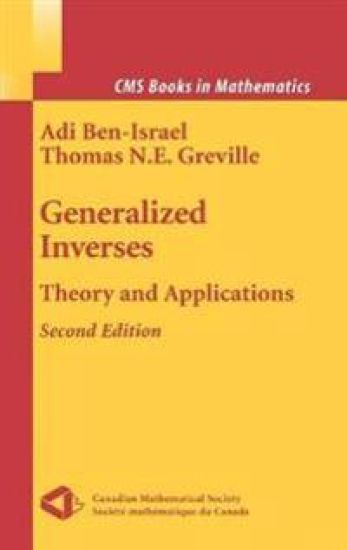
Generalized Inverses

Generalized Inverses

Adi Ben-Israel; Thomas N.E. Greville

Springer-Verlag New York Inc.
2003
sidottu
1. The Inverse of a Nonsingular Matrix It is well known that every nonsingular matrix A has a unique inverse, ?1 denoted by A , such that ?1 ?1 AA = A A =I, (1) where I is the identity matrix. Of the numerous properties of the inverse matrix, we mention a few. Thus, ?1 ?1 (A ) = A, T ?1 ?1 T (A ) =(A ) , ? ?1 ?1 ? (A ) =(A ) , ?1 ?1 ?1 (AB) = B A , T ? where A and A , respectively, denote the transpose and conjugate tra- pose of A. It will be recalled that a real or complex number ? is called an eigenvalue of a square matrix A, and a nonzero vector x is called an eigenvector of A corresponding to ?,if Ax = ?x. ?1 Another property of the inverse A is that its eigenvalues are the recip- cals of those of A. 2. Generalized Inverses of Matrices A matrix has an inverse only if it is square, and even then only if it is nonsingular or, in other words, if its columns (or rows) are linearly in- pendent. In recent years needs have been felt in numerous areas of applied mathematics for some kind of partial inverse of a matrix that is singular or even rectangular.
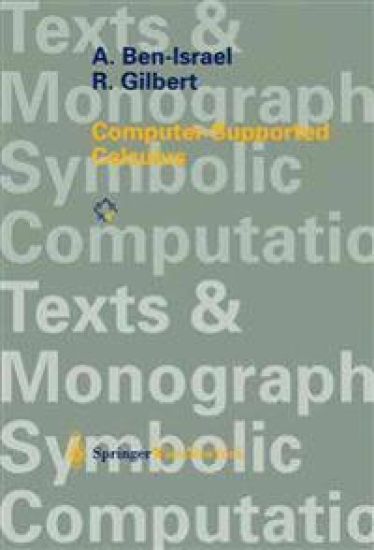
Computer Supported Calculus

Computer Supported Calculus

A. Ben-Israel; R. P. Gilbert; Adi Ben-Israel

Springer
1999
sidottu
Functions, limits, and continuity.- 1 Functions.- 1.1 Introduction.- 1.2 Functions and their graphs.- 1.3 Polynomials.- 1.4 Rational functions.- 1.5 Inverse functions.- 2 Elementary functions used in calculus.- 2.1 Exponential and logarithmic functions.- 2.2 Trigonometric functions.- 2.3 Inverse trigonometric functions.- 2.4 Hyperbolic functions.- 2.5 Inverse hyperbolic functions.- 3 Limits and continuity.- 3.1 Limits.- 3.2 One-sided limits.- 3.3 Infinite limits.- 3.4 Continuous functions.- 3.5 Continuous functions on closed intervals.- 3.6 Proofs.- Derivatives.- 4 Differentiation.- 4.1 Tangency.- 4.2 Differentiability.- 4.3 Derivative function.- 4.4 Special derivatives.- 4.5 Rectilinear motion and velocity.- 4.6 Approximations.- 4.7 Higher derivatives.- 4.8 Acceleration.- 5 Differentiation rules.- 5.1 Product and quotient rules.- 5.2 Chain rule and implicit differentiation.- 5.3 Rates of change.- 5.4 Derivatives of inverse functions.- 6 Extremum problems.- 6.1 Terminology.- 6.2 Necessary condition for a local extremum.- 6.3 First-derivative test.- 6.4 Second-derivative test.- 6.5 Optimal inventory.- 6.6 Convexity.- 6.7 Analysis of graphs.- 6.8 Proofs.- 7 Mean value theorem.- 7.1 Mean value theorem.- 7.2 Rule of l'Hospital.- 7.3 Taylor theorem.- 7.4 Antiderivatives.- 7.5 Iterative methods.- 7.6 Newton method.- 7.7 Fixed points.- 7.8 Proofs.- Integrals.- 8 Definite integrals.- 8.1 Introduction.- 8.2 Riemann sums.- 8.3 Definite integral.- 8.4 Numerical integration: trapezoid method.- 8.5 Numerical integration: Simpson method.- 8.6 Proofs.- 9 Fundamental theorem of calculus.- 9.1 Indefinite integral.- 9.2 Position and distance from velocity.- 9.3 Fundamental theorem of calculus.- 9.4 List of integrals.- 9.5 Proofs.- 10 Integration techniques.- 10.1 Changing variables.- 10.2 Integration by parts.- 10.3 Rational functions.- 10.4 Improper integrals: infinite intervals.- 10.5 Improper integrals: unbounded integrands.- 11 Applications of integrals.- 11.1 Area.- 11.2 Area by polar coordinates.- 11.3 Arc length.- 11.4 Volume.- 11.5 Solids of revolution: volume.- 11.6 Solids of revolution: surface area.- 11.7 Moments and centroids.- 11.8 Centroids of three-dimensional bodies.- 11.9 Work.- 11.10 Hydrostatic force.- Series and approximations.- 12 Sequences and series.- 12.1 Sequences and convergence.- 12.2 Series.- 12.3 Convergence criteria for series.- 12.4 Proofs.- 13 Series expansions and approximations.- 13.1 Series of functions.- 13.2 Power series.- 13.3 Differentiation of power series.- 13.4 Taylor series.- 13.5 Lagrange interpolation.- 13.6 Proofs.- Appendixes.- A Introduction to MACSYMA.- A.1 MACSYMA inputs and outputs.- A.2 Getting on-line help.- A.3 Expressions.- A.4 Constants.- A.5 Numbers.- A.6 Assignments.- A.7 Equations.- A.8 Functions.- A.9 Lists.- A.10 Expanding expressions.- A.11 Simplifying expressions.- A.12 Factoring expressions.- A.13 Making substitutions.- A.14 Extracting parts of an expression.- A.15 Trigonometric functions.- A.16 A simple program.- A.17 Plotting.- B Numbers.- B.1 Arithmetic operations.- B.2 Real numbers.- B.3 Absolute value.- B.4 Equations and inequalities.- B.5 Two fundamental properties of real numbers.- B.6 Complex numbers.- C Analytical geometry.- C.2 Lines.- C.3 Circles.- C.4 Sine, cosine, and tangent.- C.5 Polar coordinates.- D Conic sections.- D.l Conic sections.- D.2 Circle.- D.3 Parabola.- D.4 Ellipse.- D.5 Hyperbola.
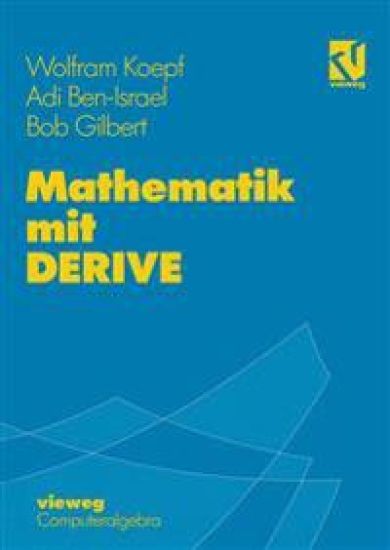
Mathematik mit DERIVE

Mathematik mit DERIVE

Wolfram Koepf; Adi Ben-Israel; Robert P. Gilbert

Vieweg+Teubner Verlag
1993
nidottu
Anläßlich eines Forschungsaufenthalts 1988/1989 von Bob Gilbert (University of De­ laware, USA) am Fachbereich Mathematik der Freien Universität Berlin wurde ich durch ihn auf die Verwendung symbolischer Mathematikprogramme, und zwar des Computeralgebrasystems MACSYMA, in der mathematischen Forschung aufmerk­ sam gemacht. Von diesem Zeitpunkt an kam ich von dem Gedanken der Benutzung solcher Programme in der mathematischen Lehre nicht mehr los. Die Miniaturisierung in der Computertechnologie hatte derartige Programme nun auf kleinsten Rechnern verfügbar gemacht, und ich war sicher, daß dies die Praxis von Mathematikerinnen und Mathematikern sowie Mathematikanwendern in der nahen Zukunft radikal verändern wird. Anstatt schwierige Integrale von Hand aus­ zurechnen - mit der Gefahr, sich in langwierigen Teilschritten zu verrechnen -, wird z. B. der zukünftige Bauingenieur versuchen, das betreffende Integral zunächst mit einem Mathematikprogramm zu lösen. Nur, wenn er hiermit scheitert, wird er zur bewährten Handberechnung übergehen. Wir wollen nicht verhehlen, daß auch dies eine nicht zu unterschätzende Gefahr birgt, nämlich die, Ergebnissen von Mathe­ matikprogrammen unbegrenzt Vertrauen zu schenken. Genauso, wie man ein von Hand berechnetes Resultat durch Kontrollrechnungen so lange überprüfen muß, bis man sich des Ergebnisses sicher ist, muß man die Ergebnisse, die ein Mathematik­ progamm erzeugt, einer sorgfältigen Überprüfung unterziehen. Wenn aber solche Programme sowohl in der Forschung als auch in der Praxis von Bedeutung sind, sollten sie in der mathematischen Lehre ebenfalls eine Rolle spie­ len. Weil die Praxis der Arbeit mit einem Mathematikprogramm einer entsprechen­ den Schulung bedarf, muß diese in die Mathematikausbildungintegriert werden.