Kirjojen hintavertailu. Mukana 12 390 323 kirjaa ja 12 kauppaa.
Kirjailija
Adrien Fontanellaz
Kirjat ja teokset yhdessä paikassa: 19 kirjaa, julkaisuja vuosilta 2015-2025, suosituimpien joukossa Wars and Insurgencies of Uganda 1971-1994. Vertaile teosten hintoja ja tarkista saatavuus suomalaisista kirjakaupoista.
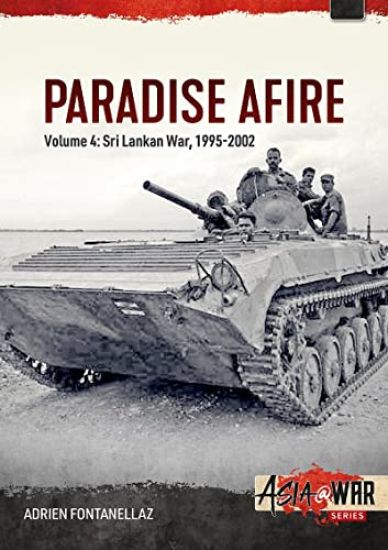
In April 1995, the LTTE resumed the war by launching a surprise attack against the Sri Lankan Navy at Trincomalee, thus opening the third phase - the so-called Eelam War III - of the decades-long Sri Lankan civil war. From 1995 to 2002, both sides battled mercilessly against each other, both on land and sea, where the LTTE naval wing, the infamous Sea Tigers, managed to keep at bay the Sri Lankan Navy in the country's northern waters whilst securing the last leg of the maritime routes connecting the LTTE-held areas with the outside world.However, the war began with a crushing blow for the insurgents with their loss of the Jaffna Peninsula. Thereafter, the sides traded massive blows with in northern Sri Lanka, and each won spectacular victories and suffered massive defeats. In early 2000, the LTTE managed to stun the world by capturing the crucial Elephant Pass, despite it being held by a full Sri Lankan division, thus winning its greatest victory ever. However, by this stage, both sides were exhausted and a fresh round of negotiations ended with a new cease-fire on 22 February 2002.This volume provides a detailed overview not only of the series of large-scale battles and campaigns fought by the two enemies, but also of their organization, tactics and equipment.
Volume 7 of War in Ukraine provides a detailed account of the air war as it developed during 2023, a period in which Russia made extensive use of Tu-95 and Tu-22 bombers and their missiles to bring about the collapse of the power supply system in Ukraine.The second year of the War in Ukraine began with the Russian attempt to collapse the power supply and power grid of Ukraine through an offensive with ballistic- and cruise missiles. Lasting months, this operation saw the sustained deployment of Tu-95 and Tu-22 bombers and their missiles, combined with tactical precision guided munitions and Iranian-made Shahed unmanned aerial vehicles (UAVs). Highly promising, early on, the offensive failed because of last-minute deliveries of advanced air defence systems and a large number of power generators from the West: even then, it was a close call, with the government in Kyiv almost making the decision to evacuate the capital. Hard on the heels of this episode, the USA and Germany rushed PAC-2/3 Patriot air defence systems to Ukraine, which Russia attempted to knock out with its Kinzhal hypersonic missiles. Around the same time, the Russians also began deploying MPK/UMPK glide bombs to strike targets along the frontline from outside the range of Ukrainian air defences.War In Ukraine: Volume 7, Air War, January - December 2023 continues the detailed military history of this ongoing conflict, the largest in Europe since the end of the Second World War in 1945. This volume is illustrated throughout with original color photographs and includes specially commissioned color artworks.
On 24 February 2022, the armed forces of the Russian Federation initiated an invasion of Ukraine. Thus began the biggest and longest air war fought in Europe since 1945, and a conflict that saw the deployment of full spectrum of the Russian air power: strategic bombers deployed hundreds of cruise missiles combined with strikes by tactical ballistic missiles; the Russian Air-Space Force deployed its tactical and helicopter aviation into large-scale airborne and heliborne operations deep into Ukraine, while the Ukrainian Air Force fought back with its interceptors and attack helicopters.Taking place after the Russian invasion of eastern Ukraine and illegal annexation of Crimea of 2014-2015, and eight years of low-scale warfare in Donbas, as well as countless incidents on the ground and at sea, cyberwarfare, and political tensions, the onslaught was expected by many Western and Russian intelligence services to quickly topple the democratically elected government in Kyiv, and overrun and disarm the Ukrainian armed forces - with help of collaborators - in just three to 14 days.Despite the realisation of a full-scale Russian assault and invasion coming as a surprise to many, the Ukrainian Air Force (PSU) offered fierce resistance. The result was weeks of high-intensity air warfare, which ended only once the ground-based air defences of both sides were deployed in force to block the airspace for tactical aircraft of both sides.Richly illustrated and providing a detailed study of the participating air forces, and the fighting in the air during the Russian invasion, War in Ukraine, Volume 6 is the first concise and inclusive military history of this drama.
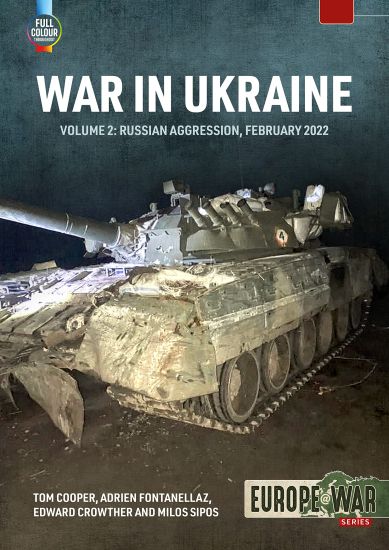
On 24 February 2022, President of the Russian Federation Vladimir Putin ordered a full-scale invasion of neighboring Ukraine. Taking place after the Russian invasion of eastern Ukraine and illegal annexation of Crimea of 2014-2015, and eight years of low-scale warfare in Donbas, as well as countless incidents on the ground and the sea, cyberwarfare, and political tensions, the onslaught was expected - both by multiple Western and multiple Russian intelligence services - to quickly topple the democratically elected government in Kyiv, and overrun and disarm the Ukrainian armed forces with help of collaborationists in a matter of between 3 and 14 days.Early on 24 February, Armed Forces of the Russian Federation (VSRF) launched a series of missile and artillery strikes on main air bases and dozens of military facilities in Ukraine. Immediately afterwards, VSRF launched ground invasion, with its forces advancing on (clockwise) Kyiv, Chernihiv, Kharkiv, Mariupol, Melitopol, and Kherson. Although following a build-up that began already in April 2021, and expected by many, the onslaught still came as a major surprise - for the Ukrainian government, for Ukrainian armed forces, for its allies in the West, but also for the mass of officers and other ranks of the VSRF. Moreover, the deeper the Russians rolled into Ukraine, the more resistance they have encountered: while some Russian units performed as expected, entire armies began falling apart while ordered to advance at maximum possible speed - and that without the necessary fire and logistic support. After suffering catastrophic losses while failing to reach the downtown Kyiv, and failing to reach and enter Chernihiv and Kharkiv, the war in northern and north-eastern Ukraine quickly settled down into a bloody stalemate. However, in the south, the Russians initially advanced at amazing rate, taking Melitopol already during the first day of their invasion, and Kherson only few days later. Indeed, it was only once President Putin attempted to accelerate the rate of advance through heliborne operations deeper into Ukraine, that the VSRF suffered a severe blow in the fighting for Voznesensk and Mykolaiv, and its advance in this part of the country came to an end.Richly illustrated, providing a detailed study of the involved armed forces, and the fighting in northern and southern Ukraine during the first two weeks of the Russian invasion in February 2022, War in Ukraine, Volume 2 is the first concise military history of this drama.
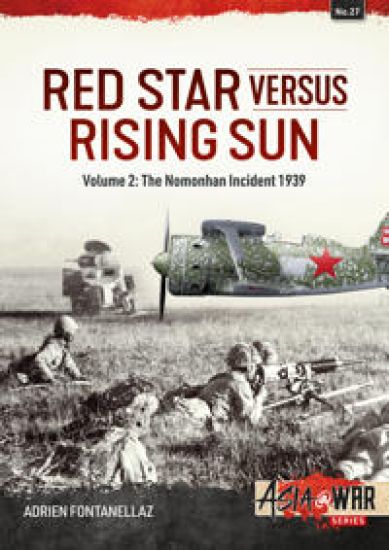
During the first half of the 20th Century, the former Czarist Russia and then the former Soviet Union, and the Empire of Japan fought a series of undeclared wars in the Far East. The first of these, fought 1904-1905 over rival imperial ambitions in Manchuria and Korea, ended in a clear-cut Japanese victory. Following the Japanese occupation of Manchuria, in 1931, Japan turned its interest to nearby Soviet territories. The result was a series of border incidents – starting with the Battle of Lake Khasan in 1938. Maintaining that the border between their proxy-state, Manchukuo, and the Soviet-dominated Mongolian People’s Republic was the Khalkhyn Gol (or Khalkha River), the Japanese deployed some of best units of their army to occupy and secure this area. Following a military build-up, a series of bitter clashes took place mid-May and June 1939, after which the Japanese launched an all-out assault in July. Due to heavy casualties, the battle resulted in a stalemate. Concerned about the possibility of facing a two-front war, the Soviets reacted with a major counter-offensive, in August 1939, and defeated the Japanese. While little known in the West, this short but bitter war – known as Nomohan Incident in Japan, or the Battle of Khalkhyn Gol in the Soviet Union – was a crucial overture for the subsequent World War II. Having secured its border in the Far East, the Soviet Union was free to concentrate on war in Europe. Although continuing to underestimate their opponents, the Japanese introduced a major reform of their army. Furthermore, after realizing the massive material disparity vis-à-vis the former USSR, Tokyo joined the Axis with Nazi Germany and Italy.
During the first half of the 20th century, Czarist Russia and then the successor Soviet Union, fought a series of undeclared wars against the Empire of Japan in the Far East. The Russo-Japanese War of 1904-1905 was fought over rival imperial ambitions in Manchuria and Korea and ended in a Japanese victory that would leave the Imperial Japanese Army with a sense of self-importance, a belief that the offensive spirit could overcome all obstacles and a strong conviction that the ends would justify the means.As the century continued, Japanese forces expanded into China and created the puppet state of Manchukuo that would become a vital resource for further imperial ambition. This expansion inevitably brought the empires of the Rising Sun and the Red Star ever closer on the ground, and in 1938 the two armies clashed at Lake Khasan, the first of a number of battles that would have far reaching consequences for the course of the world war to come.Volume 1 of the Red Star versus Rising Sun mini-series examines the origins of the rapidly modernizing Imperial Japanese Army and its expansion, largely unfettered by civilian political constraints, into mainland Asia from the late 19th century up until 1938. It examines the culture, structure and equipment of the IJA and its campaigns in warlord-era China, along with an overview of the purge-ravaged Red Army of the same period. This volume culminates in a detailed description of the major clash of the Soviet and Japanese armies at Lake Khasan in 1938. Volume 1 includes a range of specially commissioned color illustrations of the men, AFVs, artillery pieces, and aircraft that fought at Lake Khasan in 1938.
War of Intervention in Angola, Volume 4, continues the coverage of the operational history of the Angolan Air Force and Air Defence Force (FAPA/DAA) as told by Angolan and Cuban sources, in the period 1985-1988. Many accounts of this conflict - better known in the West as the ‘Border War’ or the 'Bush War', as named by its South African participants - consider the operations of the FAPA/DAA barely worth commentary. At most, they mention a few air combats involving Mirage F.1 interceptors of the South African Air Force (SAAF) in 1987 and 1988, and perhaps a little about the activity of the FAPA/DAA’s MiG-23s. However, a closer study of Angolan and Cuban sources reveals an entirely different image of the air war over Angola in the 1980s: indeed, it reveals the extent to which the flow of the entire war was dictated by the availability - or the lack - of air power. These issues strongly influenced the planning and conduct of operations by the commanders of the Angolan and Cuban forces. Based on extensive research with the help of Angolan and Cuban sources, War of Intervention in Angola, Volume 4, traces the Angolan and Cuban application of air power between 1985-1988 - during which it came of age - and the capabilities, intentions, and the combat operations of the air forces. The volume is illustrated with 100 rarely seen photographs, half a dozen maps and 15 colour profiles, and provides a unique source of reference on this subject.
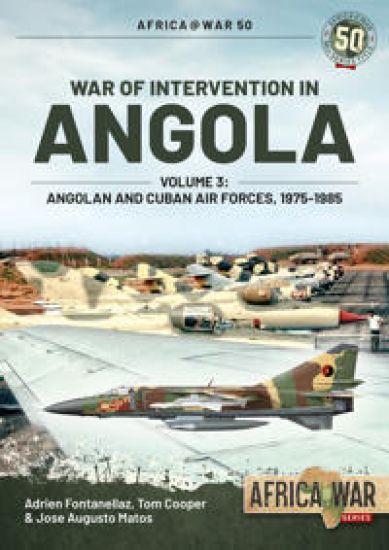
War of Intervention in Angola, Volume 3 covers the air warfare during the II Angolan War – fought 1975-1992 – through narrating the emergence and operational history of the Angolan Air Force and Air Defence Force (FAPA/DAA) as told by Angolan and Cuban sources. Most accounts of this conflict – better known in the West as the ‘Border War’ or the ‘Bush War’, as named by its South African participants – tend to find the operations by the FAPA/DAA barely worth mentioning. A handful of published histories mention two of its MiG-21s claimed as shot down by Dassault Mirage F.1 interceptors of the South African Air Force (SAAF) in 1981 and 1982, and at least something about the activities of its MiG-23 interceptors during the battles of the 1987-1988 period. On the contrary, the story told by Angolan and Cuban sources not only reveals an entirely different image of the air war over Angola of the 1980s: indeed, it reveals to what degree this conflict was dictated by the availability – or the lack of – air power and shows that precisely this issue dictated the way that the commanders of the Cuban contingents deployed to the country – whether as advisors or as combat troops – planned and conducted their operations. It is thus little surprising that the first contingent of Cuban troops deployed to Angola during Operation Carlota, in late 1975, included a sizeable group of pilots and ground personnel who subsequently helped build-up the FAPA/DAA from virtually nothing. They continued that work over the following 14 years - sometimes in cooperation of Soviet advisors and others from East European countries – eventually establishing an air force that by 1988 maintained what South African military intelligence and the media subsequently described as the ‘most advanced air defence system in Africa’. Not only the air defence system in question, but also the aircraft serving as its extended arms, ultimately managed a unique feat in contemporary military history: they enabled an air force equipped with Soviet-made aircraft and trained along the Soviet doctrine to establish at least a semblance of aerial superiority over an air force equipped with Western-made aircraft and operating under a Western doctrine. Based on extensive research with help of Angolan and Cuban sources, the ‘War of Intervention in Angola, Volume 3’, traces the military build-up of the FAPA/DAA in the period 1975-1992, its capabilities and its intentions. Moreover, it provides a unique, blow-by-blow account of its combat operations and experiences. The volume is illustrated with 100 rare photographs, half a dozen maps and 15 colour profiles, thus providing a unique source of reference on this topic.
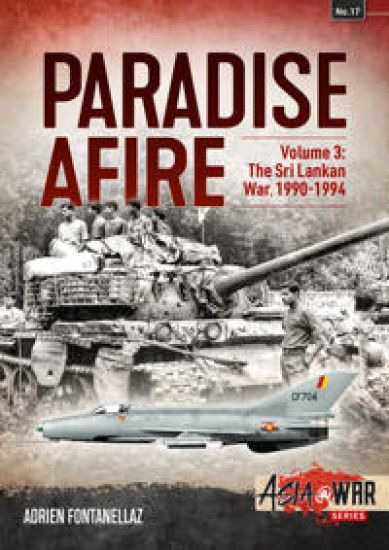
In June 1990, a mere three months after the Indian Peace Keeping Force withdrawal from Sri Lanka, the war between the Liberation Tigers of Tamil Eelam (LTTE) and the Sri Lankan government resumed and was to continue unabated until another cease-fire in early 1995. This period of the protracted Sri Lankan civil war, known as Eelam War II, saw not only the LTTE evolve into a fully-fledged semi-conventional force, but also gained the reputation of being one of the most innovative and professional armed groups ever. This volume covers in detail the coming into being and the tactics of the Sea Tigers, the movement’s naval wing infamous for its swarm tactics, but also the developments related to its intelligence wings and ground forces. The Sri Lankan armed forces were however no underdog either. To the contrary, and despite numerous flaws that plagued their efforts, they were anything but passive, launching multiple offensives which were part of a cohesive and well thought-out strategy, all the while benefiting from the leadership of several extremely gifted officers, foremost Brig.Gen. Denzil Kobbekaduwa. The two warring parties thus repeatedly fought each other in battles and campaigns of unheard off size and intensity so far, inflicting telling blows upon one another, but with both failing to gain the upper hand in the long run – until the two sides entered into a new round of negotiations which halted the conflict – for a mere few months. Illustrated with over 100 photographs, maps and colour profiles, Paradise Afire Volume 3 continues the story of the internal strife that plagued Sri Lanka in the late 20th Century.
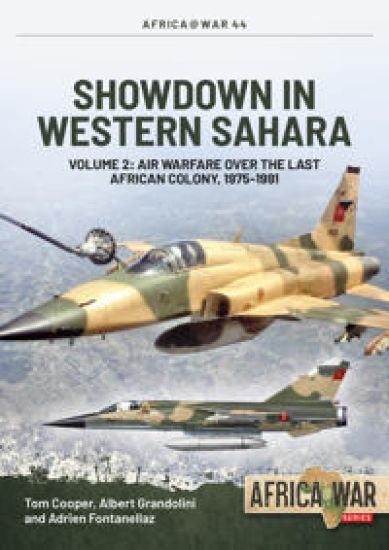
The former colony of Spanish Sahara saw frequent outbursts of tribal and ethnic rebellions while ruled by the colonial authorities in the late 19th and through the early 20th Century. Its vastness and distances essentially dictated the application of air power in response. While most of these events attracted next to no attention in English-language media, the large-scale operations of the Spanish colonial authorities of the late 1950s became notable at least for the final combat deployment of the famous Messerschmitt Bf.109. Following the Spanish withdrawal from Spanish Sahara in 1975, a major war erupted as Sahrawi nationalists – organized by the POLISARIO front – engaged in guerrilla warfare against Moroccan armed forces deployed to secure the northern part of the country, and Mauritanian forces deployed in the south. Characteristically for this period, POLISARIO’s insurgency was often misinterpreted in the West as ‘Soviet-influenced’, although the rebels never adapted any related frameworks for their operations and tactics, such as those of Mao Zedong. On the contrary, while Algeria at least tolerated their bases on its soil, it was Libya that provided most of the support for the insurgency, eventually enabling it to defeat the Mauritanian military, slightly over a year later. Combined with POLISARIO’s raids deep into Mauritania this prompted France to launch a limited military intervention in support. While tactically successful, this proved insufficient: Mauritania withdrew in 1979 after signing a peace treaty. Morocco continued fighting a series of bitter campaigns through 1979 and 1980, until rising costs and casualties prompted its government into developing an entirely new strategy. Construction of extensive earthen fortifications eventually slowed the war down to one of low intensity, only sporadically interrupted by insurgent attempts to achieve at least local successes. With both sides realizing that no solution through an armed conflict was possible, a cease-fire agreement was signed in 1991. However, this conflict still remains unresolved: it merely shifted to civilian resistance. Warfare in Western Sahara has in many ways become exemplary for modern-day counter-insurgency efforts in Africa and elsewhere. This conflict has been falsely declared as a part of some larger, external conflict – the Cold War; in regards of the concept of an insurgency applying motorized forces to deliver often spectacular ‘hit-and-run’ attacks; and in regards of a conventional military reacting with a combination of earth berms and air power. Illustrated by over 100 photograph as, a dozen maps and 18 colour profiles, Showdown in Western Sahara offers a fascinating study of the military aspects of this conflict, warfare strategies, tactics and experiences with different weapons systems.
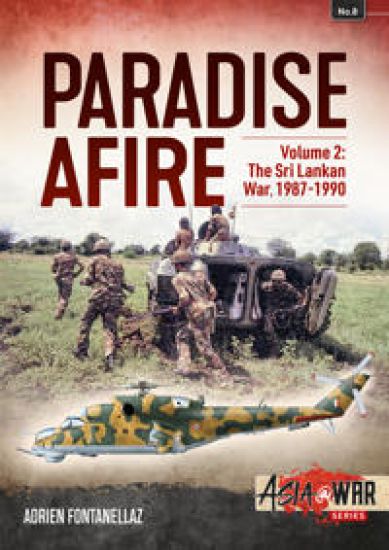
Upon achieving independence from Great Britain in 1948, the stunningly beautiful island of Ceylon, re-named Sri Lanka in 1972, was expected to become a sort of ‘South Asian Singapore’. However, stable political order and bright economic prospects proved insufficient to maintain peace. A host of unsolved ethnic conflicts and social inequalities conspired to erupt into an armed conflict in 1971. By 1987, the crisis heated up to the point where the government in New Delhi began exercising fierce pressure upon the Sri Lankan government and the Sri Lankan Tamil insurgents to arrive at a peace deal. In order to help maintain peace, the Indian Peace Keeping Force was deployed on the island. However, with a few weeks, the troops of the Indian Army found themselves involved in a bloody and protracted confrontation with the most powerful of Tamil insurgent movements – the Liberation Tamil Tigers of Elam (LTTE). The peace-keeping operation was thus quickly converted into a military intervention and a bloody quagmire. To make matters even more complex, southern Sir Lanka meanwhile became engulfed in an unprecedented wave of public violence, triggered by the second insurrection of Sinhalese ultra-leftist movement, the JVP. Calling upon extensive studies of the Sri Lankan War, with the help of first hand sources, official documentation and publications from all of the involved parties, this volume provides an in-depth and particularly detailed account of military operations between 1987 and 1990. It is illustrated by over 120 photographs, maps and 12 colour profiles.
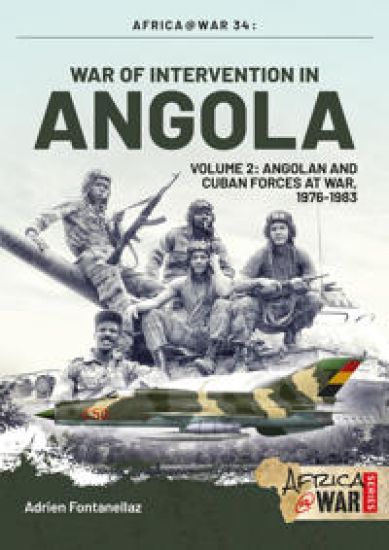
As of mid-1976, the civil war in Angola was seemingly decided: supported by a large contingent of Cuban forces, the MPLA established itself in power in Luanda. Its native competitors, the US-French-Zaire-supported FNLA, and UNITA, supported by China and South Africa, were in tatters. The French and Zaire-supported FLEC – an armed movement for the independence of the oil-rich Cabinda enclave – was in disarray. The last few of their surviving units were either driven out of the country, or forced into hiding in isolated corners of northern and south-eastern Angola. Nevertheless, the war went on. The MPLA’s government failed to decisively defeat UNITA, in southern Angola, and then found itself facing a coup attempt from within in May 1977. Crushed in blood, this resulted in thousands being jailed and tortured: many more escaped abroad, where they reinforced the ranks of the battered opposition. The coup prompted the Soviets to attempt increasing their influence with the aim of establishing permanent military bases in the country. While all such overtures were turned down, Angolan operations along the border to what was then the South-West Africa (subsequently Namibia) in October 1980, combined with the increased activity of SWAPO – an insurgency against the South African control of that territory - subsequently Namibia – prompted South Africa to launch another military intervention and resume supporting UNITA. In turn, this prompted not only the Cubans to further increase their military presence, but also the Soviet Union into delivering massive amounts of military aid to the government in Luanda. Angola not only assumed the role of one of the major hot battlefields in the Cold War: its ‘civil war’ saw a number of major showdowns between diverse belligerents, culminating in the Battle of Cangamba in 1983. Based on extensive research, with help of Angolan and Cuban sources, the ‘War of Intervention in Angola, Volume 2’, traces the military build-up of the Cuban and Soviet-supported Angolan military, the FAPLA and its combat operations, and those of the Cuban military in Angola, in the period 1976-1983, their capabilities and intentions, and their battlefield performances. The volume is illustrated with over 100 rare photographs, half a dozen maps and 18 colour profiles.
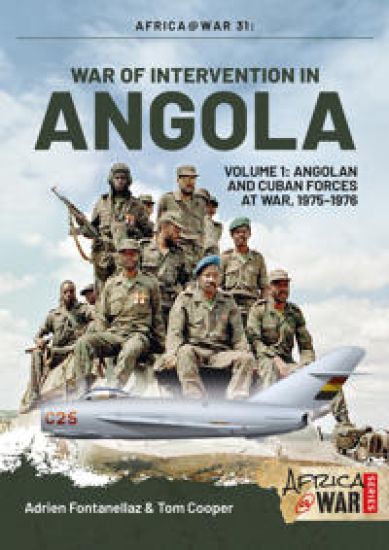
As of 1975, the decades long insurgency in Angola appeared to be short of its conclusion. However, with no less than three major insurgent movements fighting for supremacy, the war went on and then South Africa, USA, the Soviet Union, Zaire and Cuba became involved. Affairs like the CIA’s efforts to destabilise Angola for little else but to recoup its prestige after the catastrophic defeat in South Vietnam, or the South African military intervention in Angola – Operation Savannah – have attracted lots of public attention and are relatively well covered in related publications. On the contrary, the final stages of the Portuguese withdrawal, the military build-up of three native insurgent forces, and then the onset of the Cuban military intervention in Angola – Operation Carlotta run in 1975 and 1976 – remain largely unknown. Based on extensive research with help of Angolan and Cuban sources, the War of Intervention in Angola is providing a unique insight precisely into the latter topic. It traces the failures of the US-supported FNLA, the growth and reorganization of the MPLA into a conventional army; deployment of Cuban military contingents, their capabilities and intentions; and the performance and experiences of the MPLA and Cuban forces at war with South Africans and the third Angolan insurgent group – UNITA. The volume is illustrated with over 100 rare photographs, a dozen of maps and 15 colour profiles.
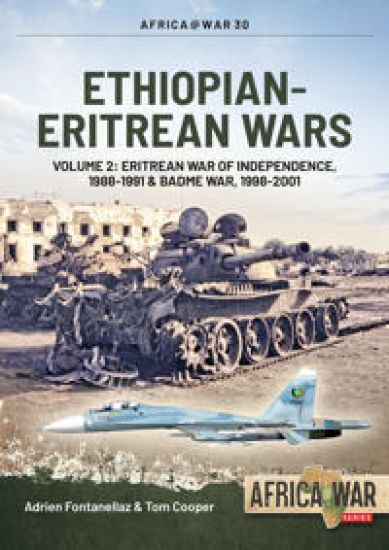
Ethiopia, a country of ancient origins in eastern Africa, remains a military powerhouse of that continent until our days. Nowadays involved in the war in neighbouring Somalia, Ethiopia was also involved in half a dozen of other armed conflicts over the last 60 years. Crucial between these was the Eritrean War of Independence. Fought 1961-1991, this was one of biggest armed conflicts on the African continent, especially if measured by numbers of involved combatants. It included a wide spectrum of operations, from ‘classic’ counter-insurgency (COIN) to conventional warfare in mountains – with the latter being one of the most complex and most demanding undertakings possible to conduct by a military force. Campaigns run during the Eritrean War of Independence often included large formations of relatively well-equipped forces, led by well-trained commanders, along well-thought-out plans, based on home-grown doctrine. The air power played a crucial – although not necessarily decisive – role in many of battles. Nevertheless, most of details about this conflict remain unknown in the wider public. Similarly, relatively few Western observers are aware of relations between the Eritrean liberation movements, and various dissident and insurgent movements inside Ethiopia – although the synergy of these eventually led the downfall of the so-called Derg government, in 1991. While the first volume in this mini-series spanned the history of wars between Ethiopia and Eritrea between 1961 and 1988, the second covers the period since. Correspondingly, it is providing coverage of military operations that led to the fall of the Derg government in Ethiopia of 1991, the period of Eritrean military build-up and a complete re-organization of the Ethiopian military in the 1990s, and concludes with the first detailed account of the so-called Badme War, fought between Ethiopia and Eritrea in period 1998-2001. It is illustrated by many contemporary photographs, maps and colour profiles.
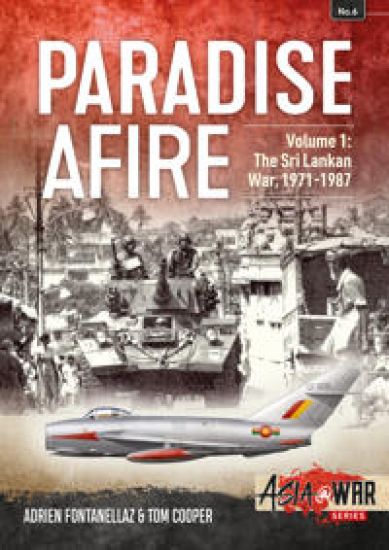
When released into independence from Great Britain, in 1948, the stunningly beautiful island of Ceylon, re-named Sri Lanka in 1972, was expected to become a sort of `South Asian Singapore’. However, stable political order and bright economic prospects proved insufficient to maintain peace. A host of unsolved ethnic conflicts and social inequalities conspired to erupt into an armed conflict, in 1971. When this broke out the entire Sri Lankan society was shocked to its core by a large-scale insurgency instigated by a Sinhalese Maoist group, JVP. Worst still, this was followed by the gradual build-up of several other Tamil groups in the north of the island. Following riots known as `Black July’, in 1983, Sri Lanka was ripped apart by a murderous war against Tamil insurgents, which caught the armed forces wrong-footed because of the government’s reluctance to build-up its military to necessary levels. This came to a temporary stop in 1987, with the implementation of a peace arrangement virtually enforced by the government of India and a deployment of a large peacekeeping force of the Indian military. By the time, the notorious LTTE emerged as the most powerful Tamil insurgent movement, and the principal opponent of the Sri Lankan armed forces. Eventually, the Indian military intervention proved to be only a temporary solution. The LTTE turned against the Indian military but suffered heavily in return. However, this provided some breathing space for the Sri Lankan military, which then launched a vicious and protracted counterinsurgency campaign against the JVP. The fighting thus went on. Relying on extensive studies of the Sri Lankan War with the help of first-hand sources, official documentation and publications from all of involved parties, this volume provides an in-depth and particularly detailed account of military operations during the first 16 years of this war.
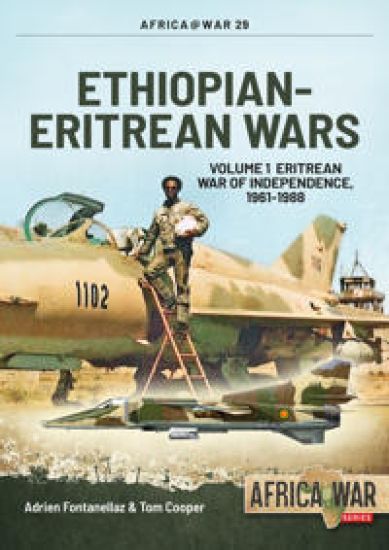
Ethiopia, a country of ancient origins in eastern Africa, has remained a military powerhouse of that continent until the present day. Currently involved in the war in neighbouring Somalia, Ethiopia was also involved in half a dozen of other armed conflicts during the last 60 years. One of the most significant was the Eritrean War of Independence. Fought 1961-1991, this was one of the biggest armed conflicts on the African continent, especially if measured by numbers of combatants involved. It included a wide spectrum of operations, from ‘classic’ counter-insurgency (COIN) to conventional warfare in mountains – with the latter being one of the most complex and demanding undertakings possible to conduct by a military force. Campaigns run during the Eritrean War of Independence often included large formations of relatively well-equipped forces, led by well-trained commanders, utilising complex plans based on home-grown doctrine. Airpower played a crucial – although not necessarily decisive – role in many of battles. Nevertheless, most of details about this conflict remain unknown to the wider public. Similarly, relatively few Western observers are aware of relations between the Eritrean liberation movements, and various dissident and insurgent movements inside Ethiopia – although the synergy of these eventually led the downfall of the so-called Derg government, in 1991. Reaching back to extensive studies of Ethiopian and Eritrean military history, this volume provides a detailed account of the first 25 years of this conflict: from the outbreak of armed insurgency in 1961 until the crucial battle of Afabet, in 1988. It is illustrated by over 100 contemporary photographs, maps and colour profiles.
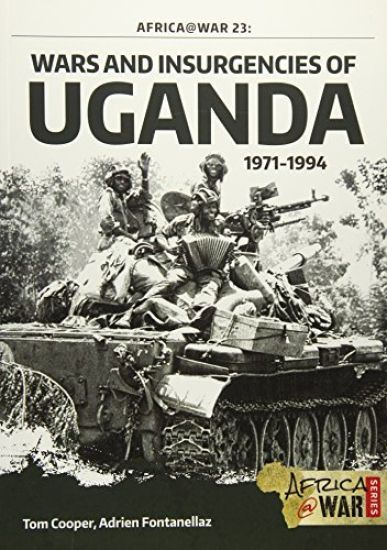
In 1971, Idi Amin Dada, a former officer of the King’s African Rifles and commander of the Ugandan Army, seized power in a military coup in Uganda. Characterised by human rights abuses, political repression, ethnic persecution, extrajudicial killings, nepotism, corruption and gross economic mismanagement, Amin’s rule drove thousands into exile. Amin shifted the country’s orientation in international relations from alliances with the West and Israel, to cooperation with the Soviet Union. With Tanzanian leader Julius Nyerere offering sanctuary to Uganda’s ousted president, Milton Obote, Ugandan relations with Tanzania soon became strained too. Already in 1972, a group of Tanzania-based exiles attempted, unsuccessfully, to invade Uganda and remove Amin. By late 1978, following another attempted coup against him, Amin deployed his troops against the mutineers, some of whom fled across the Tanzanian border. The rebellion against him thus spilled over into Tanzania, against whom Uganda then declared a state of war. Opening with an overview of the ascent of crucial military and political figures, and the build-up of the Tanzanian and Ugandan militaries during the 1960s and 1970s, this volume provides an in-depth study of the related political and military events, but foremost of military operations during the Kagera War– also known as ‘A Just War’ – fought between Tanzania and Uganda in 1978–1979. It further traces the almost continuous armed conflict in Uganda of 1981–1994, which became renowned for emergence of several insurgent movements notorious for incredible violence against civilian population, some of which remain active in central Africa to this day. This book is illustrated with an extensive selection of photographs, colour profiles, and maps, describing the equipment, markings, and tactics of the involved military forces.
On 1 October 1990, hundreds of Banyarawanda militants that served with the Ugandan Army deserted their posts to form the Rwandan Patriotic Front (RPF) and invade Rwanda. Thus began the Rwandan Civil War, which was to culminate in the famous genocide of nearly one million of Tutsi and moderate Hutus, in 1994. Starting with in-depth descriptions of the history of Rwandan political, military and security development, this volume traces the history of the RPA from its emergence as a small-scale insurgent group formed from the ranks of Rwandan refugee diaspora in Uganda; its military operations and related experiences during nearly four years of war against the Rwandan government; and its establishment of control over Kigali, in July 1994. As such, the narrative presented here provides a fascinating and unique insight into the military story behind the emergence of modern-day Rwanda and its military; considered by many to be the‘Israel of Africa’. Providing minute details about RPF’s tactics and doctrine – that strongly influenced developments in a number of other modern-day African wars – this volume is foremost an offering that provides highly interesting backgrounds for and a prequel to, nearly all of the subsequent wars in the neighbouring Democratic Republic of the Congo. Illustrated with over 150 photographs, colour profiles, and maps describing the equipment, colours, and markings, and tactics of the RPF and its opponents, this is a unique study about the emergence of one of the most important US allies on the African continent.