Kirjojen hintavertailu. Mukana 12 595 353 kirjaa ja 12 kauppaa.

Kirjailija

Adrienne Héritier

Kirjat ja teokset yhdessä paikassa: 9 kirjaa, julkaisuja vuosilta 1994-2020, suosituimpien joukossa Differential Europe. Vertaile teosten hintoja ja tarkista saatavuus suomalaisista kirjakaupoista.

Mukana myös kirjoitusasut: Adrienne Heritier

9 kirjaa

Kirjojen julkaisuhaarukka 1994-2020.

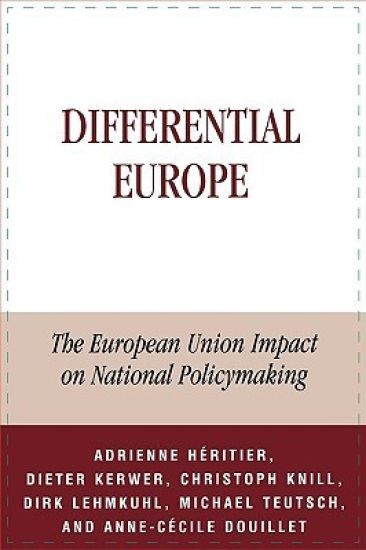
Differential Europe

Differential Europe

Adrienne Héritier; Dieter Kerwer; Christoph Knill; Dirk Lehmkuhl; Michael Teutsch; Anne-Cécile Douillet

Rowman Littlefield Publishers
2001
nidottu
Europe matters, but in different ways in different countries. The European Union affects the policy fabric of all member states, but that impact is differential rather than convergent. In some instances, new policy goals have been added to national agendas and fresh policy instruments are applied, while old ones become less important or are openly challenged. In other instances, when European and national policy objectives are concurrent, national practices may be reinforced, or even redirected, by EU policies. In all instances, however, state actors reconsider national policy practices wherever the EU extends it activities. This innovative study solves the differential puzzle by developing a sophisticated theoretical and conceptual framework for studying the impact of European policies on member states. Focusing especially on transport policy, the authors employ extensive interviews and archival research in an empirically rich set of case studies (Britain, France, Germany, Italy, and the Netherlands) to demonstrate convincingly that this influence depends on pre-existing policies and institutional capacity to change. Depending on the particular phase of regulation in which a country finds itself and on its institutional flexibility, an identical EU policy has remarkably diverse impacts within individual member states. The authors' research points to fascinating counterintuitive results and a new general model that will have implications for anyone studying policymaking in Europe.
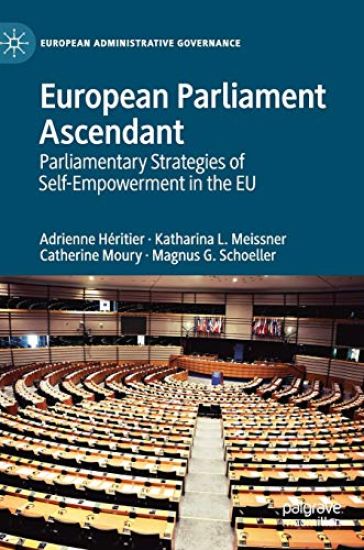
European Parliament Ascendant

European Parliament Ascendant

Adrienne Héritier; Katharina L. Meissner; Catherine Moury; Magnus G. Schoeller

Springer Nature Switzerland AG
2020
nidottu
"If one wants to understand why, from its modest beginnings, the European Parliament has become a major player in EU decision-making, look no further than this book. It presents, to date, the theoretically most compelling, methodologically disciplined and empirically richest account of parliamentary self-empowerment over time, across key functions and policy areas. This volume will be a main point of reference for work on the European Parliament, the dynamics of inter-institutional politics, and EU integration more generally for years to come."—Berthold Rittberger, Professor of International Relations, University of Munich, Germany“Anyone interested in the rise of the European Parliament as a significant actor in the EU should read this book. It offers a fascinating insight into the strategies used by the Parliament to achieve its aims and the conditions for its success or failure. It ranges widely across time and policy areas to give a comprehensive analysis of the Parliament’s changing institutional position.”—Michael Shackleton, Professor of European Institutions, Maastricht University, The Netherlands, and former EP officialThis book analyses the European Parliament’s strategies of self-empowerment over time stretching across cases of new institutional prerogatives as well as substantive policy areas. It considers why and how the Parliament has managed to gain formal and informal powers in this wide variety of cases. The book provides a systematic and comparative analysis of the European Parliament’s formal and informal empowerment in two broad sets of cases: on the one hand, it examines the EP’s empowerment since the Treaty of Rome in three areas that are characteristic of parliamentary democracies, namely legislation, the budget, and the investiture of the executive. On the other hand, it analyses the European Parliament’s role in highly politicised policy areas,namely Economic and Monetary Governance and the shaping of EU trade agreements.
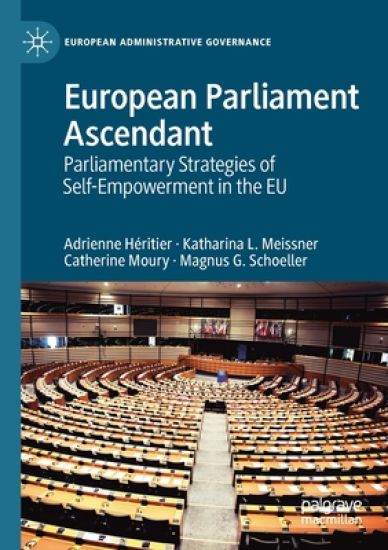
European Parliament Ascendant

European Parliament Ascendant

Adrienne Héritier; Katharina L. Meissner; Catherine Moury; Magnus G. Schoeller

Springer Nature Switzerland AG
2019
sidottu
"If one wants to understand why, from its modest beginnings, the European Parliament has become a major player in EU decision-making, look no further than this book. It presents, to date, the theoretically most compelling, methodologically disciplined and empirically richest account of parliamentary self-empowerment over time, across key functions and policy areas. This volume will be a main point of reference for work on the European Parliament, the dynamics of inter-institutional politics, and EU integration more generally for years to come."—Berthold Rittberger, Professor of International Relations, University of Munich, Germany“Anyone interested in the rise of the European Parliament as a significant actor in the EU should read this book. It offers a fascinating insight into the strategies used by the Parliament to achieve its aims and the conditions for its success or failure. It ranges widely across time and policy areas to give a comprehensive analysis of the Parliament’s changing institutional position.”—Michael Shackleton, Professor of European Institutions, Maastricht University, The Netherlands, and former EP officialThis book analyses the European Parliament’s strategies of self-empowerment over time stretching across cases of new institutional prerogatives as well as substantive policy areas. It considers why and how the Parliament has managed to gain formal and informal powers in this wide variety of cases. The book provides a systematic and comparative analysis of the European Parliament’s formal and informal empowerment in two broad sets of cases: on the one hand, it examines the EP’s empowerment since the Treaty of Rome in three areas that are characteristic of parliamentary democracies, namely legislation, the budget, and the investiture of the executive. On the other hand, it analyses the European Parliament’s role in highly politicised policy areas,namely Economic and Monetary Governance and the shaping of EU trade agreements.
Changing Rules of Delegation

Changing Rules of Delegation

Adrienne Héritier; Catherine Moury; Carina S. Bischoff; Carl Fredrik Bergström

Oxford University Press
2013
sidottu
With each legislative issue, legislators have to decide whether to delegate decision-making to the executive and/or to expert bodies in order to flesh out the details of this legislation, or, alternatively, to spell out all aspects of this decision in legislation proper. The reasons why to delegate have been of prime interest to political science. The debate has concentrated on principal-agent theory to explain why politicians delegate decision-making to bureaucrats, to independent regulatory agencies, and to others actors and how to control these agents. By contrast, Changing Rules of Delegation focuses on these questions: Which actors are empowered by delegation? Are executive actors empowered over legislative actors? How do legislative actors react to the loss of power? What opportunities are there to change the institutional rules governing delegation in order to (re)gain institutional power and, with it influence over policy outcomes? The authors analyze the conditions and processes of change of the rules that delegate decision-making power to the Commission's implementing powers under comitology. Focusing on the role of the European Parliament the authors explain why the Commission, the Council, and increasingly the Parliament, delegated decision-making to the Commission. If they chose delegation, they still have to determine under which institutional rule comitology should operate. These rules, too, distribute power unequally among actors and therefore raise the question of how they came about in the first place and whether and how the "losers" of a rule change seek to alter the rules at a later point in time.
Explaining Institutional Change in Europe

Explaining Institutional Change in Europe

Adrienne Heritier

Oxford University Press
2007
sidottu
How and why do institutions change? Institutions, understood as rules of behaviour constraining and facilitating social interaction, are subject to different forms and processes of change. A change may be designed intentionally on a large scale and then be followed by a period of only incremental adjustments to new conditions. But institutions may also emerge as informal rules, persist for a long time and only be formalized later. Why? The causes, processes and outcomes of institutional change raise a number of conceptual, theoretical and empirical questions. While we know a lot about the creation of institutions, relatively little research has been conducted about their transformation once they have been put into place. Attention has focused on politically salient events of change, such as the Intergovernmental Conferences of Treaty reform. In focussing on such grand events, we overlook inconspicuous changes of European institutional rules that are occurring on a daily basis. Thus, the European Parliament has gradually acquired a right of investing individual Commissioners. This has never been an issue in the negotiations of formal treaty revisions. Or, the decision-making rule(s) under which the European Parliament participates in the legislative process have drastically changed over the last decades starting from a modest consultation ending up with codecision. The book discusses various theories accounting for long-term institutional change and explores them on the basis of five important institutional rules in the European Union. It proposes typical sequences of long-term institutional change and their theorization which hold for other contexts as well, if the number of actors and their goals are clearly defined, and interaction takes place under the "shadow of the future" .
Policy-Making and Diversity in Europe

Policy-Making and Diversity in Europe

Adrienne Héritier

Cambridge University Press
1999
pokkari
Policy-Making and Diversity in Europe examines the European polity and its policy-making processes. In particular, it asks how an institution which is so riddled with veto points manages to be such an active and aggressive policy maker. Héritier argues that the diversity of actors’ interests and the consensus-forcing nature of European institutions would almost inevitably stall the decision-making process, were it not for the existence of creative informal strategies and policy-making patterns. Termed by the author ‘subterfuge’, these strategies prevent political impasses and ‘make Europe work’. The book examines the presence of subterfuge in the policy domains of market-making, the provision of collective goods, redistribution and distribution. Subterfuge is seen to reinforce the primary functions of the European polity: the accommodation of diversity, policy innovation and democratic legitimation. Professor Héritier concludes that the use of subterfuge to reconcile unity with diversity and competition with co-operation is the greatest challenge facing European policy-making.
Policy-Making and Diversity in Europe

Policy-Making and Diversity in Europe

Adrienne Héritier

Cambridge University Press
1999
sidottu
Policy-Making and Diversity in Europe examines the European polity and its policy-making processes. In particular, it asks how an institution which is so riddled with veto points manages to be such an active and aggressive policy maker. Héritier argues that the diversity of actors' interests and the consensus-forcing nature of European institutions would almost inevitably stall the decision-making process, were it not for the existence of creative informal strategies and policy-making patterns. Termed by the author 'subterfuge', these strategies prevent political impasses and 'make Europe work'. The book examines the presence of subterfuge in the policy domains of market-making, the provision of collective goods, redistribution and distribution. Subterfuge is seen to reinforce the primary functions of the European polity: the accommodation of diversity, policy innovation and democratic legitimation. Professor Héritier concludes that the use of subterfuge to reconcile unity with diversity and competition with co-operation is the greatest challenge facing European policy-making.