Kirjojen hintavertailu. Mukana 12 595 353 kirjaa ja 12 kauppaa.

Kirjailija

Aidan Hogan

Kirjat ja teokset yhdessä paikassa: 5 kirjaa, julkaisuja vuosilta 2020-2025, suosituimpien joukossa The Web of Data. Vertaile teosten hintoja ja tarkista saatavuus suomalaisista kirjakaupoista.

5 kirjaa

Kirjojen julkaisuhaarukka 2020-2025.

Inspiring Sports Stories for Curious Kids
Discover 14 gripping tales of perseverance and triumph from amazing athletes like Tom Brady, Bill Russell & Kathrine Switzer. Inspire young hearts and minds with stories of courage and achievement.Dive in to find heroic stories such as;Tom Brady: From underdog to Super Bowl champion, witness the resilience of this football legend.Jillian Potter: Rugby star who defied all the odds.Kathrine Switzer: Trailblazing marathon runner who shattered barriers and paved the way for women in sports.Tony Hawk: Skateboarding pioneer who defied gravity and stereotypes to become a global icon.Laird Hamilton: Surfing legend who conquered the waves and redefined the limits of human potential.And many more Benefits to you child: Enhanced Self-Belief: Stories of triumph help your child see their potential and believe in their abilities.Improved Emotional Connection: Discussing these stories can strengthen your bond and open up conversations about feelings and aspirations.Resilience and Determination: Equip your child with the mindset to keep going, even when things get tough.
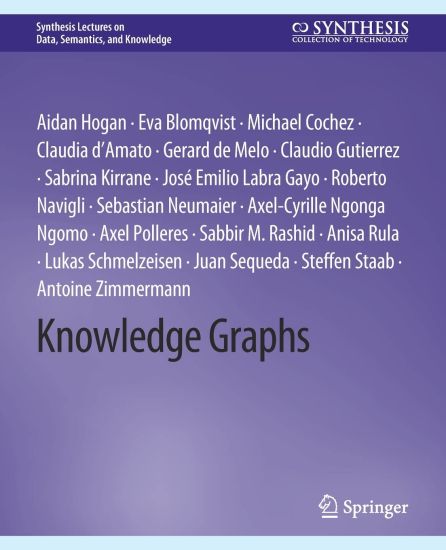
Knowledge Graphs

Knowledge Graphs

Aidan Hogan; Eva Blomqvist; Michael Cochez; Claudia d’Amato; Gerard de Melo; Claudio Gutierrez; Sabrina Kirrane; Jose Emilio Labra Gayo; Roberto Navigli; Sebastian Neumaier; Axel Polleres; Sabbir Rashid; Anisa Rula; Antoine Zimmermann; Lukas Schmelzeisen; Axel-Cyrille Ngonga Ngomo; Juan Sequeda; Steffen Staab

Springer International Publishing AG
2021
nidottu
This book provides a comprehensive and accessible introduction to knowledge graphs, which have recently garnered notable attention from both industry and academia. Knowledge graphs are founded on the principle of applying a graph-based abstraction to data, and are now broadly deployed in scenarios that require integrating and extracting value from multiple, diverse sources of data at large scale. The book defines knowledge graphs and provides a high-level overview of how they are used. It presents and contrasts popular graph models that are commonly used to represent data as graphs, and the languages by which they can be queried before describing how the resulting data graph can be enhanced with notions of schema, identity, and context. The book discusses how ontologies and rules can be used to encode knowledge as well as how inductive techniques—based on statistics, graph analytics, machine learning, etc.—can be used to encode and extract knowledge. It covers techniques for the creation, enrichment, assessment, and refinement of knowledge graphs and surveys recent open and enterprise knowledge graphs and the industries or applications within which they have been most widely adopted. The book closes by discussing the current limitations and future directions along which knowledge graphs are likely to evolve. This book is aimed at students, researchers, and practitioners who wish to learn more about knowledge graphs and how they facilitate extracting value from diverse data at large scale. To make the book accessible for newcomers, running examples and graphical notation are used throughout. Formal definitions and extensive references are also provided for those who opt to delve more deeply into specific topics.
Knowledge Graphs

Knowledge Graphs

Aidan Hogan; Eva Blomqvist; Michael Cochez; Claudia d'Amato; Gerard de Melo; Claudio Gutierrez; Sabrina Kirrane; Jose Emilio Labra Gayo; Roberto Navigli; Sebastian Neumaier; Axel-Cyrille Ngonga Ngomo; Axel Polleres; Sabbir M. Rashid; Anisa Rula; Juan Sequeda; Lukas Schmelzeisen; Steffen Staab; Antoine Zimmermann

MORGAN CLAYPOOL PUBLISHERS
2021
nidottu
This book provides a comprehensive and accessible introduction to knowledge graphs, which have recently garnered notable attention from both industry and academia. Knowledge graphs are founded on the principle of applying a graph-based abstraction to data, and are now broadly deployed in scenarios that require integrating and extracting value from multiple, diverse sources of data at large scale.The book defines knowledge graphs and provides a high-level overview of how they are used. It presents and contrasts popular graph models that are commonly used to represent data as graphs, and the languages by which they can be queried before describing how the resulting data graph can be enhanced with notions of schema, identity, and context. The book discusses how ontologies and rules can be used to encode knowledge as well as how inductive techniques—based on statistics, graph analytics, machine learning, etc.—can be used to encode and extract knowledge. It covers techniques for the creation, enrichment, assessment, and refinement of knowledge graphs and surveys recent open and enterprise knowledge graphs and the industries or applications within which they have been most widely adopted. The book closes by discussing the current limitations and future directions along which knowledge graphs are likely to evolve.This book is aimed at students, researchers, and practitioners who wish to learn more about knowledge graphs and how they facilitate extracting value from diverse data at large scale. To make the book accessible for newcomers, running examples and graphical notation are used throughout. Formal definitions and extensive references are also provided for those who opt to delve more deeply into specific topics.
The Web of Data

The Web of Data

Aidan Hogan

Springer Nature Switzerland AG
2021
nidottu
This book’s main goals are to bring together in a concise way all the methodologies, standards and recommendations related to Data, Queries, Links, Semantics, Validation and other issues concerning machine-readable data on the Web, to describe them in detail, to provide examples of their use, and to discuss how they contribute to – and how they have been used thus far on – the “Web of Data”. As the content of the Web becomes increasingly machine readable, increasingly complex tasks can be automated, yielding more and more powerful Web applications that are capable of discovering, cross-referencing, filtering, and organizing data from numerous websites in a matter of seconds.The book is divided into nine chapters, the first of which introduces the topic by discussing the shortcomings of the current Web and illustrating the need for a Web of Data. Next, “Web of Data” provides an overview of the fundamental concepts involved, and discusses some current use-cases on the Web wheresuch concepts are already being employed. “Resource Description Framework (RDF)” describes the graph-structured data model proposed by the Semantic Web community as a common data model for the Web. The chapter on “RDF Schema (RDFS) and Semantics” presents a lightweight ontology language used to define an initial semantics for terms used in RDF graphs. In turn, the chapter “Web Ontology Language (OWL)” elaborates on a more expressive ontology language built upon RDFS that offers much more powerful ontological features. In “SPARQL Query Language” a language for querying and updating RDF graphs is described, with examples of the features it supports, supplemented by a detailed definition of its semantics. “Shape Constraints and Expressions (SHACL/ShEx)” introduces two languages for describing the expected structure of – and expressing constraints on – RDF graphs for the purposes of validation. “Linked Data” discusses the principles and best practices proposed by the Linked Data communityfor publishing interlinked (RDF) data on the Web, and how these techniques have been adopted. The final chapter highlights open problems and rounds out the coverage with a more general discussion on the future of the Web of Data. The book is intended for students, researchers and advanced practitioners interested in learning more about the Web of Data, and about closely related topics such as the Semantic Web, Knowledge Graphs, Linked Data, Graph Databases, Ontologies, etc. Offering a range of accessible examples and exercises, it can be used as a textbook for students and other newcomers to the field. It can also serve as a reference handbook for researchers and developers, as it offers up-to-date details on key standards (RDF, RDFS, OWL, SPARQL, SHACL, ShEx, RDB2RDF, LDP), along with formal definitions and references to further literature. The associated website webofdatabook.org offers a wealth of complementary material, including solutions to the exercises, slides for classes, raw data for examples, and a section for comments and questions.
The Web of Data

The Web of Data

Aidan Hogan

Springer Nature Switzerland AG
2020
sidottu
This book’s main goals are to bring together in a concise way all the methodologies, standards and recommendations related to Data, Queries, Links, Semantics, Validation and other issues concerning machine-readable data on the Web, to describe them in detail, to provide examples of their use, and to discuss how they contribute to – and how they have been used thus far on – the “Web of Data”. As the content of the Web becomes increasingly machine readable, increasingly complex tasks can be automated, yielding more and more powerful Web applications that are capable of discovering, cross-referencing, filtering, and organizing data from numerous websites in a matter of seconds.The book is divided into nine chapters, the first of which introduces the topic by discussing the shortcomings of the current Web and illustrating the need for a Web of Data. Next, “Web of Data” provides an overview of the fundamental concepts involved, and discusses some current use-cases on the Web wheresuch concepts are already being employed. “Resource Description Framework (RDF)” describes the graph-structured data model proposed by the Semantic Web community as a common data model for the Web. The chapter on “RDF Schema (RDFS) and Semantics” presents a lightweight ontology language used to define an initial semantics for terms used in RDF graphs. In turn, the chapter “Web Ontology Language (OWL)” elaborates on a more expressive ontology language built upon RDFS that offers much more powerful ontological features. In “SPARQL Query Language” a language for querying and updating RDF graphs is described, with examples of the features it supports, supplemented by a detailed definition of its semantics. “Shape Constraints and Expressions (SHACL/ShEx)” introduces two languages for describing the expected structure of – and expressing constraints on – RDF graphs for the purposes of validation. “Linked Data” discusses the principles and best practices proposed by the Linked Data communityfor publishing interlinked (RDF) data on the Web, and how these techniques have been adopted. The final chapter highlights open problems and rounds out the coverage with a more general discussion on the future of the Web of Data. The book is intended for students, researchers and advanced practitioners interested in learning more about the Web of Data, and about closely related topics such as the Semantic Web, Knowledge Graphs, Linked Data, Graph Databases, Ontologies, etc. Offering a range of accessible examples and exercises, it can be used as a textbook for students and other newcomers to the field. It can also serve as a reference handbook for researchers and developers, as it offers up-to-date details on key standards (RDF, RDFS, OWL, SPARQL, SHACL, ShEx, RDB2RDF, LDP), along with formal definitions and references to further literature. The associated website webofdatabook.org offers a wealth of complementary material, including solutions to the exercises, slides for classes, raw data for examples, and a section for comments and questions.