Kirjojen hintavertailu. Mukana 12 595 353 kirjaa ja 12 kauppaa.

Kirjailija

Air Command and Staff College

Kirjat ja teokset yhdessä paikassa: 34 kirjaa, julkaisuja vuosilta 2008-2017, suosituimpien joukossa The Collapse of the Democratic People's Republic of Korea: A Multilateral Approach to Northeast Asia. Vertaile teosten hintoja ja tarkista saatavuus suomalaisista kirjakaupoista.

34 kirjaa

Kirjojen julkaisuhaarukka 2008-2017.

A Look Down the Slippery Slope: Domestic Operations, Outsourcing, and the Erosion of Military Culture

A Look Down the Slippery Slope: Domestic Operations, Outsourcing, and the Erosion of Military Culture

Bryan D. Watson; Air Command and Staff College

Createspace Independent Publishing Platform
2017
nidottu
This paper discusses two simultaneous trends inside America's military culture - its increasing domestic role and its growing reliance upon defense contractors. First, the appropriate role of a standing military in a democratic society is an issue that has been the focus of significant debate ever since the founding of our republic. The issue becomes even more complex when the military's mission takes on a domestic tone; in other words, domestic military operations can quickly result in diminished public support. Second, recent conflicts have shown a dramatic increase in the extent to which American armed forces rely upon commercial enterprises in order to achieve military objectives. Despite that fact, there exist certainfundamental differences between uniformed military personnel and their commercially-orientedcontractor counterparts; these differences are profound and involve basic issues that go to the heart of military service and the nature of the modern profession of arms. This is true despite the fact that a great many individual contractor employees are extremely patriotic, and have a deep appreciation for men and women in uniform. Together, these two independent trend lines may point to a troubling future that includes a dramatic erosion of our military culture. If that is true, America's long-term ability to project combat power may ultimately falter as well.

Historical Analysis of the 1st Air Commando Group Operations in the CBI Theater August 1943 to May 1944

Historical Analysis of the 1st Air Commando Group Operations in the CBI Theater August 1943 to May 1944

Air Command and Staff College

Createspace Independent Publishing Platform
2014
nidottu
This book conducts an analysis of the 1st Air Commando Group (ACG) and its operations in the China-Burma-India (CBI) theater from August 1943 to May 1944. History lends credence to the fact that this small unorthodox group of airmen, envisioned from the simple idea of "what if" and fashioned in a mere few months time into a cohesive and viable fighting force, breathed life into the stagnant Allied effort of removing the Japanese from the China-Burma-India theater. The question is, how? How could such a small unit, which was forced upon the traditional military structure in the CBI theater, accomplish the seemingly impossible where others before had failed?The author maintains that the success of the 1st Air Commando Group was the result of key factors which when combined formed a "magic elixir" boosting the ailing Allied effort in this theater. Those key factors were strong leadership, efficient organization including the hiring of the "right" people, unit training, joint training to promote teamwork, and, tactics and innovation.This analysis gathered supporting information from primary source documents stored at the USAF Historical Research Agency (USAFHRA) as well as utilizing secondary sources for background information. This book looks at the 1st Air Commando Group from August 1943 through May 1944. It begins with a discussion of the events which gave rise to the need for the Air Commandos. Following is a discussion of the organization of the unit, deployment, preparations in-theater, and Operation THURSDAY -the aerial invasion of Burma. Analysis of the reasons for success follows next. Finally, the book closes with final thoughts on the 1st Air Commando Group and lessons learned.The unit was broken apart following its successes through May 1944, never to fight again as an independent cohesive organization. The author surmises that the key ingredients to the "magic elixir" success of this fighting force were no longer present. Without those key factors, the unit was not to be. If it could be narrowed down to a single factor, the underlying key to the success of the Air Commandos was the effective leadership of individuals like General H. H. Arnold, Colonel Philip Cochran, Colonel John Alison, British Brigadier General Orde C. Wingate, and British Admiral Mountbatten. The strength of character and conviction of these individuals enabled an unorthodox organization to be superimposed on an orthodox system and make it work. Finally, many of the ways in which the military operates today-emphasis on joint doctrine, the establishment of US Special Operations Command, and the like-find their roots in the organization and operations of the First Air Commandos. The military was deaf to the Air Commando "lessons learned" for many years. It is ironic that the services have come full circle and now endorse many of their procedures in formalized doctrine.
Warden's Five-Ring System Theory: Legitimate Wartime Military Targeting or An Increased Potential to Violate the Law and Norms of Expected Behavior?
With the publication of -Air Theory for the Twenty-first Century," Colonel John Wardenushered in a new era of wartime targeting. No longer are warfighters limited, as in years past, toan ad hoc, haphazard system of selecting wartime targets. Rather, Warden presents the warfighter with a unique tool-the five-ring system theory-that dramatically improves the warfighter's ability to systematically identify wartime targets.However, for all of its acclaim, little has been written about Warden's five-ring system theory. Even less has been written about the legal and moral implications of using Warden's theory to identify wartime targets. In this book: (1) briefly examine Warden's theory in lightof prevailing law and norms of expected behavior; (2) find that Warden's five-ring system theorysidesteps major issues; namely it fails to account for the legal and moral constraints of wartimetargeting and, in doing so, increases the warfighter's potential to run afoul of international law, domestic law, and norms of expected behavior; and (3) conclude, as a result, that such targetingshould not be done without due consideration to the legal and moral issues surrounding thecomplex process of targeting.
America's War on Terror: Islamic Jihadist Ideologue or Radical Hijacker of Islam- Will the Real Enemy Please Step Forward
The United States National Security Strategy contends that the War on Terror is a "battle ofideas - a fight against the terrorists and against their murderous ideology." In turn, it separatesthe radical Islamist from their religion - Islam. The problem with this contention rests with thefact that there is no separation of religion from the terrorists', nor from their murderous ideology.In light of this disconnect, a new comprehensive counter strategy is required. Furthermore, ascribing to the premise that today's fight represents a global insurgency, the revised strategymust seek out ways to employ America's and its allies' full complement of instruments ofnational power. These efforts could be used to aid a grassroots establishment of a non-Western, moderate Islamic voice, go on an offensive information operations campaign, or even foster thedevelopment of a new form of Pan-Arabism. The end goal would be to create a unifying counterideological effort and win the hearts and minds of the moderate Muslim community. By winningover the hearts and minds of this populace, the counterinsurgency would gain the upper handover the effectiveness of the insurgent's efforts and his ability to use the population for his ends, and eventually achieve victo
Crisis In Mexico: Assessing The Mérida Initiative And Its Impact On Us-Mexican Security

Crisis In Mexico: Assessing The Mérida Initiative And Its Impact On Us-Mexican Security

Air Command and Staff College

Createspace Independent Publishing Platform
2014
nidottu
President George W. Bush signed the M rida Initiative, referred to as Plan Mexico by critics, into law on June 30, 2008. The plan contains approximately $1.5 billion in aid to Mexico, Central America, and Caribbean countries to improve regional security by reducing organized crime, drug smuggling, and illegal arms trafficking while strengthening domestic institutions. Critics argue that the plan does not adequately address the demand side of the drug model, will add to the militarization of Mexico, empower corrupt institutions, and reduce the rule of law while failing to address the violence of organized crime.4 The researcher has identified organized crime, socio-economic disparity, and institutional corruption as the main factors that led Mexican President Calder n to ask for assistance from the United States. Although the M rida Initiative is a comprehensive plan that attempts to solve a number of complex transnational issues that affect both the United States and Mexico, its performance to date, indicates that it is not meeting its objectives. Using problem-solution methodology, the researcher identified additional measures, such as demand-side drug reduction programs, US gun control enforcement, immigration reform, and economic reforms that would improve the chances of achieving long-term stability and security in the region. The success of the M rida Initiative will require a holistic and synergistic approach between a joint, interagency, and coalition team.
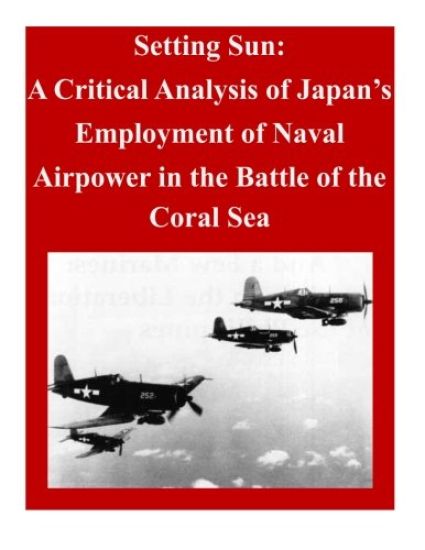
Setting Sun: A Critical Analysis of Japan's Employment of Naval Airpower in the Battle of the Coral Sea

Setting Sun: A Critical Analysis of Japan's Employment of Naval Airpower in the Battle of the Coral Sea

Air Command and Staff College

Createspace Independent Publishing Platform
2014
nidottu
The Battle of the Coral Sea, the first Naval engagement fought exclusively between Naval Air forces, was a pivotal battle of the war in the Pacific. Although considered a Japanese tactical victory, it was the beginning of the end of Japan's war effort. This analysis examines this decisive battle from the Japanese perspective. The criticalanalysis will include a summary of the reasons why the battle unfolded as it did, and willdraw conclusions as to how the Japanese may have been more successful both strategically and tactically in this key battle of World War II.
The Battle of Kasserine Pass: An Examination of Allied Operational Failings

The Battle of Kasserine Pass: An Examination of Allied Operational Failings

Air Command and Staff College

Createspace Independent Publishing Platform
2014
nidottu
The Battle of Kasserine Pass proved to be a shock both to American military forces in the field and to the American public at home. The defeat of the Allied forces in the battle put doubt into the minds of many - all of whom assumed the righteous democracies of the western Allies could not be defeated in the field by the armies of Fascism. The defeat suffered by the Allies had nothing to do with right versus wrong, however, but was very much a product of a number of operational shortcomings on the part of the Allies. Poor logistics, failures on the part of American leadership, lack of unity of effort on the part of the Allies, the lack of combat experience, and inferior equipment all combined to contribute to the failure at Kasserine.Despite the setback at Kasserine Pass, the Americans proved quick learners, and applied the lessons of the North African experience to the remainder of their campaign in the European theater.
Deflating British Radar Myths of World War II

Deflating British Radar Myths of World War II

Air Command and Staff College

Createspace Independent Publishing Platform
2014
nidottu
British and Allied memoirs and histories have contributed to the rise of three myths concerning the discovery and employment of radar. These myths are as follows. The first myth is that Sir Robert Watson-Watt is the father and sole inventor of radar. The second is that Germany's discovery and realization of radar's military worth occurred after 1940 following exposure to British systems. The third myth gives radar the pivotal role in the defeat of the Luftwaffe in the Battle of Britain.To deflate these myths the origin of radar is traced from James Maxwell's discovery of radio waves to early radar theorists and inventors. Their role in the story of radar illuminates and contributes to the deflation of the radar myths.Both the rebirth of the Luftwaffe and evolution of the R.A.F. during the 1920's and 1930's shows how each service independently arrived at the development of radar technology for different reasons. In 1939 Germany possessed some of the world's best and most enduring radar designs, as well as essential navigation and bombing aids. England's Chain Home radar was a dead end technology with serious shortcomings, but was skillfully melded to an innovative command and control system. The illumination of German radar achievements and a balanced analysis of British defensive systems essentially deflates the radar myths.
The Campaigns of Hannibal and Scipio: Searching for Congruency

The Campaigns of Hannibal and Scipio: Searching for Congruency

Air Command and Staff College

Createspace Independent Publishing Platform
2014
nidottu
This work analyzes the Second Punic War using the Contextual and Operational Elements found in the Campaign Planning Model to determine how Rome and Carthage conducted the war, and whether they maintained congruency as each respective country pursued their national objective. It examines how they selected their grand strategy, and how that strategy was interpreted and executed at the operational and tactical levels. The model highlights flaws in Carthages formulation and application of its grand strategy which, combined with the lack of strategic insight at the operational level, kept them from satisfying their objectives. This work also shows that Romes formulation and execution of its grand strategy, even with several interim changes in operational strategy, flawlessly applied the tenets of the Campaign Planning Model and enabled Rome to always keep its strategic perspective firmly in view to secure eventual victory. This work also recommends further study of Romes operational strategy, in particular the campaign of its commanding general, Publius Cornelius Scipio.Scipio's campaign provides excellent examples of the principles of surprise and concentration, and demonstrates how innovation and mobility can produce an indirect strategy that can not only defeat a larger enemy, but also maintain flawless congruency with strategic objectives. Scipio provides an outstanding study in military genius, indirect strategy application, innovation, and statesmanship. He most closely embodies the soldier-statesman needed in modern coalition warfare.