Kirjojen hintavertailu. Mukana 12 595 353 kirjaa ja 12 kauppaa.

Kirjailija

Ajit Jaokar

Kirjat ja teokset yhdessä paikassa: 2 kirjaa, julkaisuja vuosilta 2023-2024, suosituimpien joukossa AI-Assisted Programming for Web and Machine Learning. Vertaile teosten hintoja ja tarkista saatavuus suomalaisista kirjakaupoista.

2 kirjaa

Kirjojen julkaisuhaarukka 2023-2024.

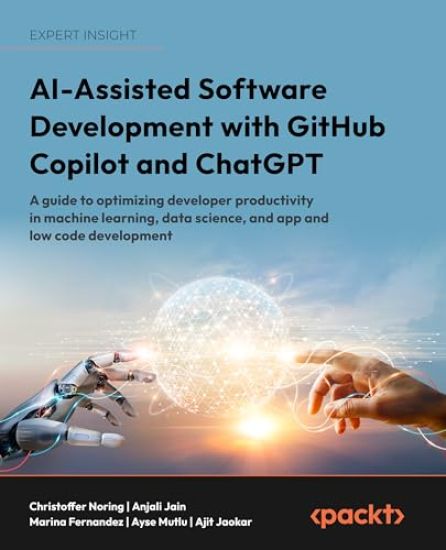
AI-Assisted Programming for Web and Machine Learning

AI-Assisted Programming for Web and Machine Learning

Christoffer Noring; Anjali Jain; Marina Fernandez; Ayse Mutlu; Ajit Jaokar

PACKT PUBLISHING LIMITED
2024
nidottu
Speed up your development processes and improve your productivity by writing practical and relevant prompts to build web applications and Machine Learning (ML) models Purchase of the print or Kindle book includes a free PDF copy Key Features Utilize prompts to enhance frontend and backend web development Develop prompt strategies to build robust machine learning models Use GitHub Copilot for data exploration, maintaining existing code bases, and augmenting ML models into web applications Book DescriptionAI-Assisted Programming for Web and Machine Learning shows you how to build applications and machine learning models and automate repetitive tasks. Part 1 focuses on coding, from building a user interface to the backend. You’ll use prompts to create the appearance of an app using HTML, styling with CSS, adding behavior with JavaScript, and working with multiple viewports. Next, you’ll build a web API with Python and Flask and refactor the code to improve code readability. Part 1 ends with using GitHub Copilot to improve the maintainability and performance of existing code. Part 2 provides a prompting toolkit for data science from data checking (inspecting data and creating distribution graphs and correlation matrices) to building and optimizing a neural network. You’ll use different prompt strategies for data preprocessing, feature engineering, model selection, training, hyperparameter optimization, and model evaluation for various machine learning models and use cases. The book closes with chapters on advanced techniques on GitHub Copilot and software agents. There are tips on code generation, debugging, and troubleshooting code. You’ll see how simpler and AI-powered agents work and discover tool calling.What you will learn Speed up your coding and machine learning workflows with GitHub Copilot and ChatGPT Use an AI-assisted approach across the development lifecycle Implement prompt engineering techniques in the data science lifecycle Develop the frontend and backend of a web application with AI assistance Build machine learning models with GitHub Copilot and ChatGPT Refactor code and fix faults for better efficiency and readability Improve your codebase with rich documentation and enhanced workflows Who this book is forExperienced developers new to GitHub Copilot and ChatGPT can discover the best strategies to improve productivity and deliver projects quicker than traditional methods. This book is ideal for software engineers working on web or machine learning projects. It is also a useful resource for web developers, data scientists, and analysts who want to improve their efficiency with the help of prompting. This book does not teach web development or how different machine learning models work.
Causal Inference and Discovery in Python

Causal Inference and Discovery in Python

Aleksander Molak; Ajit Jaokar

PACKT PUBLISHING LIMITED
2023
nidottu
Demystify causal inference and casual discovery by uncovering causal principles and merging them with powerful machine learning algorithms for observational and experimental data Purchase of the print or Kindle book includes a free PDF eBook Key Features Examine Pearlian causal concepts such as structural causal models, interventions, counterfactuals, and more Discover modern causal inference techniques for average and heterogenous treatment effect estimation Explore and leverage traditional and modern causal discovery methods Book DescriptionCausal methods present unique challenges compared to traditional machine learning and statistics. Learning causality can be challenging, but it offers distinct advantages that elude a purely statistical mindset. Causal Inference and Discovery in Python helps you unlock the potential of causality. You’ll start with basic motivations behind causal thinking and a comprehensive introduction to Pearlian causal concepts, such as structural causal models, interventions, counterfactuals, and more. Each concept is accompanied by a theoretical explanation and a set of practical exercises with Python code. Next, you’ll dive into the world of causal effect estimation, consistently progressing towards modern machine learning methods. Step-by-step, you’ll discover Python causal ecosystem and harness the power of cutting-edge algorithms. You’ll further explore the mechanics of how “causes leave traces” and compare the main families of causal discovery algorithms. The final chapter gives you a broad outlook into the future of causal AI where we examine challenges and opportunities and provide you with a comprehensive list of resources to learn more. By the end of this book, you will be able to build your own models for causal inference and discovery using statistical and machine learning techniques as well as perform basic project assessment.What you will learn Master the fundamental concepts of causal inference Decipher the mysteries of structural causal models Unleash the power of the 4-step causal inference process in Python Explore advanced uplift modeling techniques Unlock the secrets of modern causal discovery using Python Use causal inference for social impact and community benefit Who this book is forThis book is for machine learning engineers, researchers, and data scientists looking to extend their toolkit and explore causal machine learning. It will also help people who’ve worked with causality using other programming languages and now want to switch to Python, those who worked with traditional causal inference and want to learn about causal machine learning, and tech-savvy entrepreneurs who want to go beyond the limitations of traditional ML. You are expected to have basic knowledge of Python and Python scientific libraries along with knowledge of basic probability and statistics.