

Kirjailija
Alain Danielou
Kirjat ja teokset yhdessä paikassa: 10 kirjaa, julkaisuja vuosilta 1987-2021, suosituimpien joukossa El Shivaísmo. Vertaile teosten hintoja ja tarkista saatavuus suomalaisista kirjakaupoista.
Mukana myös kirjoitusasut: Alain Daniélou
10 kirjaa
Kirjojen julkaisuhaarukka 1987-2021.

Shiva et Dionysos: La religion de la Nature et de l'Eros - De la préhistoire à l'avenir
Alain Daniélou
Fayard
2018
nidottu
Pour Alain Dani lou, l'Occident a perdu sa propre tradition et loign l'homme de la nature et du divin. Il nous fait d couvrir ici que les rites et les croyances du monde occidental ancien sont tr s proches du Shiva sme et tr s ais ment expliqu s l'aide des textes et des rites pr serv s dans l'Inde. Ce sont les religions relativement r centes du monde aryen et s mitique, Juda sme, Christianisme, Islam et Communisme qui ont loign l'homme du reste de la cr ation et de l'exp rience religieuse et mystique multimill naire dont la tradition s'est pr serv e dans l'Inde jusqu' nos jours et que l'Occident, s'il veut survivre, devra retrouver.L'auteur1935-1948, tudes de sanskrit, philosophie, th ologie, musique dans les coles traditionnelles hindoues B nar s; 1948-1954, professeur l'universit hindoue de B nar s; 1954-1956, directeur de la biblioth que de manuscrits et des ditions sanskrites d'Adyar Madras; 1956-1963, membre de l'Institut fran ais d'indologie et de l'Ecole fran aise d'Extr me-Orient; 1963-1977, directeur de l'Institut international d' tudes comparatives de la musique Berlin et Venise.
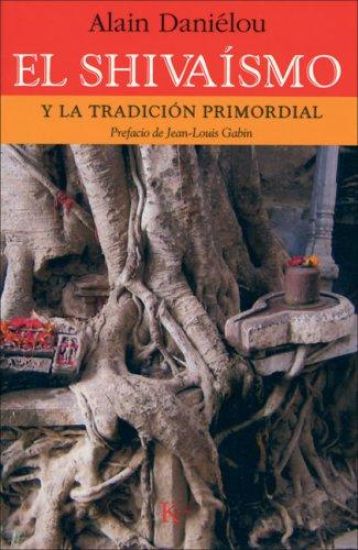
Revealing the influence of Saivism on the Western world, this rare collection of articles offers an in-depth look at the many facets of the Samkya, the cosmologic doctrines of the Saivite tradition. An oftentimes poetic discussion of sexuality, the science of dreams, and polytheism, the book illuminates the relationship between Saivism and the Western world. Revelando la influencia del Shiva en el mundo occidental, esta nica colecci n de art culos ofrece una detallada exploraci n de las doctrinas cosmol gicas del Shiva smo. Una discusi n po tica de la sexualidad, la ciencia de los sue os y del polite smo, el libro ilumina la relaci n entre el Shiva smo y la cultura occidental.

This book reveals the influence of Shaivism on the Western world, discusses Shaivism's understanding of sacred sexuality and presents the connections between Vedic poetry and metaphysics. In "Shive and the Primordial Tradition", Alain Danielou explores the relationship between Shaivism and the Western world. Shaivite philosophy does not oppose theology, cosmology and science because it recognises that their common aim is to seek to understand and explain the nature of the world. In the Western world, the idea of bridging the divide between science and religion is just beginning to touch the edges of mainstream thought. This rare collection of the late author's writings contains several never-before-published articles and offers an in-depth look at the many facets of the Samkhya, the cosmologic doctrines of the Shaivite tradition. Danielou provides important revelations on subjects such as the science of dreams, the role of poetry and sexuality in the sacred, the personality of the great Shankara and the Shaivite influence on the Scythians and the Parthians (and by extension, the Hellenic world in general).Providing a convincing argument in favour of the polytheistic approach, he explains that monotheism is merely the deification of individualism - the separation of humanity from nature - and that, by acknowledging the sacred in everything, we can recognise the imprint of the primordial tradition.
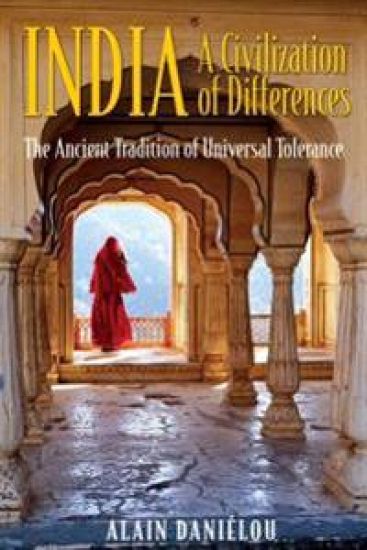
In classical India social ethics are based on each individual's functional role in society. These ethics vary according to caste in order to maximize the individual's effectiveness in the social context. This is the definition of caste ethics. The Indian caste system is not a hierarchy with some who are privileged and others who are despised: it is a natural ordering an organizing principle of a society wherein differences are embraced rather than ignored. In the caste system it is up to the individual to achieve perfection in the state to which he or she is born since to a certain extent that state also forms part of a person's nature. All people must accomplish their individual spiritual destinies while as members of a social group ensuring the continuity of the group and collaborating in creating a favourable framework for all human life - thereby fulfilling the collective destiny of the group. The notion of transmigration provides an equalizing effect on this prescribed system in that today's prince may be reborn as a woodcutter and the Brahman as a shoemaker.In INDIA: A CIVILIZATION OF DIFFERENCES Danielou explores this seldom-heard side of the caste debate and argues effectively in its favour. This rare collection of the late author's writings contains several never-before-published articles and offers an in-depth look at the structure of Indian society before and after Western colonialism.
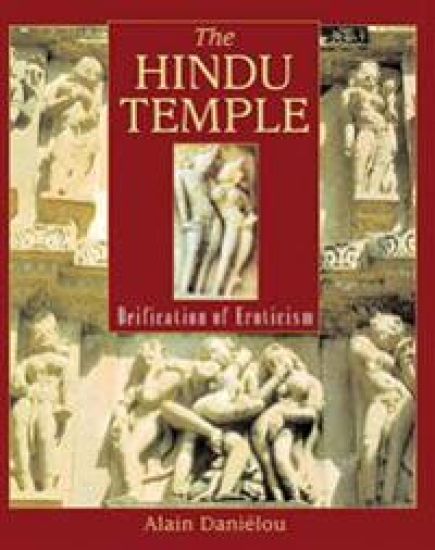
Danielou's masterpiece on the erotic nature of the sacred symbolism of the Hindu temple. - Includes stunning photographs from the major temple complexes of India. - By Alain Danielou, one of the greatest authorities on Hinduism. Ancient Indian architectural treatises state that a temple lacking erotic imagery would be ineffective and maleficent. The erotic statues and representations that cover the outer and inner walls of the Hindu temple serve both a magical and an instructional purpose. Through the power of the "yantras"--the magical diagrams created by the placement of the erotic imagery--the architect made the temple a faithful reflection of the divine. At the same time this imagery educated the faithful about the fundamental aspects of the Hindu religion, wherein the union of opposites in the sexual act is the perfect image of the creative principle, and erotic enjoyment is a reflection of divine bliss. Alain Danielou's masterpiece on the Hindu temple, now translated for the first time into English, provides a stunningly illustrated tour of the major temple complexes of India. The erotic sculptures that cover the walls of these temples are not merely symbolic portrayals of voluptuous acts but serve as profound reminders that man is closest to the divine during the instant of sexual transcendence.
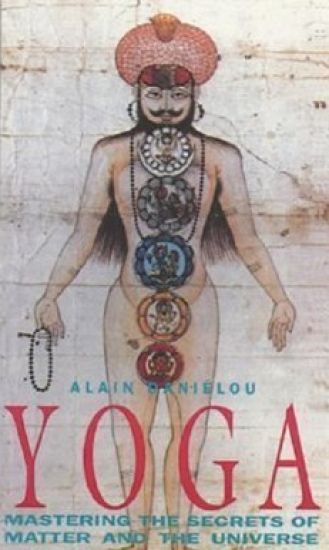
Based on original Sanskrit sources, this book gives an authentic account of the methods of yoga in its different forms, including the challenging "left-hand" paths, as well as practices best suited to Western students.
Virtue, Success, Pleasure and Liberation
Alain Danielou
Inner Traditions Bear and Company
2000
nidottu
What is the Nature of the social order that unquestionably produced one of the greatest and longest lasting civilizations known to humankind? Alain Danielou, distinguished Orientalist, musicologist, and linguist, reveals the foundations of India's culture and the four aims of human life as they are viewed in the traditional Hindu society: virtue on a moral plane; success on the material and social planes; pleasure on a sensual plane; and liberation on a spiritual plane. Coexistent with these aims are the four stages of life: quest for knowledge, family life, retreat into the forest, and renunciation. A four-fold division can be found in all traditional societies throughout the world, symbolically representing the progression of creative consciousness into physical reality. In India, this division is reflected in the caste system, a social order that differs profoundly from those accepted in the contemporary Western world. Exploring he fundamental concepts of the caste system, the author addresses issues of race, individual rights, sexual mores, martial practices, and spiritual attainments. In this light, he exposes the inherent flaws and hypocrisies of our modern egalitarian governments and shows how the shadow side of the ancient caste system persists, disguised and unacknowledged, beneath contemporary economic regimes. Danielou explains how Hindu society has served as a model for the realization of human potential on many levels, addressing sociological and human problems that are both timeless and universal.
Alain Danielou here unveils the religious impulse underlying art that at first glance seems to have no purpose beyond the erotic. Illustrated throughout with photographs and line drawings of European and Indian art, The Phallus celebrates the expression of the masculine in the religious traditions of East and West.
The Way to the Labyrinth: Autobiography
Alain Daniélou
New Directions Publishing Corporation
1987
sidottu
An authority on Hinduism and renowned for his directorship of the Institute of Comparative Music Studies in Berlin and Venice, Alain Daniélou is also an accomplished pianist, dancer, player of the Indian vînâ, painter, linguist and translator, photographer, and world traveler. To these attainments he has added The Way to the Labyrinth––as vivid, uninhibited, and wide-ranging a memoir as one is ever likely to encounter, now translated and published in English for the first time. Born of a haute-bourgeoise French family––his mother an ardent Catholic, his father an anticlerical leftwing politician, his older brother a cardinal––Daniélou spent a solitary childhood. Escaping from his family milieu, he went to Paris, where he fell in with avant-garde, bohemian, sexually liberated circles, among whose luminaries were Cocteau, Diaghilev, Max Jacob, and Maurice Sachs. But however fervently he plunged into various activities, he felt some other destiny awaited him. After a number of journeys, some of them highly adventurous, he found his real home in India. He spent twenty years there, fifteen of them in Benares on the banks of the Ganges. There he immersed himself in the study of Sanskrit, Hindu philosophy, music, and the art of the ancient temples of Northern India, and converted to the Hindu religion. But times changed, and soon after India gained its independence, he returned to live again in Europe and devoted much of his great energy to the encouragement of traditional musics from around the world.