Kirjojen hintavertailu. Mukana 12 595 353 kirjaa ja 12 kauppaa.

Kirjailija

Alan A. Powell

Kirjat ja teokset yhdessä paikassa: 2 kirjaa, julkaisuja vuosilta 1997-2012, suosituimpien joukossa Inside a Modern Macroeconometric Model. Vertaile teosten hintoja ja tarkista saatavuus suomalaisista kirjakaupoista.

2 kirjaa

Kirjojen julkaisuhaarukka 1997-2012.

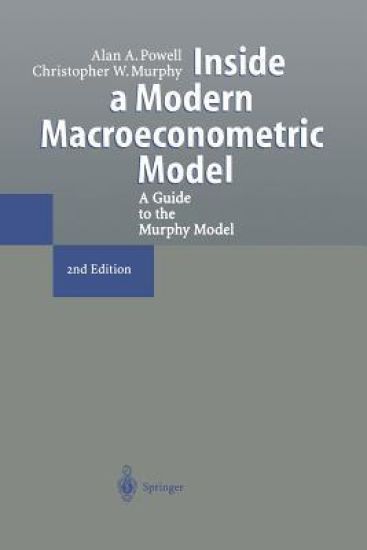
Inside a Modern Macroeconometric Model

Inside a Modern Macroeconometric Model

Alan A. Powell; Christopher W. Murphy

Springer-Verlag Berlin and Heidelberg GmbH Co. K
2012
nidottu
As Ken Wallis (1993) has pOinted out, all macroeconomic forecasters and policy analysts use economic models. That is, they have a way of going from assumptions about macroeconomic policy and the international environment, to a prediction of the likely future state of the economy. Some people do this in their heads. Increasingly though, forecasting and policy analysis is based on a formal, explicit model, represented by a set of mathematical equations and solved by computer. This provides a framework for handling, in a consistent and systematic manner, the ever-increasing amounts of relevant information. Macroeconometric modelling though, is an inexact science. A manageable model must focus only on the major driving forces in a complex economy made up of millions of households and fIrms. International economic agencies such as the IMF and OECD, and most treasuries and central banks in western countries, use macroeconometric models in their forecasting and policy analysis. Models are also used for teaching and research in universities, as well as for commercial forecasting in the private sector.
Inside a Modern Macroeconometric Model

Inside a Modern Macroeconometric Model

Alan A. Powell; Christopher W. Murphy

Springer-Verlag Berlin and Heidelberg GmbH Co. K
1997
sidottu
As Ken Wallis (1993) has pOinted out, all macroeconomic forecasters and policy analysts use economic models. That is, they have a way of going from assumptions about macroeconomic policy and the international environment, to a prediction of the likely future state of the economy. Some people do this in their heads. Increasingly though, forecasting and policy analysis is based on a formal, explicit model, represented by a set of mathematical equations and solved by computer. This provides a framework for handling, in a consistent and systematic manner, the ever-increasing amounts of relevant information. Macroeconometric modelling though, is an inexact science. A manageable model must focus only on the major driving forces in a complex economy made up of millions of households and fIrms. International economic agencies such as the IMF and OECD, and most treasuries and central banks in western countries, use macroeconometric models in their forecasting and policy analysis. Models are also used for teaching and research in universities, as well as for commercial forecasting in the private sector.