Kirjojen hintavertailu. Mukana 12 595 353 kirjaa ja 12 kauppaa.

Kirjailija

Alan Agresti

Kirjat ja teokset yhdessä paikassa: 16 kirjaa, julkaisuja vuosilta 2010-2026, suosituimpien joukossa Foundations of Bayesian Statistics for Data Scientists. Vertaile teosten hintoja ja tarkista saatavuus suomalaisista kirjakaupoista.

16 kirjaa

Kirjojen julkaisuhaarukka 2010-2026.

Foundations of Bayesian Statistics for Data Scientists

Foundations of Bayesian Statistics for Data Scientists

Alan Agresti; Maria Kateri; Ranjini Grove; Antonietta Mira

TAYLOR FRANCIS LTD
2026
nidottu
This book is an overview of the Bayesian approach to applying the most important inferential methods of statistical science. It is designed as a textbook for advanced undergraduate and master’s students in Data Science, Statistics, or Mathematics who are interested in learning about Bayesian statistics. The reader should be familiar with calculus and should have taken a statistical inference Statistics course covering the basic rules of probability, probability distributions and expectations, as well as the fundamentals of the traditional, frequentist approach to statistics, including sampling distributions, likelihood functions, basic inferential methods such as point estimation, confidence intervals, significance tests, and linear regression models. Key Features: ? Uses real world data examples and contains numerous exercises. ? Includes software appendices in R and Python. ? Offers slides, labs, and other materials on the book’s website. Each chapter begins with a brief review of the primary frequentist methods for its topic before introducing corresponding Bayesian methods. This book presents some substantive theory as well as the methods, and is therefore intended for a reader who wishes to understand Bayesian methods rather than merely apply them. The focus is not just on presenting statistical methodologies but also on demonstrating how to implement them with modern software, emphasizing appropriate simulation methods.
Foundations of Bayesian Statistics for Data Scientists

Foundations of Bayesian Statistics for Data Scientists

Alan Agresti; Maria Kateri; Ranjini Grove; Antonietta Mira

TAYLOR FRANCIS LTD
2026
sidottu
This book is an overview of the Bayesian approach to applying the most important inferential methods of statistical science. It is designed as a textbook for advanced undergraduate and master’s students in Data Science, Statistics, or Mathematics who are interested in learning about Bayesian statistics. The reader should be familiar with calculus and should have taken a statistical inference Statistics course covering the basic rules of probability, probability distributions and expectations, as well as the fundamentals of the traditional, frequentist approach to statistics, including sampling distributions, likelihood functions, basic inferential methods such as point estimation, confidence intervals, significance tests, and linear regression models. Key Features: ? Uses real world data examples and contains numerous exercises. ? Includes software appendices in R and Python. ? Offers slides, labs, and other materials on the book’s website. Each chapter begins with a brief review of the primary frequentist methods for its topic before introducing corresponding Bayesian methods. This book presents some substantive theory as well as the methods, and is therefore intended for a reader who wishes to understand Bayesian methods rather than merely apply them. The focus is not just on presenting statistical methodologies but also on demonstrating how to implement them with modern software, emphasizing appropriate simulation methods.
Statistics: The Art and Science of Learning from Data, Global Edition + MyLab Statistics with Pearson eText

Statistics: The Art and Science of Learning from Data, Global Edition + MyLab Statistics with Pearson eText

Alan Agresti; Christine Franklin; Bernhard Klingenberg

pearson education limited
2023
muu
For courses in introductory statistics. The art and science of learning from data Statistics: The Art and Science of Learning from Data takes a conceptual approach,helping students understand what statistics is about and learning the rightquestions to ask when analyzing data, rather than just memorizing procedures.This book takes the ideas that have turned statistics into a central science inmodern life and makes them accessible, without compromising the necessaryrigor. Students will enjoy reading this book, and will stay engaged with itswide variety of real-world data in the examples and exercises.
Statistics: The Art and Science of Learning from Data, Global Edition

Statistics: The Art and Science of Learning from Data, Global Edition

Alan Agresti; Christine Franklin; Bernhard Klingenberg

PEARSON EDUCATION LIMITED
2022
pokkari
Introduce your students to the art and science of learning from data. Statistics: The Art and Science of Learning from Data, Global Edition, 5th edition is the ideal introduction to statistics, encouraging students to analyse data the right way by enquiring and searching for the right questions and information rather than just memorising procedures.
Foundations of Statistics for Data Scientists

Foundations of Statistics for Data Scientists

Alan Agresti; Maria Kateri

CRC Press
2021
sidottu
Foundations of Statistics for Data Scientists: With R and Python is designed as a textbook for a one- or two-term introduction to mathematical statistics for students training to become data scientists. It is an in-depth presentation of the topics in statistical science with which any data scientist should be familiar, including probability distributions, descriptive and inferential statistical methods, and linear modeling. The book assumes knowledge of basic calculus, so the presentation can focus on "why it works" as well as "how to do it." Compared to traditional "mathematical statistics" textbooks, however, the book has less emphasis on probability theory and more emphasis on using software to implement statistical methods and to conduct simulations to illustrate key concepts. All statistical analyses in the book use R software, with an appendix showing the same analyses with Python.Key Features:Shows the elements of statistical science that are important for students who plan to become data scientists.Includes Bayesian and regularized fitting of models (e.g., showing an example using the lasso), classification and clustering, and implementing methods with modern software (R and Python).Contains nearly 500 exercises.The book also introduces modern topics that do not normally appear in mathematical statistics texts but are highly relevant for data scientists, such as Bayesian inference, generalized linear models for non-normal responses (e.g., logistic regression and Poisson loglinear models), and regularized model fitting. The nearly 500 exercises are grouped into "Data Analysis and Applications" and "Methods and Concepts." Appendices introduce R and Python and contain solutions for odd-numbered exercises. The book's website (http://stat4ds.rwth-aachen.de/) has expanded R, Python, and Matlab appendices and all data sets from the examples and exercises.
An Introduction to Categorical Data Analysis
A valuable new edition of a standard reference The use of statistical methods for categorical data has increased dramatically, particularly for applications in the biomedical and social sciences. An Introduction to Categorical Data Analysis, Third Edition summarizes these methods and shows readers how to use them using software. Readers will find a unified generalized linear models approach that connects logistic regression and loglinear models for discrete data with normal regression for continuous data. Adding to the value in the new edition is: • Illustrations of the use of R software to perform all the analyses in the book • A new chapter on alternative methods for categorical data, including smoothing and regularization methods (such as the lasso), classification methods such as linear discriminant analysis and classification trees, and cluster analysis • New sections in many chapters introducing the Bayesian approach for the methods of that chapter • More than 70 analyses of data sets to illustrate application of the methods, and about 200 exercises, many containing other data sets • An appendix showing how to use SAS, Stata, and SPSS, and an appendix with short solutions to most odd-numbered exercises Written in an applied, nontechnical style, this book illustrates the methods using a wide variety of real data, including medical clinical trials, environmental questions, drug use by teenagers, horseshoe crab mating, basketball shooting, correlates of happiness, and much more. An Introduction to Categorical Data Analysis, Third Edition is an invaluable tool for statisticians and biostatisticians as well as methodologists in the social and behavioral sciences, medicine and public health, marketing, education, and the biological and agricultural sciences.
Statistical Methods for the Social Sciences, Global Edition
Help your students gain statistics skills for the social sciences with this accessible text Statistical Methods for the Social Sciences introduces your students to the subject in a low-technical way with no statistics knowledge necessary. This edition presents the latest information in a way ideal for two-semester courses in social science.
Statistical Methods for the Social Sciences
For courses in Statistical Methods for the Social Sciences . Statistical methods applied to social sciences, made accessible to all through an emphasis on concepts Statistical Methods for the Social Sciences introduces statistical methods to students majoring in social science disciplines. With an emphasis on concepts and applications, this book assumes you have no previous knowledge of statistics and only a minimal mathematical background. It contains sufficient material for a two-semester course. The 5th Edition gives you examples and exercises with a variety of “real data.” It includes more illustrations of statistical software for computations and takes advantage of the outstanding applets to explain key concepts, such as sampling distributions and conducting basic data analyses. It continues to downplay mathematics–often a stumbling block for students–while avoiding reliance on an overly simplistic recipe-based approach to statistics.
Statistics: The Art and Science of Learning from Data, Global Edition + MyLab Statistics with Pearson eText

Statistics: The Art and Science of Learning from Data, Global Edition + MyLab Statistics with Pearson eText

Alan Agresti; Christine Franklin; Bernhard Klingenberg

Pearson Education Limited
2017
muu
For courses in introductory statistics. This package includes MyStatLab(TM). The Art and Science of Learning from Data Statistics: The Art and Science of Learning from Data, Fourth Edition, takes a conceptual approach, helping students understand what statistics is about and learning the right questions to ask when analyzing data, rather than just memorizing procedures. This book takes the ideas that have turned statistics into a central science in modern life and makes them accessible, without compromising the necessary rigor. Students will enjoy reading this book, and will stay engaged with its wide variety of real-world data in the examples and exercises. The authors believe that it's important for students to learn and analyze both quantitative and categorical data. As a result, the text pays greater attention to the analysis of proportions than many other introductory statistics texts. Concepts are introduced first with categorical data, and then with quantitative data. This package includes MyStatLab, an online homework, tutorial, and assessment program designed to work with this text to personalize learning and improve results. With a wide range of interactive, engaging, and assignable activities, students are encouraged to actively learn and retain tough course concepts. MyStatLab should only be purchased when required by an instructor. Please be sure you have the correct ISBN and Course ID. Instructors, contact your Pearson representative for more information.
Foundations of Linear and Generalized Linear Models
A valuable overview of the most important ideas and results in statistical modeling Written by a highly-experienced author, Foundations of Linear and Generalized Linear Models is a clear and comprehensive guide to the key concepts and results of linearstatistical models. The book presents a broad, in-depth overview of the most commonly usedstatistical models by discussing the theory underlying the models, R software applications,and examples with crafted models to elucidate key ideas and promote practical modelbuilding. The book begins by illustrating the fundamentals of linear models, such as how the model-fitting projects the data onto a model vector subspace and how orthogonal decompositions of the data yield information about the effects of explanatory variables. Subsequently, the book covers the most popular generalized linear models, which include binomial and multinomial logistic regression for categorical data, and Poisson and negative binomial loglinear models for count data. Focusing on the theoretical underpinnings of these models, Foundations ofLinear and Generalized Linear Models also features: An introduction to quasi-likelihood methods that require weaker distributional assumptions, such as generalized estimating equation methodsAn overview of linear mixed models and generalized linear mixed models with random effects for clustered correlated data, Bayesian modeling, and extensions to handle problematic cases such as high dimensional problemsNumerous examples that use R software for all text data analysesMore than 400 exercises for readers to practice and extend the theory, methods, and data analysisA supplementary website with datasets for the examples and exercises An invaluable textbook for upper-undergraduate and graduate-level students in statistics and biostatistics courses, Foundations of Linear and Generalized Linear Models is also an excellent reference for practicing statisticians and biostatisticians, as well as anyone who is interested in learning about the most important statistical models for analyzing data.
Categorical Data Analysis

Categorical Data Analysis

Alan Agresti

John Wiley Sons Inc
2013
sidottu
Praise for the Second Edition "A must-have book for anyone expecting to do research and/or applications in categorical data analysis." —Statistics in Medicine "It is a total delight reading this book." —Pharmaceutical Research "If you do any analysis of categorical data, this is an essential desktop reference." —Technometrics The use of statistical methods for analyzing categorical data has increased dramatically, particularly in the biomedical, social sciences, and financial industries. Responding to new developments, this book offers a comprehensive treatment of the most important methods for categorical data analysis. Categorical Data Analysis, Third Edition summarizes the latest methods for univariate and correlated multivariate categorical responses. Readers will find a unified generalized linear models approach that connects logistic regression and Poisson and negative binomial loglinear models for discrete data with normal regression for continuous data. This edition also features: An emphasis on logistic and probit regression methods for binary, ordinal, and nominal responses for independent observations and for clustered data with marginal models and random effects modelsTwo new chapters on alternative methods for binary response data, including smoothing and regularization methods, classification methods such as linear discriminant analysis and classification trees, and cluster analysisNew sections introducing the Bayesian approach for methods in that chapterMore than 100 analyses of data sets and over 600 exercisesNotes at the end of each chapter that provide references to recent research and topics not covered in the text, linked to a bibliography of more than 1,200 sourcesA supplementary website showing how to use R and SAS; for all examples in the text, with information also about SPSS and Stata and with exercise solutions Categorical Data Analysis, Third Edition is an invaluable tool for statisticians and methodologists, such as biostatisticians and researchers in the social and behavioral sciences, medicine and public health, marketing, education, finance, biological and agricultural sciences, and industrial quality control.
Graphing Calculator Manual for Statistics: The Art and Science of Learning from Data
This manual is organized to follow the sequence of topics in the text, and provides an easy-to-follow, step-by-step guide with worked-out examples to help students fully understand and get the most out of their graphing calculator. Compatible models include the popular TI-83/84 Plus and TI-89. The Graphing Calculator Manual is available from within MyStatLab® and from www.pearsonhighered.com/mathstatsresources.
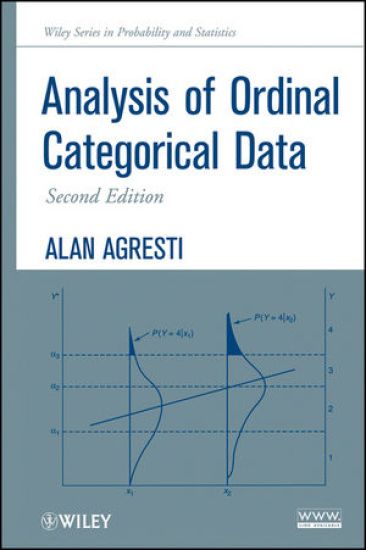
Analysis of Ordinal Categorical Data

Analysis of Ordinal Categorical Data

Alan Agresti

John Wiley Sons Inc
2010
sidottu
Statistical science’s first coordinated manual of methods for analyzing ordered categorical data, now fully revised and updated, continues to present applications and case studies in fields as diverse as sociology, public health, ecology, marketing, and pharmacy. Analysis of Ordinal Categorical Data, Second Edition provides an introduction to basic descriptive and inferential methods for categorical data, giving thorough coverage of new developments and recent methods. Special emphasis is placed on interpretation and application of methods including an integrated comparison of the available strategies for analyzing ordinal data. Practitioners of statistics in government, industry (particularly pharmaceutical), and academia will want this new edition.