Kirjojen hintavertailu. Mukana 12 595 353 kirjaa ja 12 kauppaa.

Kirjailija

Alan C. Bovik

Kirjat ja teokset yhdessä paikassa: 3 kirjaa, julkaisuja vuosilta 2007-2009, suosituimpien joukossa Communications Engineering Desk Reference. Vertaile teosten hintoja ja tarkista saatavuus suomalaisista kirjakaupoista.

3 kirjaa

Kirjojen julkaisuhaarukka 2007-2009.

Communications Engineering Desk Reference

Communications Engineering Desk Reference

Erik Dahlman; Ed da Silva; Luis M. Correia; Philip A Chou; Mihaela van der Schaar; Ronald Kitchen; Daniel M. Dobkin; Dan Bensky; Juanita Ellis; Charles Pursell; Joy Rahman; Stefan Parkvall; Leonidas Guibas; Feng Zhao; Johan Skold; Per Beming; Alan C. Bovik; Bruce A. Fette; Keith Jack; Farid Dowla; Casimer DeCusatis

Academic Press Inc
2009
sidottu
A one-stop desk reference for R&D engineers involved in communications engineering, this book will not gather dust on the shelf. It brings together the essential professional reference content from leading international contributors in the field. Material covers a wide scope of topics, including voice, computer, facsimile, video, and multimedia data technologies.
Modern Image Quality Assessment

Modern Image Quality Assessment

Zhou Wang; Alan C. Bovik

Springer International Publishing AG
2007
nidottu
This Lecture book is about objective image quality assessment—where the aim is to provide computational models that can automatically predict perceptual image quality. The early years of the 21st century have witnessed a tremendous growth in the use of digital images as a means for representing and communicating information. A considerable percentage of this literature is devoted to methods for improving the appearance of images, or for maintaining the appearance of images that are processed. Nevertheless, the quality of digital images, processed or otherwise, is rarely perfect. Images are subject to distortions during acquisition, compression, transmission, processing, and reproduction. To maintain, control, and enhance the quality of images, it is important for image acquisition, management, communication, and processing systems to be able to identify and quantify image quality degradations. The goals of this book are as follows; a) to introduce the fundamentals of image quality assessment, and to explain the relevant engineering problems, b) to give a broad treatment of the current state-of-the-art in image quality assessment, by describing leading algorithms that address these engineering problems, and c) to provide new directions for future research, by introducing recent models and paradigms that significantly differ from those used in the past. The book is written to be accessible to university students curious about the state-of-the-art of image quality assessment, expert industrial R&D engineers seeking to implement image/video quality assessment systems for specific applications, and academic theorists interested in developing new algorithms for image quality assessment or using existing algorithms to design or optimize other image processing applications.
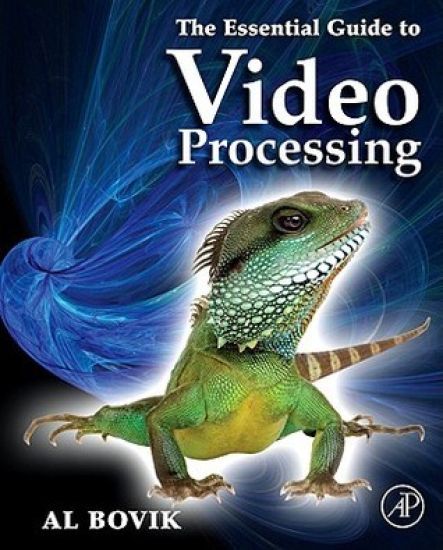
The Essential Guide to Video Processing

The Essential Guide to Video Processing

Alan C. Bovik

Academic Press Inc
2009
nidottu
This comprehensive and state-of-the art approach to video processing gives engineers and students a comprehensive introduction and includes full coverage of key applications: wireless video, video networks, video indexing and retrieval and use of video in speech processing. Containing all the essential methods in video processing alongside the latest standards, it is a complete resource for the professional engineer, researcher and graduate student. Numerous conceptual and numerical examples All the latest standards are thoroughly covered: MPEG-1, MPEG-2, MPEG-4, H.264 and AVC Coverage of the latest techniques in video security "Like its sister volume "The Essential Guide to Image Processing," Professor Bovik’s Essential Guide to Video Processing provides a timely and comprehensive survey, with contributions from leading researchers in the area. Highly recommended for everyone with an interest in this fascinating and fast-moving field." —Prof. Bernd Girod, Stanford University, USA