Kirjojen hintavertailu. Mukana 12 595 353 kirjaa ja 12 kauppaa.
Kirjailija
Alan Feldman
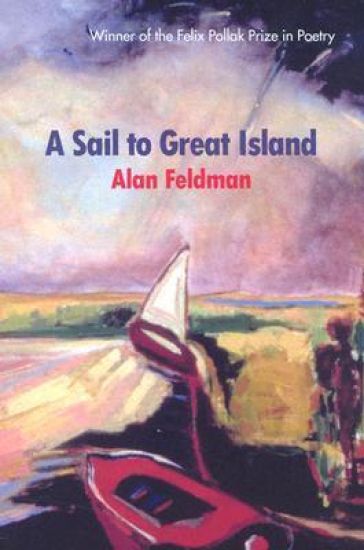
Kirjat ja teokset yhdessä paikassa: 6 kirjaa, julkaisuja vuosilta 1999-2018, suosituimpien joukossa A Sail to Great Island. Vertaile teosten hintoja ja tarkista saatavuus suomalaisista kirjakaupoista.
What is good fortune? The Golden Coin asks—and answers—this question in poems about youth, conflict, travel, family love, and the joys and fears of getting old. Aboard his sailboat, Feldman draws lessons from the sea about time and history. His gaze tempered not by nostalgia or longing but by satisfaction and happiness, he finds wry joy in the Havana airport's sniffer dog napping near the impounded luggage. In acknowledging the inevitability of change, he reports from the battle zones of an essentially lucky life, with only as much sadness and terror as ordinary life inevitably requires.
“Drop the personal,” Alan Feldman’s best friend advises. But what else does he have? Feldman takes his title from Zhivago’s interpretations of the afterlife: “Your soul, your immortality, your life in others.”In a collection where the dead do speak, Feldman’s poems in his first segment, “Self-Portraits,” are more likely to be about others than about himself. The segment “Partners” reflects on marriage and divorce, the latter an “uncontested victor over marriage, / the way the flood is champion over the flood plain.” In the section “Offshore” Feldman writes about travel to Uruguay, his impractical love of sailing, and his wonder at Walter Cronkite’s obtuseness about Vietnam. In his final segment, “What Now?,” he asks about meaning itself. Babysitting his tiny granddaughter, he thinks of sailing—hours of boredom punctuated by moments of terror—and wonders if even this suggests something world-encompassing he’s “still hoping to find a name for. / If it isn’t joy.”
The first full-length collection in many years by an award-winning poet whose work has appeared in The Atlantic, The New Yorker, The Nation, Poetry, The Kenyon Review, The Threepenny Review, and a host of other journals.
The first full-length collection in many years by an award-winning poet whose work has appeared in The Atlantic, The New Yorker, The Nation, Poetry, The Kenyon Review, The Threepenny Review, and a host of other journals.
Network Science, A Decade Later--the result of NSF-funded research that looked at the experiences of a set of science projects which use the Internet--offers an understanding of how the Internet can be used effectively by science teachers and students to support inquiry-based teaching and learning. The book emphasizes theoretical and critical perspectives and is intended to raise questions about the goals of education and the ways that technology helps reach those goals and ways that it cannot. The theoretical perspective of inquiry-based teaching and learning in which the book is grounded is consistent with the current discipline-based curriculum standards and frameworks. The chapters in Part I, "State of the Art," describe the history and current practice of network science. Those in Part II, "Looking Deeply," extend the inquiry into network science by examining discourse and data in depth, using both empirical data and theoretical perspectives. In Part III, "Looking Forward," the authors step back from the issues of network science to take a broader view, focusing on the question: How should the Internet be used--and not used--to support student learning? The book concludes with a reminder that technology will not replace teachers. Rather, the power of new technologies to give students both an overwhelming access to resources--experts, peers, teachers, texts, images, and data--and the opportunity to pursue questions of their own design, increases the need for highly skilled teachers and forward-looking administrators. This is a book for them, and for all educators, policymakers, students involved in science and technology education. For more information about the authors, an archived discussions space, a few chapters that can be downloaded as PDF files, and ordering information, visit teaparty.terc.edu/book/
Network Science, A Decade Later--the result of NSF-funded research that looked at the experiences of a set of science projects which use the Internet--offers an understanding of how the Internet can be used effectively by science teachers and students to support inquiry-based teaching and learning. The book emphasizes theoretical and critical perspectives and is intended to raise questions about the goals of education and the ways that technology helps reach those goals and ways that it cannot. The theoretical perspective of inquiry-based teaching and learning in which the book is grounded is consistent with the current discipline-based curriculum standards and frameworks. The chapters in Part I, "State of the Art," describe the history and current practice of network science. Those in Part II, "Looking Deeply," extend the inquiry into network science by examining discourse and data in depth, using both empirical data and theoretical perspectives. In Part III, "Looking Forward," the authors step back from the issues of network science to take a broader view, focusing on the question: How should the Internet be used--and not used--to support student learning? The book concludes with a reminder that technology will not replace teachers. Rather, the power of new technologies to give students both an overwhelming access to resources--experts, peers, teachers, texts, images, and data--and the opportunity to pursue questions of their own design, increases the need for highly skilled teachers and forward-looking administrators. This is a book for them, and for all educators, policymakers, students involved in science and technology education. For more information about the authors, an archived discussions space, a few chapters that can be downloaded as PDF files, and ordering information, visit teaparty.terc.edu/book/