Kirjojen hintavertailu. Mukana 12 478 644 kirjaa ja 12 kauppaa.

Kirjailija

Alan Hunt

Kirjat ja teokset yhdessä paikassa: 7 kirjaa, julkaisuja vuosilta 1994-2025, suosituimpien joukossa Communicating Archaeology. Vertaile teosten hintoja ja tarkista saatavuus suomalaisista kirjakaupoista.

7 kirjaa

Kirjojen julkaisuhaarukka 1994-2025.

To Die in Oslo

To Die in Oslo

Alan Hunt

TROUBADOR PUBLISHING
2025
nidottu
“I do have one piece of useful intelligence,” said Freddie. “Guy Chesterton’s out.” Adam White, British ambassador in Oslo, is shocked to learn that the man who tried to kill him fifteen years earlier in Oxford is out of prison and seeking revenge. In the same week, MI6 officer Hugh Tennyson informs Adam that a man murdered on an Oslo train is Leonid Zabolotny, a Russian FSB agent claiming knowledge of a mole in the Norwegian security service (the PST) and of an unspecified threat to British security. Hugh joins Oslo Police detective Rebekka Storvik in the hunt for the killer. Others soon involved are Adam’s lover, Alison Webster, the former Oxford student Taraneh Esfahani and her onetime MI6 handler, Freddie Gardiner, a sworn enemy of Hugh Tennyson. How and when will Chesterton strike? Who is the PST mole? What is the threat to British security? The Deputy head of the PST, Holger Selberg, is arrested, but protests his innocence. Has he been framed? If so, who by? There is no shortage of suspects, and any number of twists and turns, as the intertwined stories come to a series of unexpected climaxes.

An Expected Death

An Expected Death

Alan Hunt

TROUBADOR PUBLISHING
2022
nidottu
Take as long as you need, they said. Enjoy Oxford. Get better. But it didn’t turn out that way… Recovering from a near-fatal shooting, British diplomat Adam White is sent on a sabbatical to Oxford University. He soon becomes embroiled in the murder of an Oxford colleague. There is no shortage of suspects: the victim was widely disliked and feared. Among those affected are Sir Julian de Crespigny, director of the diplomacy programme, Catriona MacKay, the programme administrator, and Dame Gillian King, master of St Christopher’s College. MI6 are also involved, through the shadowy figure of John Smith, tasked with recruiting spies at Oxford. Impatient with the speed of police investigations, Adam sets out to solve the murder himself, his characteristically incautious approach putting him rapidly in jeopardy. In the past, against the odds, he has escaped death three times. Has his luck finally run out? Meanwhile, Adam’s partner, Alison, becomes emotionally involved with a colleague in New York, not suspecting that she too will be drawn into danger as the fates of the various characters converge. The story concludes with a denouement both violent and shocking. As readers of Alan Hunt’s previous books have come to expect, nothing is quite as it seems…
Communicating Archaeology

Communicating Archaeology

John Beavis; Alan Hunt

Oxbow Books
1999
nidottu
A volume of essays on communicating archaeology by every imaginable means provides an excellent tribute to the work of Bill Putnam - always a communicator. Learning by doing (Philip Rahtz), field archaeology in the 70s and 80s (John Hinchliffe), ignore good communication at your peril (Andrew Lawson), the IFA: what it means to be a member of a professional body (Timothy Darvill), talking to ourselves (Ellen McAdam), commissioning knowledge or making archaeology for books (Peter Kemmis Betty), arcane to ARC: the York experience (Andrew Jones), the National Curriculum (Mike Corbishley), past experience: the view from teacher education (Tim Copeland), child's play: archaeology out of school (Kate Pretty), university archaeology: ivory tower or white elephant? (Kevin Andrews) , liberal adult education in the second half of the twentieth century (Trevor Rowley), the local societies (John Manley) , archaeology in museums (Roger Peers).
Governing Morals

Governing Morals

Alan Hunt

Cambridge University Press
1999
pokkari
This evocative and broad-ranging book traces the history of moral regulation in Britain and the US from the late seventeenth century to the present day. Specific coverage is given to movements such as the Society for the Reformation of Manners and the Vice Society, the sexual abuse and anti-pornography movements, and contemporary self-help movements. Hunt argues that the main impetus for moral regulations often stems from the middle classes, rather than those with institutional power, but most significantly they provide classic instances of the intimate link between the ‘governance of others’ and the ‘governance of the self’. Using the work of Foucault, this book analyses how projects of self-regulation can manifest themselves into the regulation of others. Concurrent with this is the rise of health discourses, which play a central role in contemporary discussions of moral governance.
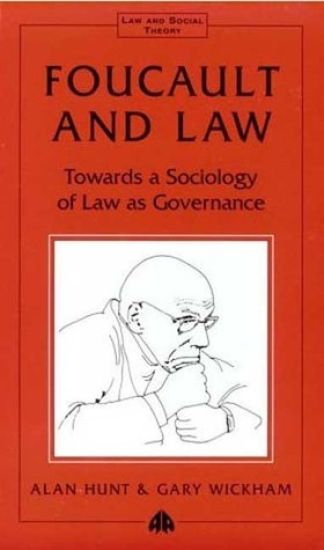
Foucault and Law

Foucault and Law

Alan Hunt; Gary Wickham

Pluto Press
1994
pokkari
When he died in 1984, Michel Foucault was regarded as one of the most profoundly influential philosophers of his day. Although the law itself never formed a central focus for Foucault, many of the principal themes in his writings are concerned with issues of governance and power that are of direct relevance to the study of law. And yet, until now, Foucault's work has attracted only fleeting attention from the legal academy. Foucault and Law corrects this oversight. Opening with a lucid, critical and unpretentious account of Foucault's work, Hunt and Wickham map out a terrain of methodological and theoretical principles, providing the groundwork for a new sociology of law as governance.