Kirjojen hintavertailu. Mukana 12 127 016 kirjaa ja 12 kauppaa.

Kirjailija

Alan J Vick

Kirjat ja teokset yhdessä paikassa: 14 kirjaa, julkaisuja vuosilta 2006-2022, suosituimpien joukossa Air Base Attacks and Defensive Counters. Vertaile teosten hintoja ja tarkista saatavuus suomalaisista kirjakaupoista.

Mukana myös kirjoitusasut: Alan J. Vick

14 kirjaa

Kirjojen julkaisuhaarukka 2006-2022.

Is the USAF Flying Force Large Enough?

Is the USAF Flying Force Large Enough?

Alan J Vick; Paul Dreyer; John Speed Meyers

RAND
2018
nidottu
The U.S. military has mostly operated at a high operational tempo since the end of the Cold War, and there appears to be no significant reduction in demand on the horizon. This report draws on historical data to quantify gaps in the U.S. Air Force's capacity to meet potential future demands.
Air Base Attacks and Defensive Counters
This report provides a reference on air-base attack and defense, explores the history of air-base attacks in the past century, and describes the American way of war that emerged after the fall of the Soviet Union. Finally, it identifies five classes of defensive options that have proven valuable in past conflicts and offers recommendations on how best to win the battle of the airfields.
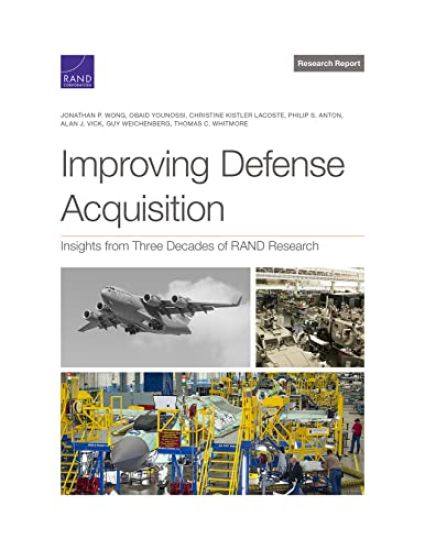
Improving Defense Acquisition

Improving Defense Acquisition

Jonathan P Wong; Obaid Younossi; Christine Kistler Lacoste; Philip S Anton; Alan J Vick; Guy Weichenberg; Thomas C Whitmore

RAND Corporation
2022
pokkari
In this report, researchers describe overarching trends that affect defense acquisition, outline challenges in the defense acquisition process, and suggest improvements that might help address those challenges. The study is informed by open-source documents and insights from publicly available RAND Corporation defense acquisition research, especially reports published since 1986, when a similar review of RAND research was published.
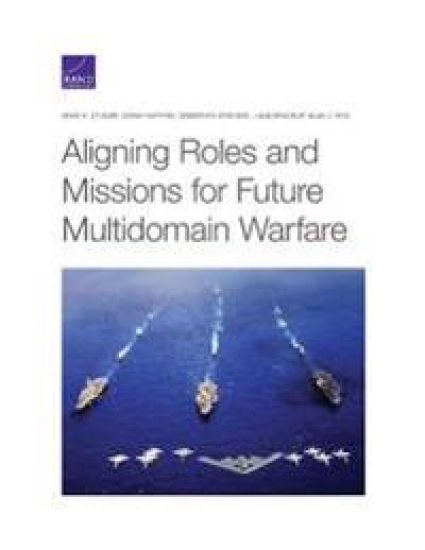
Aligning Roles and Missions for Future Multidomain Warfare

Aligning Roles and Missions for Future Multidomain Warfare

Sean M Zeigler; Sarah Harting; Sebastian Joon Bae; Julia Brackup; Alan J Vick

RAND
2021
nidottu
The authors identified disputes among roles, missions, and functions (RMF) that have endured as problems for the U.S. Air Force, factors associated with major RMF changes, and reasons why reform efforts failed. In crafting a framework for analyzing the RMF implications of strategic-level guidance and emerging operational concepts, the authors considered how future leadership choices will influence relative attractiveness of RMF courses of action.
Air Base Defense

Air Base Defense

Alan J Vick; Sean M Zeigler; Julia Brackup

RAND
2020
nidottu
The growing cruise and ballistic missile threat to U.S. Air Force bases in Europe has led to a reassessment of defensive options, including ground-based systems currently assigned to the Army. The gap between this threat and the U.S. capacity and capability to counter the threat is particularly worrisome. This report offers alternative courses of action for Air Force consideration and assesses strengths and weaknesses of each.
Force Presentation in U.S. Air Force History and Airpower Narratives
Force presentation constructs are salient to service leaders because they are often viewed as a way to constrain demands for rotational forces and personnel, thereby protecting service readiness and retention. USAF leaders are concerned that their force presentation construct is lacking in this regard. This report presents historical analysis and recommendations to inform USAF deliberations regarding future force presentation constructs.
Continuity and Contingency in USAF Posture Planning

Continuity and Contingency in USAF Posture Planning

Alan J. Vick; Stacie L. Pettyjohn; Meagan L. Smith; Sean M. Zeigler; Daniel Tremblay; Phillip Johnson

RAND
2016
pokkari
This study develops a framework for long-term U.S. Air Force posture planning that accounts for posture drivers and identifies steps to take to increase posture robustness and agility over the 30-year planning period. The authors recommend testing posture against failure of key assumptions and a large number of possible demands; considering seemingly implausible or unimportant future demands; and balancing posture stickiness and agility."
Proclaiming Airpower

Proclaiming Airpower

Alan J. Vick

RAND
2015
pokkari
This report examines the evolution and interaction of U.S. Air Force narratives and popular attitudes toward civil and military aviation over the past century. It draws on a historical review of the social currency of aviation and airpower, changes in Air Force narratives during the period, and the evolution of the American public s attitudes toward the Air Force since 1935, as shown by polling data."
The Posture Triangle

The Posture Triangle

Stacie L. Pettyjohn; Alan J. Vick

RAND
2013
pokkari
U.S. Air Force (USAF) global posture its overseas forces, facilities, and arrangements with partner nations faces a variety of fiscal, political, and military challenges. This report seeks to identify why the USAF needs a global posture, where it needs basing and access, the types of security partnerships that minimize peacetime access risk, and the amount of forward presence that the USAF requires."
Managing Risk in USAF Force Planning

Managing Risk in USAF Force Planning

Frank Camm; Lauren Caston; Alexander C Hou; Forrest E Morgan; Alan J Vick

RAND
2009
pokkari
Presents a risk-management process would help senior Air Force leaders to (1) focus planning on the most salient threats, (2) gain greater clarity on the risks associated with alternative courses of action across multiple futures, (3) maintain a sense of the persistent uncertainties associated with any policy choice, and (4) effectively communicate their judgments about risk to key audiences.
A New Division of Labor

A New Division of Labor

Andrew R. Hoehn; Adam Grissom; David A. Ochmanek; David A. Shlapak; Alan J. Vick

RAND
2007
pokkari
An emerging U.S. grand strategy--the promotion of democracy and freedom abroad--will certainly involve the U.S. armed forces. Although they must change to meet changes in emphasis and demand, they cannot risk their historic strengths. Some areas of interest are the organization and employment of forces, planning for future conflicts, developing information resources, and fostering partnerships among the services and with allies.