Kirjojen hintavertailu. Mukana 12 152 606 kirjaa ja 12 kauppaa.

Kirjailija

Alan Jeffrey

Kirjat ja teokset yhdessä paikassa: 11 kirjaa, julkaisuja vuosilta 2002-2019, suosituimpien joukossa Essentials Engineering Mathematics. Vertaile teosten hintoja ja tarkista saatavuus suomalaisista kirjakaupoista.

11 kirjaa

Kirjojen julkaisuhaarukka 2002-2019.

Mathematics for Engineers and Scientists
Since its original publication in 1969, Mathematics for Engineers and Scientists has built a solid foundation in mathematics for legions of undergraduate science and engineering students. It continues to do so, but as the influence of computers has grown and syllabi have evolved, once again the time has come for a new edition.Thoroughly revised to meet the needs of today's curricula, Mathematics for Engineers and Scientists, Sixth Edition covers all of the topics typically introduced to first- or second-year engineering students, from number systems, functions, and vectors to series, differential equations, and numerical analysis. Among the most significant revisions to this edition are:Simplified presentation of many topics and expanded explanations that further ease the comprehension of incoming engineering students A new chapter on double integrals Many more exercises, applications, and worked examples A new chapter introducing the MATLAB and Maple software packagesAlthough designed as a textbook with problem sets in each chapter and selected answers at the end of the book, Mathematics for Engineers and Scientists, Sixth Edition serves equally well as a supplemental text and for self-study. The author strongly encourages readers to make use of computer algebra software, to experiment with it, and to learn more about mathematical functions and the operations that it can perform.
Essentials Engineering Mathematics
First published in 1992, Essentials of Engineering Mathematics is a widely popular reference ideal for self-study, review, and fast answers to specific questions. While retaining the style and content that made the first edition so successful, the second edition provides even more examples, new material, and most importantly, an introduction to using two of the most prevalent software packages in engineering: Maple and MATLAB. Specifically, this edition includes:Introductory accounts of Maple and MATLAB that offer a quick start to using symbolic software to perform calculations, explore the properties of functions and mathematical operations, and generate graphical output New problems involving the mean value theorem for derivatives Extension of the account of stationary points of functions of two variables The concept of the direction field of a first-order differential equation Introduction to the delta function and its use with the Laplace transformThe author includes all of the topics typically covered in first-year undergraduate engineering mathematics courses, organized into short, easily digestible sections that make it easy to find any subject of interest. Concise, right-to-the-point exposition, a wealth of examples, and extensive problem sets at the end each chapter--with answers at the end of the book--combine to make Essentials of Engineering Mathematics, Second Edition ideal as a supplemental textbook, for self-study, and as a quick guide to fundamental concepts and techniques.
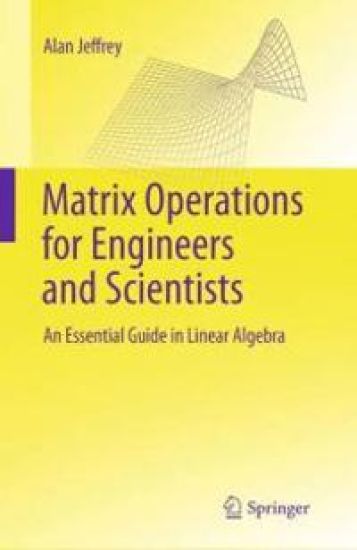
Matrix Operations for Engineers and Scientists
Engineers and scientists need to have an introduction to the basics of linear algebra in a context they understand. Computer algebra systems make the manipulation of matrices and the determination of their properties a simple matter, and in practical applications such software is often essential. However, using this tool when learning about matrices, without first gaining a proper understanding of the underlying theory, limits the ability to use matrices and to apply them to new problems. This book explains matrices in the detail required by engineering or science students, and it discusses linear systems of ordinary differential equations. These students require a straightforward introduction to linear algebra illustrated by applications to which they can relate. It caters of the needs of undergraduate engineers in all disciplines, and provides considerable detail where it is likely to be helpful. According to the author the best way to understand the theory of matrices is by working simple exercises designed to emphasize the theory, that at the same time avoid distractions caused by unnecessary numerical calculations. Hence, examples and exercises in this book have been constructed in such a way that wherever calculations are necessary they are straightforward. For example, when a characteristic equation occurs, its roots (the eigenvalues of a matrix) can be found by inspection. The author of this book is Alan Jeffrey, Emeritus Professor of mathematics at the University of Newcastle upon Tyne. He has given courses on engineering mathematics at UK and US Universities.
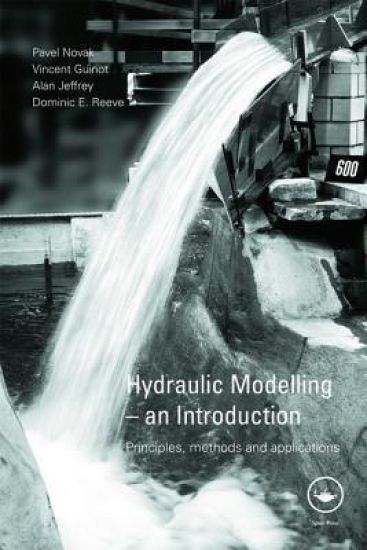
Hydraulic Modelling: An Introduction

Hydraulic Modelling: An Introduction

Pavel Novak; Vincent Guinot; Alan Jeffrey; Dominic E. Reeve

Spon Press
2010
nidottu
Modelling forms a vital part of all engineering design, yet many hydraulic engineers are not fully aware of the assumptions they make. These assumptions can have important consequences when choosing the best model to inform design decisions.Considering the advantages and limitations of both physical and mathematical methods, this book will help you identify the most appropriate form of analysis for the hydraulic engineering application in question. All models require the knowledge of their background, good data and careful interpretation and so this book also provides guidance on the range of accuracy to be expected of the model simulations and how they should be related to the prototype.Applications to models include: open channel systemsclosed conduit flowsstorm drainage systemsestuariescoastal and nearshore structureshydraulic structures.This an invaluable guide for students and professionals.
Hydraulic Modelling: An Introduction

Hydraulic Modelling: An Introduction

Pavel Novak; Vincent Guinot; Alan Jeffrey; Dominic E. Reeve

Spon Press
2010
sidottu
Modelling forms a vital part of all engineering design, yet many hydraulic engineers are not fully aware of the assumptions they make. These assumptions can have important consequences when choosing the best model to inform design decisions.Considering the advantages and limitations of both physical and mathematical methods, this book will help you identify the most appropriate form of analysis for the hydraulic engineering application in question. All models require the knowledge of their background, good data and careful interpretation and so this book also provides guidance on the range of accuracy to be expected of the model simulations and how they should be related to the prototype.Applications to models include: open channel systemsclosed conduit flowsstorm drainage systemsestuariescoastal and nearshore structureshydraulic structures.This an invaluable guide for students and professionals.
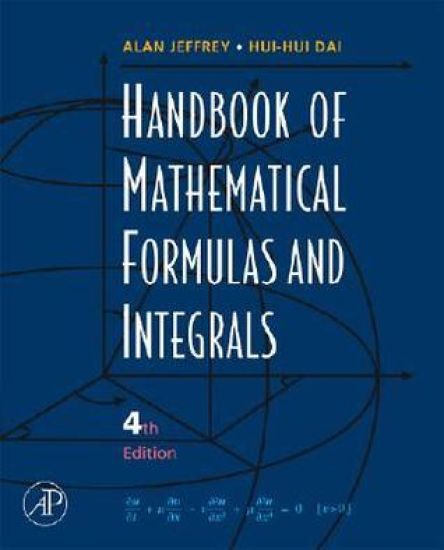
Handbook of Mathematical Formulas and Integrals

Handbook of Mathematical Formulas and Integrals

Alan Jeffrey; Hui Hui Dai

Academic Press Inc
2008
nidottu
The extensive additions, and the inclusion of a new chapter, has made this classic work by Jeffrey, now joined by co-author Dr. H.H. Dai, an even more essential reference for researchers and students in applied mathematics, engineering, and physics. It provides quick access to important formulas, relationships between functions, and mathematical techniques that range from matrix theory and integrals of commonly occurring functions to vector calculus, ordinary and partial differential equations, special functions, Fourier series, orthogonal polynomials, and Laplace and Fourier transforms. During the preparation of this edition full advantage was taken of the recently updated seventh edition of Gradshteyn and Ryzhik’s Table of Integrals, Series, and Products and other important reference works. Suggestions from users of the third edition of the Handbook have resulted in the expansion of many sections, and because of the relevance to boundary value problems for the Laplace equation in the plane, a new chapter on conformal mapping, has been added, complete with an atlas of useful mappings.
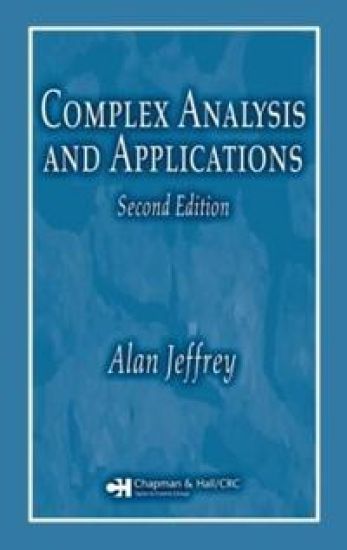
Complex Analysis and Applications

Complex Analysis and Applications

Alan Jeffrey

Chapman Hall/CRC
2005
nidottu
Complex Analysis and Applications, Second Edition explains complex analysis for students of applied mathematics and engineering. Restructured and completely revised, this textbook first develops the theory of complex analysis, and then examines its geometrical interpretation and application to Dirichlet and Neumann boundary value problems.A discussion of complex analysis now forms the first three chapters of the book, with a description of conformal mapping and its application to boundary value problems for the two-dimensional Laplace equation forming the final two chapters. This new structure enables students to study theory and applications separately, as needed. In order to maintain brevity and clarity, the text limits the application of complex analysis to two-dimensional boundary value problems related to temperature distribution, fluid flow, and electrostatics. In each case, in order to show the relevance of complex analysis, each application is preceded by mathematical background that demonstrates how a real valued potential function and its related complex potential can be derived from the mathematics that describes the physical situation.
Essentials Engineering Mathematics

Essentials Engineering Mathematics

Alan Jeffrey

Chapman Hall/CRC
2004
nidottu
First published in 1992, Essentials of Engineering Mathematics is a widely popular reference ideal for self-study, review, and fast answers to specific questions. While retaining the style and content that made the first edition so successful, the second edition provides even more examples, new material, and most importantly, an introduction to using two of the most prevalent software packages in engineering: Maple and MATLAB. Specifically, this edition includes:Introductory accounts of Maple and MATLAB that offer a quick start to using symbolic software to perform calculations, explore the properties of functions and mathematical operations, and generate graphical output New problems involving the mean value theorem for derivatives Extension of the account of stationary points of functions of two variables The concept of the direction field of a first-order differential equation Introduction to the delta function and its use with the Laplace transformThe author includes all of the topics typically covered in first-year undergraduate engineering mathematics courses, organized into short, easily digestible sections that make it easy to find any subject of interest. Concise, right-to-the-point exposition, a wealth of examples, and extensive problem sets at the end each chapter--with answers at the end of the book--combine to make Essentials of Engineering Mathematics, Second Edition ideal as a supplemental textbook, for self-study, and as a quick guide to fundamental concepts and techniques.
Mathematics for Engineers and Scientists

Mathematics for Engineers and Scientists

Alan Jeffrey

Chapman Hall/CRC
2004
nidottu
Since its original publication in 1969, Mathematics for Engineers and Scientists has built a solid foundation in mathematics for legions of undergraduate science and engineering students. It continues to do so, but as the influence of computers has grown and syllabi have evolved, once again the time has come for a new edition.Thoroughly revised to meet the needs of today's curricula, Mathematics for Engineers and Scientists, Sixth Edition covers all of the topics typically introduced to first- or second-year engineering students, from number systems, functions, and vectors to series, differential equations, and numerical analysis. Among the most significant revisions to this edition are:Simplified presentation of many topics and expanded explanations that further ease the comprehension of incoming engineering students A new chapter on double integrals Many more exercises, applications, and worked examples A new chapter introducing the MATLAB and Maple software packagesAlthough designed as a textbook with problem sets in each chapter and selected answers at the end of the book, Mathematics for Engineers and Scientists, Sixth Edition serves equally well as a supplemental text and for self-study. The author strongly encourages readers to make use of computer algebra software, to experiment with it, and to learn more about mathematical functions and the operations that it can perform.
Applied Partial Differential Equations: An Introduction
This book is written to meet the needs of undergraduates in applied mathematics, physics and engineering studying partial differential equations. It is a more modern, comprehensive treatment intended for students who need more than the purely numerical solutions provided by programs like the MATLAB PDE Toolbox, and those obtained by the method of separation of variables, which is usually the only theoretical approach found in the majority of elementary textbooks. This will fill a need in the market for a more modern text for future working engineers, and one that students can read and understand much more easily than those currently on the market.