
Kirjojen hintavertailu. Mukana 12 595 353 kirjaa ja 12 kauppaa.

Kirjailija

Alan M. Kraut

Kirjat ja teokset yhdessä paikassa: 5 kirjaa, julkaisuja vuosilta 1988-2006, suosituimpien joukossa American Refugee Policy and European Jewry, 1933-1945. Vertaile teosten hintoja ja tarkista saatavuus suomalaisista kirjakaupoista.

5 kirjaa

Kirjojen julkaisuhaarukka 1988-2006.

Covenant of Care

Covenant of Care

Alan M. Kraut; Deborah Kraut

Rutgers University Press
2006
sidottu
Winner of the 2008 Author's Award from the New Jersey Studies Academic Alliance Where were you born? Were you born at the Beth? Many thousands of Americans-Jewish and non-Jewish-were born at a hospital bearing the Star of David and named Beth Israel, Mount Sinai, or Montefiore. In the United States, health care has been bound closely to the religious impulse. Newark Beth Israel Hospital is a distinguished modern medical institution in New Jersey whose history opens a window on American health care, the immigrant experience, and urban life. Alan M. and Deborah A. Kraut tell the story of this important institution, illuminating the broader history of voluntary nonprofit hospitals created under religious auspices initially to serve poor immigrant communities. Like so many Jewish hospitals in the early half of the twentieth century, "the Beth" cared not only for its own community's poor and underprivileged, a responsibility grounded in the Jewish traditions of tzedakah ("justice") and tikkun olam ("to heal the world"), but for all Newarkers. Since it first opened its doors in 1902, the Beth has been an engine of social change. Jewish women activists and immigrant physicians founded an institution with a nonsectarian admissions policy and a welcome mat for physicians and nurses seeking opportunity denied them by anti-Semitism elsewhere. Research, too, flourished at the Beth. Here dedicated medical detectives did path-breaking research on the Rh blood factor and pacemaker development. When economic shortfalls and the Great Depression threatened the Beth's existence, philanthropic contributions from prominent Newark Jews such as Louis Bamberger and Felix Fuld, the efforts of women volunteers, and, later, income from well-insured patients saved the institution that had become the pride of the Jewish community. The Krauts tell the Beth Israel story against the backdrop of twentieth-century medical progress, Newark's tumultuous history, and the broader social and demographic changes altering the landscape of American cities. Today, the United States, in the midst of another great wave of immigration, once again faces the question of how to provide newcomers with culturally sensitive and economically accessible medical care. Covenant of Care will inform and inspire all those working to meet these demands, offering a compelling look at the creative ways that voluntary hospitals navigated similar challenges throughout the twentieth century.
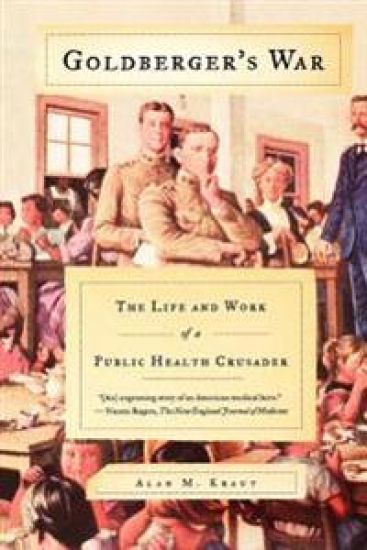
Goldberger's War: The Life and Work of a Public Health Crusader
For fans of Guns, Germs, and Steel, Alan M. Kraut's Goldberg's War tells the story of one doctor's courageous journey to cure deadly diseases and epidemics. Goldberger's War chronicles one of the U.S. Public Health Service's most renowned heroes--an immigrant Jew who trained as a doctor at Bellevue, became a young recruit to the federal government's health service, and ended an American plague. He did so by defying conventional wisdom, experimenting on humans, and telling the South precisely what it didn't want to hear. Kraut shows how Dr. Goldberger's life became, quite literally, the stuff of legends. On the front lines of the major public-health battles of the early 20th-century, he fought the epidemics that were then routinely sweeping the nation--typhoid, yellow fever, and the measles. After successfully confronting (and often contracting) the infectious diseases of his day, in 1914 he was assigned the mystery of pellagra, a disease whose cause and cure had eluded the world for centuries and was then afflicting tens of thousands of Americans every year, particularly in the emerging "New South." "Engrossing story of an American medical hero." --The New England Journal of Medicine
The Huddled Masses

The Huddled Masses

Alan M. Kraut

Harlan Davidson Inc
2001
sidottu
This history of the 'new immigration' weighs the many factors that prompted the decision to leave the old world. Though the designation 'new immigrant' generally refers to southern and eastern Europeans only, this volume also includes the Chinese and Japanese who arrived in the period from 1880-1921. Kraut argues that immigration to America was but one of the many choices available to the immigrants, and that individual aptitude and desires were just as influential as cultural, social, and familial pressures to find a better life. The immigrants' impact on America and their new countrymen is also considered. Includes a very good, 32-page photographic essay
Silent Travelers

Silent Travelers

Alan M. Kraut

Johns Hopkins University Press
1995
pokkari
This study traces the American tradition of the suspicion of immigrant populations spreading disease. From the cholera outbreak of the 1930s to the associations of Haitians and AIDS, the author shows how immigrant groups have been regularly slandered as carriers of particular diseases.
American Refugee Policy and European Jewry, 1933-1945

American Refugee Policy and European Jewry, 1933-1945

Richard Bretman; Alan M. Kraut

Indiana University Press
1988
sidottu
How does one explain America's failure to take bold action to resist the Nazi persecution and murder of European Jews? In contrast to recent writers who place the blame on anti-Semitism in American society at large and within the Roosevelt administration in particular, Richard Breitman and Alan M. Kraut seek the answer in a detailed analysis of American political realities and bureaucratic processes. Drawing on exhaustive archival research, the authors describe and analyze American immigration policy as well as rescue and relief efforts directed toward European Jewry between 1933 and 1945. They contend that U.S. policy was the product of preexisting restrictive immigration laws; an entrenched State Department bureaucracy committed to a narrow defense of American interests; public opposition to any increase in immigration; and the reluctance of Franklin D. Roosevelt to accept the political risks of humanitarian measures to benefit the European Jews. The authors find that the bureaucrats who made and implemented refugee policy were motivated by institutional priorities and reluctance to take risks, rather than by moral or humanitarian concerns.