Kirjojen hintavertailu. Mukana 12 657 676 kirjaa ja 12 kauppaa.

Kirjailija

Alan Watson

Kirjat ja teokset yhdessä paikassa: 29 kirjaa, julkaisuja vuosilta 1989-2024, suosituimpien joukossa Connor the Conker and the Breezy Day. Vertaile teosten hintoja ja tarkista saatavuus suomalaisista kirjakaupoista.

29 kirjaa

Kirjojen julkaisuhaarukka 1989-2024.

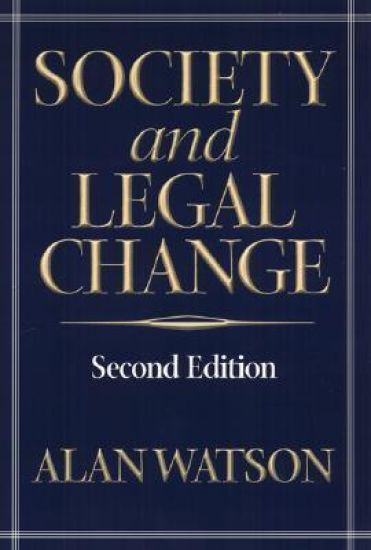
Society And Legal Change 2Nd Ed

Society And Legal Change 2Nd Ed

Alan Watson

Temple University Press,U.S.
2001
pokkari
In this first U.S. edition of a classic work of comparative legal scholarship, Alan Watson argues that law fails to keep step with social change, even when that change is massive. To illustrate the ways in which law is dysfunctional, he draws on the two most innovative western systems, of Rome and England, to show that harmful rules continue for centuries. To make his case, he uses examples where, in the main, "the law benefits no recognizable group or class within the society (except possibly lawyers who benefit from confusion) and is generally inconvenient or positively harmful to society as a whole or to large or powerful groups within the society." Widely respected for his "fearless challenge of the accepted or dominant view and his own encyclopedic knowledge of Roman law" (The Encyclopedia of Historians and Historical Writing), Watson considers the development of law in global terms and across the centuries. His arguments centering on how societies borrow from other legal systems and the continuity of legal systems are particularly instructive for those interested in legal development and the development of a common law for the European Union. postamble();
Society And Legal Change 2Nd Ed

Society And Legal Change 2Nd Ed

Alan Watson

Temple University Press,U.S.
2001
sidottu
In this first U.S. edition of a classic work of comparative legal scholarship, Alan Watson argues that law fails to keep step with social change, even when that change is massive. To illustrate the ways in which law is dysfunctional, he draws on the two most innovative western systems, of Rome and England, to show that harmful rules continue for centuries. To make his case, he uses examples where, in the main, 'the law benefits no recognizable group or class within the society (except possibly lawyers who benefit from confusion) and is generally inconvenient or positively harmful to society as a whole or to large or powerful groups within the society'. Widely respected for his 'fearless challenge of the accepted or dominant view and his own encyclopedic knowledge of Roman law' ("The Encyclopedia of Historians and Historical Writing"), Watson considers the development of law in global terms and across the centuries.His arguments centering on how societies borrow from other legal systems and the continuity of legal systems are particularly instructive for those interested in legal development and the development of a common law for the European Union. Author note: Alan Watson is Ernest P. Rogers Professor of Law and Distinguished Research Professor at the University of Georgia School of Law; he is the author or editor of some forty books, including "The Evolution of Western Private Law" and "Legal Transplants" (now in its second edition). Two collection of essays honoring Professor Watson's work have recently been published.
The Evolution of Western Private Law

The Evolution of Western Private Law

Alan Watson

Johns Hopkins University Press
2001
sidottu
In The Evolution of Western Private Law, renowned legal scholar Alan Watson presents a comprehensive overview of legal change in the Western world. Watson explains why and how such change occurs in mature systems, in underdeveloped systems, and when legal systems of different levels of sophistication and from different societal roots-such as those of the Romans and of Germanic tribes-come into contact. Originally intended as a second edition of the author's widely acclaimed The Evolution of Law (1985), this expanded edition has been completely restructured with more than double the number of examples. The result is a work that incorporates all the ideas that Watson has put forward during his twenty-five years studying comparative law and the development of legal systems, combining a remarkable range of sources with superb insight.
Sources of Law, Legal Change, and Ambiguity

Sources of Law, Legal Change, and Ambiguity

Alan Watson

University of Pennsylvania Press
1997
pokkari
Why is the law notoriously unclear, arcane, slow to change in the face of changing circumstances? In this sweeping comparative analysis of the lawmaking process from ancient Rome to the present day, Alan Watson argues that the answer has largely to do with the mixed ancestry of modern law, the confusion of sources-custom, legislation, scholarly writing, and judicial precedent-from which it derives.
Legal Transplants

Legal Transplants

Alan Watson

University of Georgia Press
1993
sidottu
In Legal Transplants, one of the world's foremost authorities on legal history and comparative law puts forth a clear and concise statement of his controversial thesis on the way that law has developed throughout history.When it was first published in 1974, Legal Transplants sparked both praise and outrage. Alan Watson's argument challenges the long-prevailing notion that a close connection exists between the law and the society in which it operates. His main thesis is that a society's laws do not usually develop as a logical outgrowth of its own experience. Instead, he contends, the laws of one society are primarily borrowed from other societies; therefore, most law operates in a society very different from the one for which it was originally created. Utilizing a wealth of primary sources, Watson illustrates his argument with examples ranging from the ancient Near East, ancient Rome, early modern Europe, Puritan New England, and modern New Zealand. The resulting picture of the law's surprising longevity and acceptance in foreign conditions carries important implications for legal historians and sociologists. The law cannot be used as a tool to understand society, Watson believes, without a careful consideration of legal transplants.For this edition, Watson has written a new afterword in which he places his original study in the context of more recent scholarship and offers some new reflections on legal borrowings, law, and society.
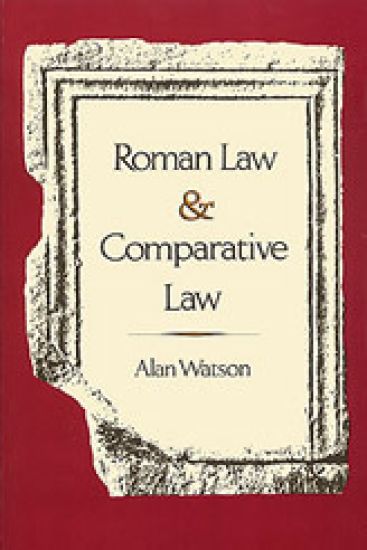
Roman Law and Comparative Law

Roman Law and Comparative Law

Alan Watson

University of Georgia Press
1991
pokkari
To understand how law develops and how legal rules and structures relate to society, one must examine the issues both comparatively and historically, Alan Watson asserts. And in the Western world, he adds, in order to understand law comparatively, one must have knowledge of Roman law.As his title suggests, Watson has divided the book into two related but independent parts. The first part, a revised and enlarged version of his 1970 volume The Law of the Ancient Romans, provides a comprehensive description of the system of Roman law. Watson begins with a discussion of law and the Roman mind and proceeds to such topics as slavery, property, contracts, delicts, and succession. In part two he argues that comparative law--an area of study still in its infancy--can help us "to identify the circumstances in which law changes, thereby uncovering the causes of legal development."Guided by this purpose, Watson examines the ways in which Roman law influenced later legal systems and how comparative law explains the role of law in society. He ties his explication throughout to individual issues. These include the structure of European legal systems, tort law in the French civil code, the structure of Blackstone's Commentaries on the Law of England, differences between contract law in France and Germany, the parameters of judicial reasoning, lessons to be drawn from feudal law, and the interests of governments in making and communicating law. He takes care to discriminate between law created by legislatures and law conceived by scholarly jurists or judges.
Studies in Roman Private Law

Studies in Roman Private Law

Alan Watson

BLOOMSBURY PUBLISHING PLC
1990
sidottu
This edited collection brings together recent scholarship on the understanding of Roman private law. From studying the Latin texts of some of the most famous and influential Roman scholars such as Livy and Cicero, Watson has built an invaluable resource on the details of Roman law. The topics covered in this volume include:- Enuptio gentis – the right to marry outside the gens;- Manus marriage;- Divorce;- Acquisition of Possession;- Acquisition of Ownership;- Acquisition of Young;- Drunkenness;- Personal injuries.Including analysis of little-studied Latin texts this important volume comes from one of the world's foremost authorities on Roman law, comparative law, legal history, and law and religion.