Kirjojen hintavertailu. Mukana 12 261 518 kirjaa ja 12 kauppaa.

Kirjailija

Alastair Matthews

Kirjat ja teokset yhdessä paikassa: 2 kirjaa, julkaisuja vuosilta 2012-2016, suosituimpien joukossa The Kaiserchronik. Vertaile teosten hintoja ja tarkista saatavuus suomalaisista kirjakaupoista.

2 kirjaa

Kirjojen julkaisuhaarukka 2012-2016.

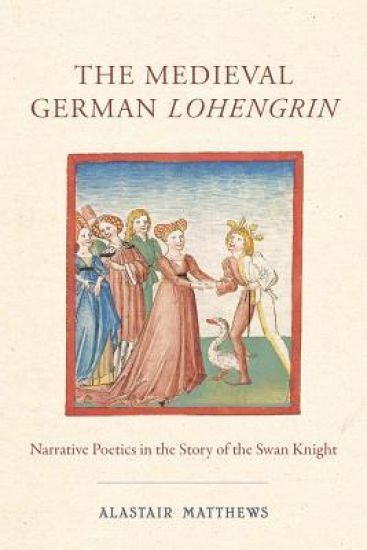
The Medieval German Lohengrin

The Medieval German Lohengrin

Alastair Matthews

Camden House Inc
2016
sidottu
The first monograph in English on the German Lohengrin, offering a new response to the challenges posed by the text. The tale of the mysterious knight carried across the water by a swan to the woman he saves and marries is one of the great narrative traditions of the Middle Ages. The version in the German Lohengrin (ca.1300) is perhaps the most striking. It captures the imagination with the appearance of the epic poet Wolfram von Eschenbach as narrator, the changing forms of the swan, and Lohengrin's appearance as a warrior alongside Saints Peter and Paul. In thepast, however, Lohengrin has been dismissed as an awkward amalgamation of earlier sources - partly due to more recent retellings of the material, such as Wagner's opera. This first monograph on Lohengrin in English presents a new response to the challenges the text poses. It is a study of how we read narrative across temporal distance, and at its heart lies the question: if a story is not held together by the chronological and causal links characteristic of modern narratives, how does it cohere? Alastair Matthews analyzes both the invocations of Wolfram that frame the text and the story of the Swan Knight that they enclose, arguing that Lohengrin is defined by a web of connections in which questions of identity and recognition are crucial, and thus that the themes at the core of the tale govern how it is told. Alastair Matthews, DPhil Oxford, is a Marie Curie ResearchFellow at the Centre for Medieval Literature, University of Southern Denmark.
The Kaiserchronik

The Kaiserchronik

Alastair Matthews

Oxford University Press
2012
sidottu
This book presents a narratological analysis of the Kaiserchronik, or chronicle of the emperors, the first verse chronicle to have been written in any European vernacular language, which provides an account of the Roman and Holy Roman emperors from the foundation of Rome to the eve of the Second Crusade. Previous research has concentrated on the structure and sources of the work and emphasized its role as a Christian narrative of history, but this study shows that the Kaiserchronik does not simply illustrate a didactic religious message: it also provides an example of how story-telling techniques in the vernacular were developed and explored in twelfth-century Germany. Four aspects of narrative are described (time and space, motivation, perspective, and narrative strands), each of which is examined with reference to the story of a particular emperor (Constantine the Great, Charlemagne, Otto the Great, and Henry IV). Rather than imposing a single analytical framework on the Kaiserchronik, the book takes account of the fact that modern theory cannot always be applied directly to works from premodern periods: it draws critically on a variety of approaches, including those of Gérard Genette, Boris Uspensky, and Eberhard Lämmert. Throughout the book, the narrative techniques described are contextualized by means of comparisons with other texts in both Middle High German and Latin, making clear the place of the Kaiserchronik as a literary narrative in the twelfth century.