Kirjojen hintavertailu. Mukana 12 390 323 kirjaa ja 12 kauppaa.

Kirjailija

Alastair Owens

Kirjat ja teokset yhdessä paikassa: 4 kirjaa, julkaisuja vuosilta 2000-2020, suosituimpien joukossa Gender Inequalities, Households and the Production of Well-Being in Modern Europe. Vertaile teosten hintoja ja tarkista saatavuus suomalaisista kirjakaupoista.

4 kirjaa

Kirjojen julkaisuhaarukka 2000-2020.

Gender Inequalities, Households and the Production of Well-Being in Modern Europe

Gender Inequalities, Households and the Production of Well-Being in Modern Europe

Tindara Addabbo; Marie-Pierre Arrizabalaga; Alastair Owens

Routledge
2020
nidottu
Feminist scholars have long pointed out the relevance of the unpaid work that goes on within European households in sustaining the well-being of the continent's populations. However, care work and domestic labour continue to be largely unremunerated and unequally distributed by gender. This unique volume of interdisciplinary essays casts new light on the roles that households play in securing the well-being of individuals and families, uncovering the processes of bargaining and accommodation, and conflict and compromise that underpin them. Contributors put gender at the centre of their analyses, demonstrating the uneven experiences of men and women as both providers and receivers of welfare in European households, in both the past and the present. As European states grapple with changing family forms, a growing population of dependent people, increased participation of women in labour markets and a profound shift in the nature and organisation of work, this book makes a timely contribution to our understanding of the critical role played by households in mediating processes of economic and social change. It offers new challenges to scholars, researchers and policy makers eager to address gender inequalities and enhance well-being. This book is the second of four volumes being published as part of Ashgate's 'Gender and Well-Being' series that arise from a programme of international symposia funded by the European Science Foundation under the auspices of COST (European Cooperation in the field of Scientific and Technical Research).
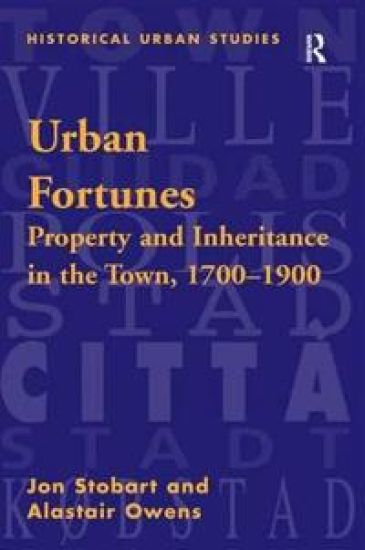
Urban Fortunes

Urban Fortunes

Jon Stobart; Alastair Owens

Routledge
2016
nidottu
Property is central to any historical analyses of production, reproduction and consumption. It lies at the heart of discussions of material culture, class relations and the household economy. Recent work has begun to look beyond the acquisition and possession of goods to examine what the disposal, transmission and giving of property might tell us about changing society and culture. This landmark collection of articles represents a wide range of approaches to and perspectives on the ownership, use and transmission of property in eighteenth and nineteenth-century towns. An introductory essay highlights the importance of property and inheritance in shaping social, cultural, economic and political structures and interactions within and between towns and cities. Writing from a variety of disciplinary backgrounds, the contributors then explore in detail the changing meaning of property to households and individuals; the social, economic and geographical contexts of inheritance practices; the geography of wealth; the role of gender in shaping property relations and, perhaps above all, the enduring link between property, the family and the household in urban contexts.
Gender Inequalities, Households and the Production of Well-Being in Modern Europe

Gender Inequalities, Households and the Production of Well-Being in Modern Europe

Tindara Addabbo; Marie-Pierre Arrizabalaga; Alastair Owens

Ashgate Publishing Limited
2010
sidottu
Feminist scholars have long pointed out the relevance of the unpaid work that goes on within European households in sustaining the well-being of the continent's populations. However, care work and domestic labour continue to be largely unremunerated and unequally distributed by gender. This unique volume of interdisciplinary essays casts new light on the roles that households play in securing the well-being of individuals and families, uncovering the processes of bargaining and accommodation, and conflict and compromise that underpin them. Contributors put gender at the centre of their analyses, demonstrating the uneven experiences of men and women as both providers and receivers of welfare in European households, in both the past and the present. As European states grapple with changing family forms, a growing population of dependent people, increased participation of women in labour markets and a profound shift in the nature and organisation of work, this book makes a timely contribution to our understanding of the critical role played by households in mediating processes of economic and social change. It offers new challenges to scholars, researchers and policy makers eager to address gender inequalities and enhance well-being. This book is the second of four volumes being published as part of Ashgate's 'Gender and Well-Being' series that arise from a programme of international symposia funded by the European Science Foundation under the auspices of COST (European Cooperation in the field of Scientific and Technical Research).
Urban Fortunes

Urban Fortunes

Jon Stobart; Alastair Owens

Ashgate Publishing Limited
2000
sidottu
Property is central to any historical analyses of production, reproduction and consumption. It lies at the heart of discussions of material culture, class relations and the household economy. Recent work has begun to look beyond the acquisition and possession of goods to examine what the disposal, transmission and giving of property might tell us about changing society and culture. This landmark collection of articles represents a wide range of approaches to and perspectives on the ownership, use and transmission of property in eighteenth and nineteenth-century towns. An introductory essay highlights the importance of property and inheritance in shaping social, cultural, economic and political structures and interactions within and between towns and cities. Writing from a variety of disciplinary backgrounds, the contributors then explore in detail the changing meaning of property to households and individuals; the social, economic and geographical contexts of inheritance practices; the geography of wealth; the role of gender in shaping property relations and, perhaps above all, the enduring link between property, the family and the household in urban contexts.