Kirjojen hintavertailu. Mukana 12 339 022 kirjaa ja 12 kauppaa.

Kirjailija

Albert O. Hirschman

Kirjat ja teokset yhdessä paikassa: 22 kirjaa, julkaisuja vuosilta 1968-2024, suosituimpien joukossa Taantumuksen retoriikka. Vertaile teosten hintoja ja tarkista saatavuus suomalaisista kirjakaupoista.

Mukana myös kirjoitusasut: Albert O Hirschman

22 kirjaa

Kirjojen julkaisuhaarukka 1968-2024.

Taantumuksen retoriikka

Taantumuksen retoriikka

Albert O. Hirschman

Eurooppalaisen filosofian seura
2024
nidottu
Yhteiskuntatieteiden klassikko Taantumuksen retoriikka esittelee kolme konservatiivista tapaa puhua uudistusten kierouttavuudesta, turhuudesta tai vaarallisuudesta ja osoittaa väitteiden heikkoudet.
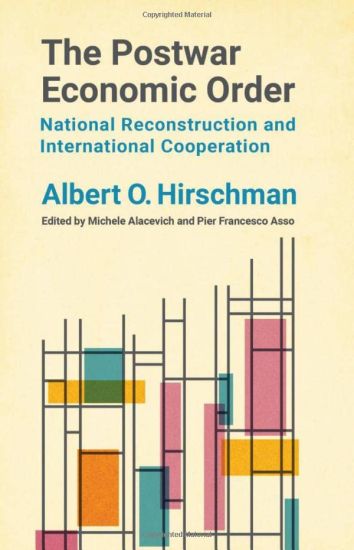
The Postwar Economic Order

The Postwar Economic Order

Albert O. Hirschman

Columbia University Press
2022
pokkari
Winner, 2024 Best Scholarly Edition Award, European Society for the History of Economic ThoughtYears before he became renowned as one of the most original social scientists of the twentieth century, Albert O. Hirschman played an active role in the rebuilding of postwar Europe. Between 1946 and 1952, he worked as an economic analyst in the Research Division of the Federal Reserve Board of the United States, focusing on the reconstruction of Europe and the Marshall Plan. In that capacity, Hirschman wrote a number of reports about European economic policies, the first efforts at intra-European cooperation, and the uncertainties that surrounded the shaping of a new international economic order with the United States at its core.The Postwar Economic Order presents a collection of these interrelated reports, which offer incisive firsthand analysis of postwar Europe and give a behind-the-scenes view of American debates on European economic recovery. They feature nuanced and sophisticated discussion of topics such as the postwar “dollar shortage,” U.S.-European relations, and the first steps toward European economic integration. Hirschman provides original and perceptive interpretations of the struggles that European governments faced along their paths toward economic recovery. Throughout, Hirschman’s stylistic gifts and characteristic ways of reasoning are on full display as he highlights the counterintuitive and paradoxical aspects of economic and political processes. Shedding new light on the origins of European economic cooperation, this book provides unparalleled insight into the development of Hirschman’s thinking on economic development and reform.
The Postwar Economic Order

The Postwar Economic Order

Albert O. Hirschman

Columbia University Press
2022
sidottu
Winner, 2024 Best Scholarly Edition Award, European Society for the History of Economic ThoughtYears before he became renowned as one of the most original social scientists of the twentieth century, Albert O. Hirschman played an active role in the rebuilding of postwar Europe. Between 1946 and 1952, he worked as an economic analyst in the Research Division of the Federal Reserve Board of the United States, focusing on the reconstruction of Europe and the Marshall Plan. In that capacity, Hirschman wrote a number of reports about European economic policies, the first efforts at intra-European cooperation, and the uncertainties that surrounded the shaping of a new international economic order with the United States at its core.The Postwar Economic Order presents a collection of these interrelated reports, which offer incisive firsthand analysis of postwar Europe and give a behind-the-scenes view of American debates on European economic recovery. They feature nuanced and sophisticated discussion of topics such as the postwar “dollar shortage,” U.S.-European relations, and the first steps toward European economic integration. Hirschman provides original and perceptive interpretations of the struggles that European governments faced along their paths toward economic recovery. Throughout, Hirschman’s stylistic gifts and characteristic ways of reasoning are on full display as he highlights the counterintuitive and paradoxical aspects of economic and political processes. Shedding new light on the origins of European economic cooperation, this book provides unparalleled insight into the development of Hirschman’s thinking on economic development and reform.
How Reforms Should Be Passed

How Reforms Should Be Passed

Albert O. Hirschman

PETER LANG PUBLISHING INC
2021
sidottu
Well-known as a pioneer of economic development, Albert O. Hirschman has been the flag-bearer of possibilism and reform-mongering in political science. How Reforms Should Be Passed is an anthology of texts chosen personally by Hirschman on the latter production line—as he was to call it informally—that is rooted in his long and quasi-exclusive concern for development and Latin America. Key essays on the formation and the evolution of Hirschman’s point of view on the subject are collected: from "Ideologies of Economic Development in Latin America" to Journeys (and later "A Return Journey") on policy-making; from "Obstacles to the Perception of Change" to "The Search for Paradigms as a Hindrance to Understanding." They show an extraordinary turn of the mind in the making that will be very useful for the United States and the developed world as well—as the final texts of the book on democracy and Europe (Italy, Germany and France) bear out. This book represents a unique opportunity for becoming familiar with many original and perceptive lenses provided by Hirschman to look at the world we live in, and especially to favor social change—focusing (first of all) on the cultural and political side of the matter.
How Economics Should Be Complicated

How Economics Should Be Complicated

Albert O. Hirschman

Peter Lang Publishing Inc
2020
sidottu
This volume brings together select texts representative of the full range of intellectual output of one of the greatest and most eclectic economists of our time, Albert O. Hirschman. Covering a time span of over forty years, they recall his most prominent books and include many additional themes taken from essays of wide-ranging origin and content. The title How Economics Should Be Complicated has the dual sense of an endpoint and a central and recurrent theme in the author’s experience, which unfolds in his critical—but constructive—relationship with economic theory, his openness to other social sciences and his democratic and "possibilist" political inspiration. This stands as the basis of an important lesson in intellectual rebirth.
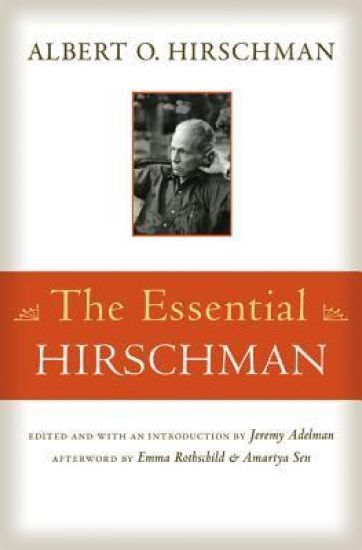
The Essential Hirschman

The Essential Hirschman

Albert O. Hirschman; Emma Rothschild; Amartya Sen
Princeton University Press
2015
pokkari
The Essential Hirschman brings together some of the finest essays in the social sciences, written by one of the twentieth century's most influential and provocative thinkers. Albert O. Hirschman was a master essayist, one who possessed the rare ability to blend the precision of economics with the elegance of literary imagination. In an age in which our academic disciplines require ever-greater specialization and narrowness, it is rare to encounter an intellectual who can transform how we think about inequality by writing about traffic, or who can slip in a quote from Flaubert to reveal something surprising about taxes. The essays gathered here span an astonishing range of topics and perspectives, including industrialization in Latin America, imagining reform as more than repair, the relationship between imagination and leadership, routine thinking and the marketplace, and the ways our arguments affect democratic life. Throughout, we find humor, unforgettable metaphors, brilliant analysis, and elegance of style that give Hirschman such a singular voice. Featuring an introduction by Jeremy Adelman that places each of these essays in context as well as an insightful afterword by Emma Rothschild and Amartya Sen, The Essential Hirschman is the ideal introduction to Hirschman for a new generation of readers and a must-have collection for anyone seeking his most important writings in one book.
Development Projects Observed

Development Projects Observed

Albert O. Hirschman; Cass R. Sunstein; Michele Alacevich
Brookings Institution
2014
nidottu
"Originally published in 1967, the modest and plainly descriptive title of Development Projects Observed is deceptive. Today, it is recognized as the ultimate volume of Hirschman's groundbreaking trilogy on development, and as the bridge to the broader social science themes of his subsequent writings. Though among his lesser-known works, this unassuming tome is one of his most influential.It is in this book that Hirschman first shared his now famous ""Principle of the Hiding Hand."" In an April 2013 New Yorker issue, Malcolm Gladwell wrote an appreciation of the principle, described by Cass Sunstein in the book's new foreword as ""a bit of a trick up history's sleeve."" It can be summed up as a phenomenon in which people's inability to foresee obstacles leads to actions that succeed because people have far more problem-solving ability that they anticipate or appreciate.And it is in Development Projects Observed that Hirschman laid the foundation for the core of his most important work, Exit, Voice, and Loyalty, and later led to the concept of an ""exit strategy."""
The Essential Hirschman

The Essential Hirschman

Albert O. Hirschman; Emma Rothschild; Amartya Sen
Princeton University Press
2013
sidottu
The Essential Hirschman brings together some of the finest essays in the social sciences, written by one of the twentieth century's most influential and provocative thinkers. Albert O. Hirschman was a master essayist, one who possessed the rare ability to blend the precision of economics with the elegance of literary imagination. In an age in which our academic disciplines require ever-greater specialization and narrowness, it is rare to encounter an intellectual who can transform how we think about inequality by writing about traffic, or who can slip in a quote from Flaubert to reveal something surprising about taxes. The essays gathered here span an astonishing range of topics and perspectives, including industrialization in Latin America, imagining reform as more than repair, the relationship between imagination and leadership, routine thinking and the marketplace, and the ways our arguments affect democratic life. Throughout, we find humor, unforgettable metaphors, brilliant analysis, and elegance of style that give Hirschman such a singular voice. Featuring an introduction by Jeremy Adelman that places each of these essays in context as well as an insightful afterword by Emma Rothschild and Amartya Sen, The Essential Hirschman is the ideal introduction to Hirschman for a new generation of readers and a must-have collection for anyone seeking his most important writings in one book.
The Passions and the Interests

The Passions and the Interests

Albert O. Hirschman; Amartya Sen; Jeremy Adelman

Princeton University Press
2013
pokkari
In this volume, Albert Hirschman reconstructs the intellectual climate of the seventeenth and eighteenth centuries to illuminate the intricate ideological transformation that occurred, wherein the pursuit of material interests--so long condemned as the deadly sin of avarice--was assigned the role of containing the unruly and destructive passions of man. Hirschman here offers a new interpretation for the rise of capitalism, one that emphasizes the continuities between old and new, in contrast to the assumption of a sharp break that is a common feature of both Marxian and Weberian thinking. Among the insights presented here is the ironical finding that capitalism was originally supposed to accomplish exactly what was soon denounced as its worst feature: the repression of the passions in favor of the "harmless," if one-dimensional, interests of commercial life. To portray this lengthy ideological change as an endogenous process, Hirschman draws on the writings of a large number of thinkers, including Montesquieu, Sir James Steuart, and Adam Smith. Featuring a new afterword by Jeremy Adelman and a foreword by Amartya Sen, this Princeton Classics edition of The Passions and the Interests sheds light on the intricate ideological transformation from which capitalism emerged triumphant, and reaffirms Hirschman's stature as one of our most influential and provocative thinkers.
Sorti eller protest : en fråga om lojaliteter

Sorti eller protest : en fråga om lojaliteter

Albert O. Hirschman

Arkiv förlag/A-Z förlag
2009
nidottu
Albert O. Hirschman visar i sitt klassiska arbete, Sorti eller protest. En fråga om lojaliteter (1970), hur fruktbart det är att kontrastera sortin, protesten och lojaliteten som olika sätt att handla inom den ekonomiska, politiska och civila sfären. I företag, politiska partier, organisationer eller nationer, i bagatellartade situationer eller livsavgörande ögonblick ställs individen ibland inför valet att lojalt acceptera, att säga ifrån och försöka påverka eller att ta konsekvenserna av en oacceptabel och ohållbar situation och dra sig ur spelet. Hirschmans eleganta teori och uppslagsrika begrepp erbjuder skarpa vetenskapliga verktyg för analyser av många av samtidens frågor. Hans begrepp är lika användbara på historiens stora skeenden, dess vändpunkter - Berlinmurens och Östtysklands fall - som för en analys av den skröplige åldringens utsatthet i ett hårdhänt rationaliserat vårdmaskineri. Det är inte märkligt att denna bok blivit en klassiker. Lena Agevall och Gunnar Olofsson beskriver kort Hirschmans liv och verk och diskuterar i ett förord författarens egen vidareutveckling av bokens begrepp och tematik.
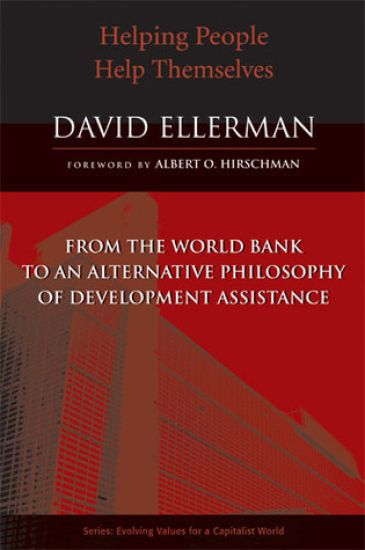
Helping People Help Themselves

Helping People Help Themselves

David Ellerman; Albert O. Hirschman
The University of Michigan Press
2006
nidottu
David Ellerman relates a deep theoretical groundwork for a philosophy of development, while offering a descriptive, practical suggestion of how goals of development can be better set and met. Beginning with the assertion that development assistance agencies are inherently structured to provide help that is ultimately unhelpful by overriding or undercutting the capacity of people to help themselves, David Ellerman argues that the best strategy for development is a drastic reduction in development assistance. The locus of initiative can then shift from the would-be helpers to the doers (recipients) of development. Ellerman presents various methods for shifting initiative that are indirect, enabling and autonomy-respecting. Eight representative figures in the fields of education, community organization, economic development, psychotherapy and management theory including: Albert Hirschman, Paulo Freire, John Dewey, and Søren Kierkegaard demonstrate how the major themes of assisting autonomy among people are essentially the same.David Ellerman is currently a Visiting Scholar in the Economics Department at the University of California at Riverside.
Development Projects Observed

Development Projects Observed

Albert O. Hirschman

Brookings Institution
2002
nidottu
The experience accumulated in the wake of more than two decades of sustained effort to promote growth and change in the low-income countries presents a rich field for scholarly inquiry and new insights into the development process. The success and failures of such projects, the new skills and attitudes they impart, and the internal tensions they sometimes generate obviously have an important bearing on the next stages of a county's development effort. Yet little has become known about these truly formative experiences which are due to the behavior —and misbehavior —of development projects. In this recent volume, Professor Albert O. Hirschman turns his attention to the ways in which decision making is molded, activated, or hampered by the specific nature of the project that is undertaken; for example, the establishment and operation of a pulp and paper mill in east Pakistan, an irrigation project in Peru, railway expansion in Nigeria, and other development undertakings. In some parts of the present inquiry Hirschman elaborates on his earlier writings in this series; and occasionally, he qualifies or modifies his previous conclusions; the bulk of the study explores new territory.
Shifting Involvements

Shifting Involvements

Albert O. Hirschman

Princeton University Press
2002
pokkari
Why does society oscillate between intense interest in public issues and almost total concentration on private goals? In this classic work, Albert O. Hirschman offers a stimulating social, political, and economic analysis dealing with how and why frustrations of private concerns lead to public involvement and public participation that eventually lead back to those private concerns. Emerging from this study is a wide range of insights, from a critique of conventional consumption theory to a new understanding of collective action and of universal suffrage.
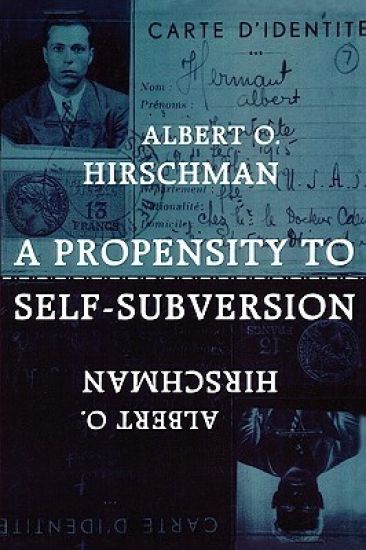
A Propensity to Self-Subversion

A Propensity to Self-Subversion

Albert O. Hirschman

Harvard University Press
1998
nidottu
Albert O. Hirschman is renowned worldwide for theories that have been at the forefront of political economics during the last half century. In these twenty essays he casts his sharp analytical eye on his own ideas, questioning and qualifying some of his major propositions on social change and economic development. Hirschman's self-subversion, as well as the self-affirmation that is also present here, reveal the workings of a distinguished mind. They also bring us fresh perspective on the material in his twelve previous books and countless essays.In the substantial essays that open this collection, Hirschman reappraises points he made in such books as Exit, Voice, and Loyalty, The Strategy of Economic Development, and The Rhetoric of Reaction. Subsequent essays fruitfully reexplore the themes of Latin American development and market society that have occupied him throughout his career. Hirschman also forays into new puzzles, such as the likely impact, negative or otherwise, of the Eastern European revolutions of 1989 on the Third World, the on-and-off connections between political and economic progress, and the role of conflict in enhancing community spirit in a liberal democracy.In a rare and particularly welcome section of the book, Hirschman presents autobiographical fragments that reflect his deep involvement in some of the important events of this century. He recollects his flight from Hitler's Germany in 1933, his studies in Paris, his work with the antifascist underground in Italy in 1937-38, and his role in helping Varian Fry in Marseilles, in 1940, to rescue political and intellectual refugees from Vichy France. Such accounts deepen our understanding of how Hirschman's penetrating insights took shape.
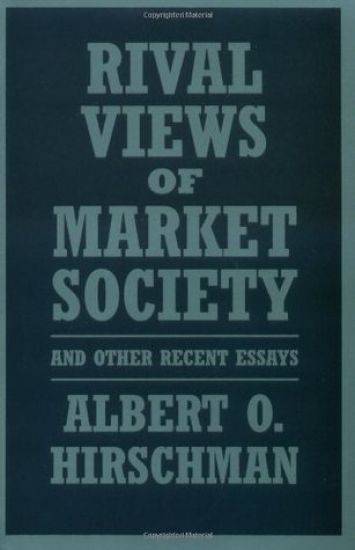
Rival Views of Market Society and Other Recent Essays

Rival Views of Market Society and Other Recent Essays

Albert O. Hirschman

HARVARD UNIVERSITY PRESS
1992
nidottu
Since the mid-twentieth century Albert O. Hirschman has been known for his innovative, lucid, and brilliantly argued contributions to economics, the history of ideas, and the social sciences. Two central and already widely admired essays in this collection explore new territory. The title essay distinguishes among four very different conceptions of the characteristics and dynamics of capitalist societies. A related plea for embracing complexity is made in "Against Parsimony," a wide-ranging critique of traditional economic models. In other writings Hirschman revisits his own views on economic development, the concept of interest, and the roles of "exit" and "voice" in economic and social systems. This volume reaffirms the powerful originality and enduring value of Hirschman's work.
The Rhetoric of Reaction

The Rhetoric of Reaction

Albert O. Hirschman

The Belknap Press
1991
nidottu
With engaging wit and subtle irony, Albert Hirschman maps the diffuse and treacherous world of reactionary rhetoric in which conservative public figures, thinkers, and polemicists have been arguing against progressive agendas and reforms for the past two hundred years.Hirschman draws his examples from three successive waves of reactive thought that arose in response to the liberal ideas of the French Revolution and the Declaration of the Rights of Man, to democratization and the drive toward universal suffrage in the nineteenth century, and to the welfare state in our own century. In each case he identifies three principal arguments invariably used: (1) the perversity thesis, whereby any action to improve some feature of the political, social, or economic order is alleged to result in the exact opposite of what was intended; (2) the futility thesis, which predicts that attempts at social transformation will produce no effects whatever—will simply be incapable of making a dent in the status quo; (3) the jeopardy thesis, holding that the cost of the proposed reform is unacceptable because it will endanger previous hard-won accomplishments. He illustrates these propositions by citing writers across the centuries from Alexis de Tocqueville to George Stigler, Herbert Spencer to Jay Forrester, Edmund Burke to Charles Murray. Finally, in a lightning turnabout, he shows that progressives are frequently apt to employ closely related rhetorical postures, which are as biased as their reactionary counterparts. For those who aspire to the genuine dialogue that characterizes a truly democratic society, Hirschman points out that both types of rhetoric function, in effect, as contraptions designed to make debate impossible. In the process, his book makes an original contribution to democratic thought.The Rhetoric of Reaction is a delightful handbook for all discussions of public affairs, the welfare state, and the history of social, economic, and political thought, whether conducted by ordinary citizens or academics.
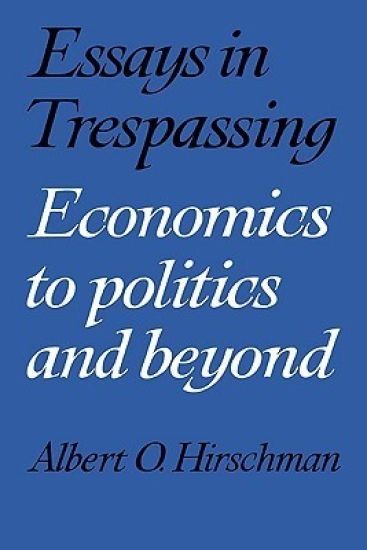
Essays in Trespassing

Essays in Trespassing

Albert O. Hirschman

Cambridge University Press
1981
pokkari
This book brings together fourteen articles and papers written by Albert O. Hirschman. About half deal with the interaction of economic development with politics and ideology, the area in which Hirschman perhaps has made most noted contributions. Among these papers are 'The Rise and Declines of Development Economics', a magisterial and yet pointed essay in intellectual history and his famous article 'The Changing Tolerance for Income Inequality in the Course of Economic Development'. Hirschman's ability to trespass - or rather his inability not to trespass - from one social science to another and beyond is the unifying characteristic of the volume. Authoritative, searching surveys alternate here with essays presenting some of Hirschman's characteristic inventions, for instance the 'tunnel effect' and 'obituary-improving activities'. Three of the papers have not been published previously and a number of introductory notes have been especially drafted for the present volume to evoke the intellectual-political climate in which certain groups of essays were written.