Kirjojen hintavertailu. Mukana 12 475 307 kirjaa ja 12 kauppaa.

Kirjailija

Alberto Pérez-Gómez

Kirjat ja teokset yhdessä paikassa: 21 kirjaa, julkaisuja vuosilta 1985-2016, suosituimpien joukossa Chora 2. Vertaile teosten hintoja ja tarkista saatavuus suomalaisista kirjakaupoista.

Mukana myös kirjoitusasut: Alberto Pérez-Gomez, Alberto Perez-Gomez

21 kirjaa

Kirjojen julkaisuhaarukka 1985-2016.

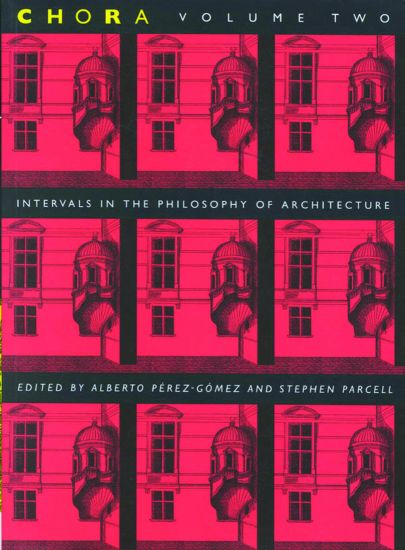
Chora 2

Chora 2

Alberto Pérez-Gómez; Stephen Parcell

McGill-Queen's University Press
1996
nidottu
Karsten Harries provides a new and long-overdue reading of Martin Heidegger's well-known essay "Building Dwelling Thinking." Donald Kunze and Stephen Parcell consider possibilities of meaningful architectural space for a visual culture, continuing themes they addressed in Chora 1. Further reflections on the spaces of literature, cinema, and architecture include an interview with French writer and film maker Alain Robbe-Grillet and articles by Dagmar Motycka Weston on the surrealist city, Tracey Eve Winton on the museum as a paradigmatic modern building, and Terrance Galvin on spiritual space in the works of Jean Cocteau. Jean-Pierre Chupin and Bram Ratner explore historical themes in their essays on French Renaissance architect Philibert de l'Orme and the Jewish myth of the Golem. Gregory Caicco addresses ethical questions in his essay on the Greek agora and the death of Socrates, as does Lily Chi in her meditation on the critical issue of use in architectural works. A concern with architectural representation and generative strategies for the making of architecture is present throughout, especially in the essay by Joanna Merwood on the provocative House by British artist Rachel Whiteread.
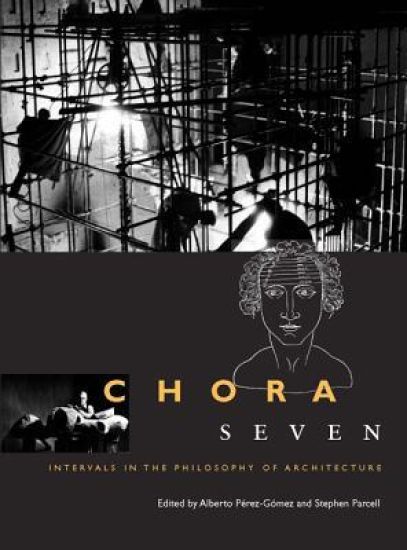
Chora 7

Chora 7

Alberto Pérez-Gómez; Stephen Parcell

McGill-Queen's University Press
2016
sidottu
For over twenty years, the Chora series has received international acclaim for its excellence in interdisciplinary research on architecture. The seven volumes of Chora have challenged readers to consider alternatives to conventional aesthetic and technological concepts. The seventy-eight authors and eighty-seven scholarly essays in the series have investigated profound cultural roots of architecture and revealed rich possibilities for architecture and its related disciplines. Chora 7, the final volume in the series, includes fifteen essays on architectural topics from around the world (France, Greece, Iran, Italy, Korea, and the United States) and from diverse cultures (antiquity, Renaissance Italy, early modern France, and the past hundred years). Thematically, they bring original approaches to human experience, theatre, architectural creation, and historical origins. Readers will also gain insights into theoretical and practical work by architects and artists such as Leon Battista Alberti, Peter Brook, Douglas Darden, Filarete, Andy Goldsworthy, Anselm Kiefer, Frederick Kiesler, Claude-Nicolas Ledoux, and Peter Zumthor. Contributors to Chora 7 include Anne Bordeleau (University of Waterloo), Diana Cheng (Montreal), Negin Djavaherian (Montreal), Paul Emmons (Washington-Alexandria Architecture Center of Virginia Tech), Paul Holmquist (McGill University), Ron Jelaco (McGill University), Yoonchun Jung (Kyoto University), Christos Kakalis (Edinburgh School of Architecture and Landscape Architecture), Lisa Landrum (University of Manitoba), Robert Nelson (Monash University), Marc J Neveu (Woodbury University), Alberto Perez-Gomez (McGill University), Angeliki Sioli (Monterrey Institute of Technology and Higher Education), Nikolaos-Ion Terzoglou (National Technical University of Athens), and Stephen Wischer (North Dakota State University).
Chora 6

Chora 6

Alberto Pérez-Gómez; Stephen Parcell

McGill-Queen's University Press
2011
sidottu
Different concepts of the machine are pursued in essays on Fritz Lang's Metropolis, Alfred Jarry's pataphysical machines, and cosmological and political orders in sixteenth-century utopias. Cross-cultural tensions are examined in essays on the Christian appropriation of Aztec symbolism, and on Jesuit perspectives in an imperial Chinese garden in Beijing. Architectural origins and education are revisited in essays on fire and language in Vitruvius, on storytelling by Spanish theorist Juan Caramuel de Lobkowitz, and on the role of history in the design of the Prato della Valle, a public square in Padua. Phenomenal experience is the focus of essays on light and stone in the Gothic church of Saint-Denis, and on bodily movement through the ancient Palace of Minos at Knossos in Crete. Tensions in architectural representation are investigated in essays on the influence of Villard de Honnecourt on drawings by William Burges in Victorian England, and on Stendhal's curious narrative drawings in his book Vie de Henry Brulard. Contemporary beliefs are scrutinized in an essay that uses psychoanalytic theory to examine the modern concept of sustainability.
Chora 6

Chora 6

Alberto Pérez-Gómez; Stephen Parcell

McGill-Queen's University Press
2011
nidottu
Different concepts of the machine are pursued in essays on Fritz Lang's Metropolis, Alfred Jarry's pataphysical machines, and cosmological and political orders in sixteenth-century utopias. Cross-cultural tensions are examined in essays on the Christian appropriation of Aztec symbolism, and on Jesuit perspectives in an imperial Chinese garden in Beijing. Architectural origins and education are revisited in essays on fire and language in Vitruvius, on storytelling by Spanish theorist Juan Caramuel de Lobkowitz, and on the role of history in the design of the Prato della Valle, a public square in Padua. Phenomenal experience is the focus of essays on light and stone in the Gothic church of Saint-Denis, and on bodily movement through the ancient Palace of Minos at Knossos in Crete. Tensions in architectural representation are investigated in essays on the influence of Villard de Honnecourt on drawings by William Burges in Victorian England, and on Stendhal's curious narrative drawings in his book Vie de Henry Brulard. Contemporary beliefs are scrutinized in an essay that uses psychoanalytic theory to examine the modern concept of sustainability.
Chora 5

Chora 5

Alberto Pérez-Gomez; Stephen Parcell

McGill-Queen's University Press
2007
sidottu
Provocative views on why architecture matters offer vital information for developing a richer architecture
Chora 5

Chora 5

Alberto Pérez-Gomez; Stephen Parcell

McGill-Queen's University Press
2007
nidottu
Provocative views on why architecture matters offer vital information for developing a richer architecture
Chora 4

Chora 4

Alberto Pérez-Gomez; Stephen Parcell

McGill-Queen's University Press
2004
nidottu
Chora IV continues a tradition of excellence in open, interdisciplinary research into architecture.
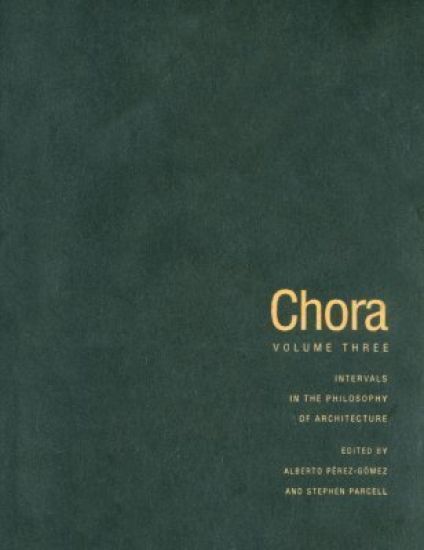
Chora 3

Chora 3

Alberto Pérez-Gómez; Stephen Parcell

McGill-Queen's University Press
1999
nidottu
The thirteen essays in this collection include historical subjects as well as speculative theoretical "projects" that blur conventional boundaries between history and fiction. Ricardo Castro provides an original reading of the Kogi culture in Colombia; Maria Karvouni explores philological and architectonic connections between the Greek demas (the political individual) and domus (the house); Mark Rozahegy speculates on relationships between architecture and memory; Myriam Blais discusses technical inventions by sixteenth-century French architect Philibert de l'Orme; Alberto Perez-Gomez examines the late sixteenth-century reconstruction of the Temple of Jerusalem by Juan Bautista Villalpando; Janine Debanne offers a new perspective on Guarino Guarini's Chapel of the Holy Shroud in Turin; Katja Grillner examines the early seventeenth-century writings of Salomon de Caus and his built work in Heidelberg; David Winterton reflects on Charles-Francois Viel's "Letters"; Franca Trubiano looks at Jean-Jacques Lequeu's controversial Civil Architecture; Henrik Reeh considers the work of Sigfried Kracauer, a disciple of Walter Benjamin; Irena dantovska Murray reflects on work by artist Jana Sterbak; artist Ellen Zweig presents a textual project that demonstrates the charged poetic space created by film makers such as Antonioni and Hitchcock; and Swedish writer and architect Soren Thurell asks a riddle about architecture and its mimetic origins. The essays in this volume demonstrate a reconciliatory architecture that respects cultural differences, acknowledges the globalization of technological culture, and points to a referent other than itself.
Chora 2

Chora 2

Alberto Pérez-Gómez; Stephen Parcell

McGill-Queen's University Press
1996
sidottu
Karsten Harries provides a new and long-overdue reading of Martin Heidegger's well-known essay "Building Dwelling Thinking." Donald Kunze and Stephen Parcell consider possibilities of meaningful architectural space for a visual culture, continuing themes they addressed in Chora 1. Further reflections on the spaces of literature, cinema, and architecture include an interview with French writer and film maker Alain Robbe-Grillet and articles by Dagmar Motycka Weston on the surrealist city, Tracey Eve Winton on the museum as a paradigmatic modern building, and Terrance Galvin on spiritual space in the works of Jean Cocteau. Jean-Pierre Chupin and Bram Ratner explore historical themes in their essays on French Renaissance architect Philibert de l'Orme and the Jewish myth of the Golem. Gregory Caicco addresses ethical questions in his essay on the Greek agora and the death of Socrates, as does Lily Chi in her meditation on the critical issue of use in architectural works. A concern with architectural representation and generative strategies for the making of architecture is present throughout, especially in the essay by Joanna Merwood on the provocative House by British artist Rachel Whiteread.
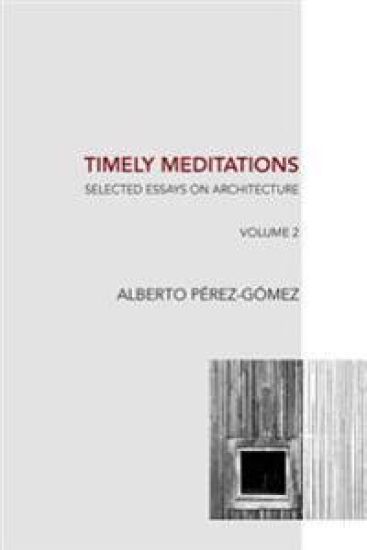
Timely Meditations, vol.2

Timely Meditations, vol.2

Alberto Perez-Gomez

Createspace Independent Publishing Platform
2016
pokkari
This remarkable collection brings together a selection of essays by Alberto P rez-G mez, originally published in diverse periodicals and as chapters in books, over a period of twenty-five years. The essays have been revised and updated by the author, sometimes substantially modified to reflect more accurately the state of contemporary questions in the field of architecture. While the writing deliberately blurs the edges of history and theory, the essays have been collected in two separate volumes: the first focusing on architectural theories and practices both historical and recent, and the second on more general aspects of architectural philosophy.The untimeliness of these texts on architecture, history, and philosophy is a welcome departure from today's incessant demand for timely innovation. These articles engage with central and marginal figures from architecture's past, converse with contemporaries who hold a sympathetic stance, and engage diverse philosophical positions. The essays draw from other fields of inquiry: philosophy, theatre, literature, art, dance, and neuroscience, to name a few. It is through these interdisciplinary conversations and the questions they generate that the works manifest their full power, rendering visible many currently-ignored issues. Against some of our most assured convictions and protocols, P rez-G mez consistently seeks meaningful sites in which to re-negotiate the architect's task of imagining the world otherwise. This is done without affectation or pretense, acknowledging the task's difficulty in our late-modern world. By joining past, present, and future, the texts offer their gift: the hopeful shaping of a time to come. This remarkable collection is a testament to three decades of thinking, whose untimeliness will challenge and reward readers, placing the search for dwelling, belonging and love at the heart of architecture (Foreword by Peter Olshavsky).
Timely Meditations, vol.1

Timely Meditations, vol.1

Alberto Perez-Gomez

Createspace Independent Publishing Platform
2016
pokkari
This remarkable collection brings together a selection of essays by Alberto P rez-G mez, originally published in diverse periodicals and as chapters in books, over a period of twenty-five years. The essays have been revised and updated by the author, sometimes substantially modified to reflect more accurately the state of contemporary questions in the field of architecture. While the writing deliberately blurs the edges of history and theory, the essays have been collected in two separate volumes: the first focusing on architectural theories and practices both historical and recent, and the second on more general aspects of architectural philosophy.The untimeliness of these texts on architecture, history, and philosophy is a welcome departure from today's incessant demand for timely innovation. These articles engage with central and marginal figures from architecture's past, converse with contemporaries who hold a sympathetic stance, and engage diverse philosophical positions. The essays draw from other fields of inquiry: philosophy, theatre, literature, art, dance, and neuroscience, to name a few. It is through these interdisciplinary conversations and the questions they generate that the works manifest their full power, rendering visible many currently-ignored issues. Against some of our most assured convictions and protocols, P rez-G mez consistently seeks meaningful sites in which to re-negotiate the architect's task of imagining the world otherwise. This is done without affectation or pretense, acknowledging the task's difficulty in our late-modern world. By joining past, present, and future, the texts offer their gift: the hopeful shaping of a time to come. This remarkable collection is a testament to three decades of thinking, whose untimeliness will challenge and reward readers, placing the search for dwelling, belonging and love at the heart of architecture (Foreword by Peter Olshavsky).
Attunement

Attunement

Alberto Pérez-Gómez

MIT Press
2016
pokkari
How architecture can move beyond the contemporary enthusiasms for the technically sustainable and the formally dazzling to enhance our human values and capacities.Architecture remains in crisis, its social relevance lost between the two poles of formal innovation and technical sustainability. In Attunement, Alberto Perez-Gomez calls for an architecture that can enhance our human values and capacities, an architecture that is connected-attuned-to its location and its inhabitants. Architecture, Perez-Gomez explains, operates as a communicative setting for societies; its beauty and its meaning lie in its connection to human health and self-understanding.Our physical places are of utmost importance for our well-being. Drawing on recent work in embodied cognition, Perez-Gomez argues that the environment, including the built environment, matters not only as a material ecology but because it is nothing less than a constituent part of our consciousness. To be fully self-aware, we need an external environment replete with meanings and emotions.Perez-Gomez views architecture through the lens of mood and atmosphere, linking these ideas to the key German concept of Stimmung-attunement-and its roots in Pythagorean harmony and Vitruvian temperance or proportion. He considers the primacy of place over space; the linguistic aspect of architecture-the voices of architecture and the voice of the architect; architecture as a multisensory (not pictorial) experience, with Piranesi, Ledoux, and Hejduk as examples of metaphorical modeling; and how Stimmung might be put to work today to realize the contemporary possibilities of attunement.
Chora 7

Chora 7

Alberto Pérez-Gómez; Stephen Parcell

McGill-Queen's University Press
2016
nidottu
For over twenty years, the Chora series has received international acclaim for its excellence in interdisciplinary research on architecture. The seven volumes of Chora have challenged readers to consider alternatives to conventional aesthetic and technological concepts. The seventy-eight authors and eighty-seven scholarly essays in the series have investigated profound cultural roots of architecture and revealed rich possibilities for architecture and its related disciplines. Chora 7, the final volume in the series, includes fifteen essays on architectural topics from around the world (France, Greece, Iran, Italy, Korea, and the United States) and from diverse cultures (antiquity, Renaissance Italy, early modern France, and the past hundred years). Thematically, they bring original approaches to human experience, theatre, architectural creation, and historical origins. Readers will also gain insights into theoretical and practical work by architects and artists such as Leon Battista Alberti, Peter Brook, Douglas Darden, Filarete, Andy Goldsworthy, Anselm Kiefer, Frederick Kiesler, Claude-Nicolas Ledoux, and Peter Zumthor. Contributors to Chora 7 include Anne Bordeleau (University of Waterloo), Diana Cheng (Montreal), Negin Djavaherian (Montreal), Paul Emmons (Washington-Alexandria Architecture Center of Virginia Tech), Paul Holmquist (McGill University), Ron Jelaco (McGill University), Yoonchun Jung (Kyoto University), Christos Kakalis (Edinburgh School of Architecture and Landscape Architecture), Lisa Landrum (University of Manitoba), Robert Nelson (Monash University), Marc J Neveu (Woodbury University), Alberto Perez-Gomez (McGill University), Angeliki Sioli (Monterrey Institute of Technology and Higher Education), Nikolaos-Ion Terzoglou (National Technical University of Athens), and Stephen Wischer (North Dakota State University).
El Sueno de Polyfilo: Origen Erotico del Significado Arquitectonico

El Sueno de Polyfilo: Origen Erotico del Significado Arquitectonico

Alberto Perez-Gomez

Createspace Independent Publishing Platform
2014
nidottu
Este poema filos fico en prosa narrativa constituye una reflexi n original sobre la er tica de la arquitectura. La obra recibi una entusiasta recepci n cr tica a ra z de su primera edici n inglesa en 1992 y ha sido actualizada para esta edici n por el autor. P rez-G mez recuenta la historia de amor del famoso tratado en forma de novela del Renacimiento Italiano Hypnerotomachia Poliphili (1499) desde una perspectiva contempor nea. La obra original, que ha sido libro de culto de arquitectos, fil sofos, alquimistas, escritores y artistas durante muchos siglos, revela el espacio er tico en las labores de Polyfilo en busca de su amada, un peregrinaje pasando de un bosque oscuro a un jard n salpicado de ruinas y monumentos, canales, fuentes y juegos hidr ulicos que a trav s de sus ambientes y experiencias dan sentido a la vida. En la nueva versi n, el bosque ha sido reemplazado por el espacio de la alta tecnolog a de artefactos, aviones y aeropuertos, y los ejemplos arquitect nicos incluyen m ltiples importantes edificios contempor neos al igual que espacios conjurados en otros medios art sticos, desde la pintura y la escultura a la cinematograf a y la literatura. Ambas versiones existen en los limites entre la ficci n y la teor a.
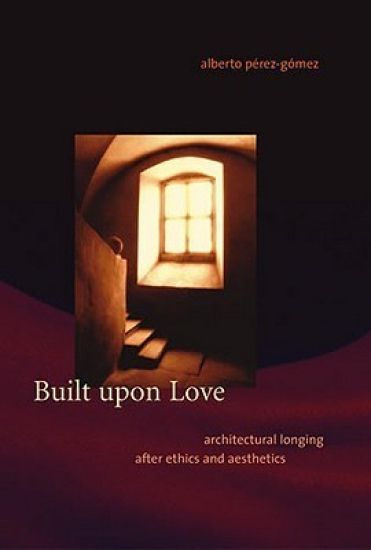
Built upon Love

Built upon Love

Alberto Pérez-Gómez

MIT Press
2008
pokkari
A vision of architecture that transcends concerns of form and function and finds the connections between the architect's wish to design a beautiful world and architecture's imperative to provide a better place for society.The forced polarity between form and function in considerations of architecture-opposing art to social interests, ethics to poetic expression-obscures the deep connections between ethical and poetical values in architectural tradition. Architecture has been, and must continue to be, writes Alberto Perez-Gomez, built upon love. Modernity has rightly rejected past architectural excesses, but, Perez-Gomez argues, the materialistic and technological alternatives it proposes do not answer satisfactorily the complex desire that defines humanity. True architecture is concerned with far more than fashionable form, affordable homes, and sustainable development; it responds to a desire for an eloquent place to dwell-one that lovingly provides a sense of order resonant with our dreams. In Built upon Love Perez-Gomez uncovers the relationship between love and architecture in order to find the points of contact between poetics and ethics-between the architect's wish to design a beautiful world and architecture's imperative to provide a better place for society.Eros, as first imagined by the early lyric poets of classical Greece, is the invisible force at the root of our capacity to create and comprehend the poetic image. Perez-Gomez examines the nature of architectural form in the light of eros, seduction, and the tradition of the poetic image in Western architecture. He charts the ethical dimension of architecture, tracing the connections between philia-the love of friends that entails mutual responsibility among equals-and architectural program. He explores the position of architecture at the limits of language and discusses the analogical language of philia in modernist architectural theory. Finally, he uncovers connections between ethics and poetics, describing a contemporary practice of architecture under the sign of love, incorporating both eros and philia.
Chora 4

Chora 4

Alberto Pérez-Gomez; Stephen Parcell

McGill-Queen's University Press
2004
sidottu
Chora IV continues a tradition of excellence in open, interdisciplinary research into architecture.
Chora 3

Chora 3

Alberto Pérez-Gómez; Stephen Parcell

McGill-Queen's University Press
1999
sidottu
The thirteen essays in this collection include historical subjects as well as speculative theoretical "projects" that blur conventional boundaries between history and fiction. Ricardo Castro provides an original reading of the Kogi culture in Colombia; Maria Karvouni explores philological and architectonic connections between the Greek demas (the political individual) and domus (the house); Mark Rozahegy speculates on relationships between architecture and memory; Myriam Blais discusses technical inventions by sixteenth-century French architect Philibert de l'Orme; Alberto Perez-Gomez examines the late sixteenth-century reconstruction of the Temple of Jerusalem by Juan Bautista Villalpando; Janine Debanne offers a new perspective on Guarino Guarini's Chapel of the Holy Shroud in Turin; Katja Grillner examines the early seventeenth-century writings of Salomon de Caus and his built work in Heidelberg; David Winterton reflects on Charles-Francois Viel's "Letters"; Franca Trubiano looks at Jean-Jacques Lequeu's controversial Civil Architecture; Henrik Reeh considers the work of Sigfried Kracauer, a disciple of Walter Benjamin; Irena dantovska Murray reflects on work by artist Jana Sterbak; artist Ellen Zweig presents a textual project that demonstrates the charged poetic space created by film makers such as Antonioni and Hitchcock; and Swedish writer and architect Soren Thurell asks a riddle about architecture and its mimetic origins. The essays in this volume demonstrate a reconciliatory architecture that respects cultural differences, acknowledges the globalization of technological culture, and points to a referent other than itself.
Anamorphosis

Anamorphosis

Alberto Pérez-Gómez; Louise Pelletier

McGill-Queen's University Press
1996
sidottu
Anamorphosis has raised crucial questions for architectural representation since the seventh century when epistemological conditions for modern thought and architecture were first articulated. By manipulating the theory of perspective, anamorphosis revealed potential discontinuity between an object present to perception and its visual appearance, complicating the relationship between building and drawing, and between design and construction. This annotated bibliography includes all known existing sources on anamorphosis, starting with Leonardo da Vinci's Notebooks and culminating with works of the twentieth-century Avant-Garde, such as Marcel Duchamp. The book makes special reference to questions about architectural representation, such as synthetic space as a possible alternative understanding of the relationship between architectural drawing and building, and provides extensive bibliographic descriptions of the primary sources for first editions and important subsequent editions or translations, including physical descriptions of the books and graphic materials.
Chora 1

Chora 1

Alberto Pérez-Gómez; Stephen Parcell

McGill-Queen's University Press
1994
sidottu
Contents Chora: The Space of Architectural Representation - Alberto Perez-Gomez - The Measure of Expression: Physiognomy and Character in the Nouvelle Methode of Jean-Jacques Lequeu - Jean-Francois Bedard - Michelangelo: The Image of the Human Body, Artifice, and Architecture - Helmut Klassen - Architecture as Site of Reception - Part I: Cuisine, Frontality, and the Infra-thin - Donald Kunze - Fictional Cities - Graham Livesey - Instrumentality and the Organic Assistance of Looms - Indra Kagis McEwen - Space and Image in Andrey Tarkovsky's "Nostalgia": Notes on a Phenomenology of Architecture in Cinema - Juhani Pallasmaa - The Momentary Modern Magic of the Panorama - Stephen Parcell - The Building of a Horizon - Louise Pelletier - Anaesthetic Induction: An Excursion into the World of Visual Indifference - Natalija Subotincic. The essays in this collection explore architectural form and content in the hope of finding new and better alternatives to traditionally accepted practices.
Architecture, Ethics, and Technology

Architecture, Ethics, and Technology

Louise Pelletier; Alberto Pérez-Gómez

McGill-Queen's University Press
1994
sidottu
An enlightened discussion of all relevant aspects of architecture shows the necessity for revision of commonly held assumptions about the nature of architectural history, theory, representation, and ideation; the production of buildings in the postindustrial city; and professional ethics. These topics provide the basis for the fourteen interdisciplinary papers presented here. The introductory section includes an examination of the epistemological origins of technology in the early modern European context and two alternative visions of ethics and its potential relevance for architecture. The second part presents four perspectives on important questions about how we represent buildings and the ethical values involved in that representation. "Ethics and Poetics in the Context of Technological Production" considers the role of philosophical ethics (i.e., a rational structure of categories in architectural practice) and the possibility, and desirability, of incorporating ethical reflections into the generation of architectural form. "The Architectural Uses of History and Narrative in a Technocratic World" explores alternatives for articulating an ethical attitude in forms of discourse other than philosophy and science. These papers were originally presented at the bilingual symposium "Architecture, Ethics, and Technology" held at the Canadian Centre for Architecture in Montreal in 1991.