Kirjojen hintavertailu. Mukana 12 595 353 kirjaa ja 12 kauppaa.

Kirjailija

Alberto Sangiovanni-Vincentelli

Kirjat ja teokset yhdessä paikassa: 12 kirjaa, julkaisuja vuosilta 1996-2018, suosituimpien joukossa Security-Aware Design for Cyber-Physical Systems. Vertaile teosten hintoja ja tarkista saatavuus suomalaisista kirjakaupoista.

12 kirjaa

Kirjojen julkaisuhaarukka 1996-2018.

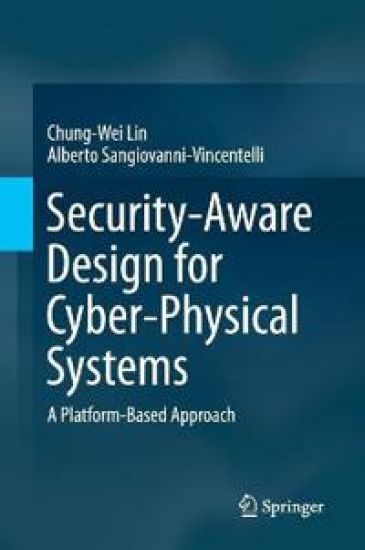
Security-Aware Design for Cyber-Physical Systems

Security-Aware Design for Cyber-Physical Systems

Chung-Wei Lin; Alberto Sangiovanni-Vincentelli

Springer International Publishing AG
2018
nidottu
Addressing the rising security issues during the design stages of cyber-physical systems, this book develops a systematic approach to address security at early design stages together with all other design constraints. Cyber-attacks become more threatening as systems are becoming more connected with the surrounding environment, infrastructures, and other systems. Security mechanisms can be designed to protect against attacks and meet security requirements, but there are many challenges of applying security mechanisms to cyber-physical systems including open environments, limited resources, strict timing requirements, and large number of devices. Designed for researchers and professionals, this book is valuable for individuals working in network systems, security mechanisms, and system design. It is also suitable for advanced-level students of computer science.
Security-Aware Design for Cyber-Physical Systems

Security-Aware Design for Cyber-Physical Systems

Chung-Wei Lin; Alberto Sangiovanni-Vincentelli

Springer International Publishing AG
2017
sidottu
Addressing the rising security issues during the design stages of cyber-physical systems, this book develops a systematic approach to address security at early design stages together with all other design constraints. Cyber-attacks become more threatening as systems are becoming more connected with the surrounding environment, infrastructures, and other systems. Security mechanisms can be designed to protect against attacks and meet security requirements, but there are many challenges of applying security mechanisms to cyber-physical systems including open environments, limited resources, strict timing requirements, and large number of devices. Designed for researchers and professionals, this book is valuable for individuals working in network systems, security mechanisms, and system design. It is also suitable for advanced-level students of computer science.

Smart Connected Buildings Design Automation

Smart Connected Buildings Design Automation

Mehdi Maasoumy; Alberto Sangiovanni-Vincentelli

now publishers Inc
2016
nidottu
The term intelligent or smart building refers to the next generation of buildings that provide new levels of comfort to the occupants with minimum possible energy consumption. They not only follow commands but also proactively learn from occupants' behavior and adapt their operation based on the indoor and outdoor conditions. These buildings are no longer solely consumers of energy, but also significant players in the ecosystem of the smart grid, in that they provide regulation services to the grid as well as energy if equipped with solar panels or other green sources. Intelligent buildings are not only safe by design but also react in the case of a fault, system malfunction, or cyber-attack to steer the system into a safe operating region. There has been much research in academia and industry towards this goal.Smart Connected Buildings Design Automation provides the reader with a broad overview of the activities in the field of smart connected building design automation that attempts to make the vision a reality. The overarching range of such activities includes developing simulation tools for modeling and the design of buildings, and consequently control algorithms proposed to make buildings smarter and more efficient.It goes on to survey real-world and large-scale implementation of such control strategies on physical buildings. It then presents a formal co-design methodology to design buildings, taking the view that buildings are prime examples of cyber-physical systems where the virtual and physical worlds meet. It concludes by describing the growing role of buildings in the operation of the smart grid.This book will be of interest to industry professionals and researchers who work in the area of smart buildings, smart cities, and smart grid, with an emphasis on energy efficiency, simulation tools, optimal control, and cyber-physical systems for the emerging power markets.
The Unknown Component Problem

The Unknown Component Problem

Tiziano Villa; Nina Yevtushenko; Robert K. Brayton; Alan Mishchenko; Alexandre Petrenko; Alberto Sangiovanni-Vincentelli

Springer-Verlag New York Inc.
2014
nidottu
The Problem of the Unknown Component: Theory and Applications addresses the issue of designing a component that, combined with a known part of a system, conforms to an overall specification. The authors tackle this problem by solving abstract equations over a language. The most general solutions are studied when both synchronous and parallel composition operators are used. The abstract equations are specialized to languages associated with important classes of automata used for modeling systems. The book is a blend of theory and practice, which includes a description of a software package with applications to sequential synthesis of finite state machines. Specific topologies interconnecting the components, exact and heuristic techniques, and optimization scenarios are studied. Finally the scope is enlarged to domains like testing, supervisory control, game theory and synthesis for special omega languages. The authors present original results of the authors along with an overview of existing ones.
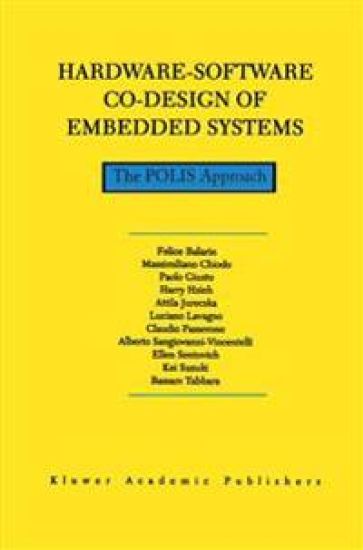
Hardware-Software Co-Design of Embedded Systems

Hardware-Software Co-Design of Embedded Systems

F. Balarin; Paolo Giusto; Attila Jurecska; Claudio Passerone; Ellen Sentovich; Bassam Tabbara; M. Chiodo; Harry Hsieh; Luciano Lavagno; Alberto Sangiovanni-Vincentelli; Kei Suzuki

Springer-Verlag New York Inc.
2013
nidottu
Embedded systems are informally defined as a collection of programmable parts surrounded by ASICs and other standard components, that interact continuously with an environment through sensors and actuators. The programmable parts include micro-controllers and Digital Signal Processors (DSPs). Embedded systems are often used in life-critical situations, where reliability and safety are more important criteria than performance. Today, embedded systems are designed with an ad hoc approach that is heavily based on earlier experience with similar products and on manual design. Use of higher-level languages such as C helps structure the design somewhat, but with increasing complexity it is not sufficient. Formal verification and automatic synthesis of implementations are the surest ways to guarantee safety. Thus, the POLIS system which is a co-design environment for embedded systems is based on a formal model of computation. POLIS was initiated in 1988 as a research project at the University of California at Berkeley and, over the years, grew into a full design methodology with a software system supporting it. Hardware-Software Co-Design of Embedded Systems: The POLIS Approach is intended to give a complete overview of the POLIS system including its formal and algorithmic aspects. Hardware-Software Co-Design of Embedded Systems: The POLIS Approach will be of interest to embedded system designers (automotive electronics, consumer electronics and telecommunications), micro-controller designers, CAD developers and students.
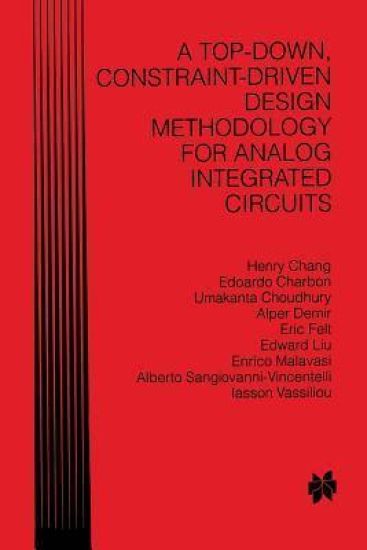
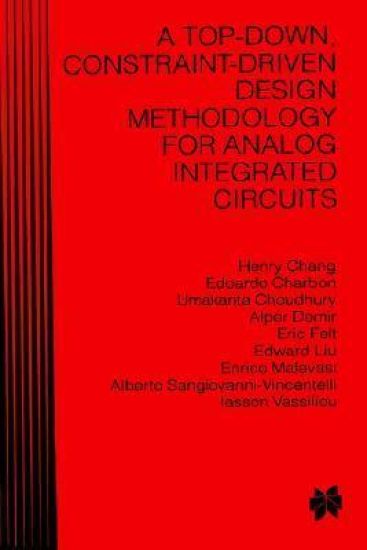
A Top-Down, Constraint-Driven Design Methodology for Analog Integrated Circuits

A Top-Down, Constraint-Driven Design Methodology for Analog Integrated Circuits

Henry Chang; Edoardo Charbon; Umakanta Choudhury; Alper Demir; Eric Felt; Edward Liu; Enrico Malavasi; Alberto Sangiovanni-Vincentelli; Iasson Vassiliou

Springer-Verlag New York Inc.
2012
nidottu
Analog circuit design is often the bottleneck when designing mixed analog-digital systems. A Top-Down, Constraint-Driven Design Methodology for Analog Integrated Circuits presents a new methodology based on a top-down, constraint-driven design paradigm that provides a solution to this problem. This methodology has two principal advantages: (1) it provides a high probability for the first silicon which meets all specifications, and (2) it shortens the design cycle. A Top-Down, Constraint-Driven Design Methodology for Analog Integrated Circuits is part of an ongoing research effort at the University of California at Berkeley in the Electrical Engineering and Computer Sciences Department. Many faculty and students, past and present, are working on this design methodology and its supporting tools. The principal goals are: (1) developing the design methodology, (2) developing and applying new tools, and (3) `proving' the methodology by undertaking `industrial strength' design examples. The work presented here is neither a beginning nor an end in the development of a complete top-down, constraint-driven design methodology, but rather a step in its development. This work is divided into three parts. Chapter 2 presents the design methodology along with foundation material. Chapters 3-8 describe supporting concepts for the methodology, from behavioral simulation and modeling to circuit module generators. Finally, Chapters 9-11 illustrate the methodology in detail by presenting the entire design cycle through three large-scale examples. These include the design of a current source D/A converter, a Sigma-Delta A/D converter, and a video driver system. Chapter 12 presents conclusions and current research topics. A Top-Down, Constraint-Driven Design Methodology for Analog Integrated Circuits will be of interest to analog and mixed-signal designers as well as CAD tool developers.
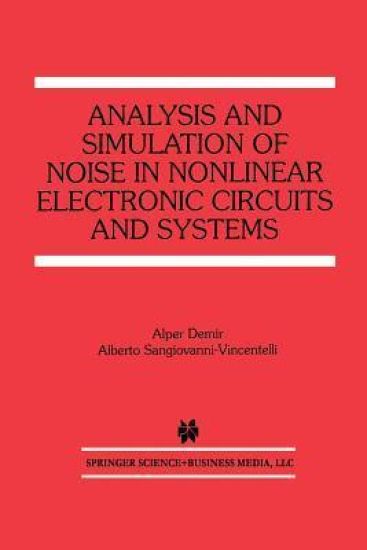
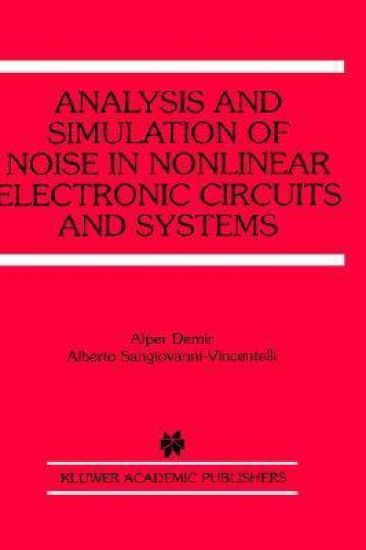
Analysis and Simulation of Noise in Nonlinear Electronic Circuits and Systems

Analysis and Simulation of Noise in Nonlinear Electronic Circuits and Systems

Alper Demir; Alberto Sangiovanni-Vincentelli

Springer-Verlag New York Inc.
2012
nidottu
In electronic circuit and system design, the word noise is used to refer to any undesired excitation on the system. In other contexts, noise is also used to refer to signals or excitations which exhibit chaotic or random behavior. The source of noise can be either internal or external to the system. For instance, the thermal and shot noise generated within integrated circuit devices are in­ ternal noise sources, and the noise picked up from the environment through electromagnetic interference is an external one. Electromagnetic interference can also occur between different components of the same system. In integrated circuits (Ies), signals in one part of the system can propagate to the other parts of the same system through electromagnetic coupling, power supply lines and the Ie substrate. For instance, in a mixed-signal Ie, the switching activity in the digital parts of the circuit can adversely affect the performance of the analog section of the circuit by traveling through the power supply lines and the substrate. Prediction of the effect of these noise sources on the performance of an electronic system is called noise analysis or noise simulation. A methodology for the noise analysis or simulation of an electronic system usually has the following four components: 2 NOISE IN NONLINEAR ELECTRONIC CIRCUITS • Mathematical representations or models for the noise sources. • Mathematical model or representation for the system that is under the in­ fluence of the noise sources.
The Unknown Component Problem

The Unknown Component Problem

Tiziano Villa; Nina Yevtushenko; Robert K. Brayton; Alan Mishchenko; Alexandre Petrenko; Alberto Sangiovanni-Vincentelli

Springer-Verlag New York Inc.
2011
sidottu
The Problem of the Unknown Component: Theory and Applications addresses the issue of designing a component that, combined with a known part of a system, conforms to an overall specification. The authors tackle this problem by solving abstract equations over a language. The most general solutions are studied when both synchronous and parallel composition operators are used. The abstract equations are specialized to languages associated with important classes of automata used for modeling systems. The book is a blend of theory and practice, which includes a description of a software package with applications to sequential synthesis of finite state machines. Specific topologies interconnecting the components, exact and heuristic techniques, and optimization scenarios are studied. Finally the scope is enlarged to domains like testing, supervisory control, game theory and synthesis for special omega languages. The authors present original results of the authors along with an overview of existing ones.
Platform-Based Design

Platform-Based Design

Alberto Sangiovanni-Vincentelli; Roberto Passerone

Springer-Verlag New York Inc.
2011
sidottu
Embedded Systems design becomes more complex as increasingly sophisticated functionality is added to designs. In addition to considerations of cost, performance, and time-to-market, various system integration issues become challenging, given the inherently heterogeneous nature of embedded systems. Platform Based Design introduces a rigorous design methodology to address the various challenges posed by complex, heterogeneous, embedded systems.
Analysis and Simulation of Noise in Nonlinear Electronic Circuits and Systems

Analysis and Simulation of Noise in Nonlinear Electronic Circuits and Systems

Alper Demir; Alberto Sangiovanni-Vincentelli

Springer
1997
sidottu
In electronic circuit and system design, the word noise is used to refer to any undesired excitation on the system. In other contexts, noise is also used to refer to signals or excitations which exhibit chaotic or random behavior. The source of noise can be either internal or external to the system. For instance, the thermal and shot noise generated within integrated circuit devices are in­ ternal noise sources, and the noise picked up from the environment through electromagnetic interference is an external one. Electromagnetic interference can also occur between different components of the same system. In integrated circuits (Ies), signals in one part of the system can propagate to the other parts of the same system through electromagnetic coupling, power supply lines and the Ie substrate. For instance, in a mixed-signal Ie, the switching activity in the digital parts of the circuit can adversely affect the performance of the analog section of the circuit by traveling through the power supply lines and the substrate. Prediction of the effect of these noise sources on the performance of an electronic system is called noise analysis or noise simulation. A methodology for the noise analysis or simulation of an electronic system usually has the following four components: 2 NOISE IN NONLINEAR ELECTRONIC CIRCUITS • Mathematical representations or models for the noise sources. • Mathematical model or representation for the system that is under the in­ fluence of the noise sources.
Hardware-Software Co-Design of Embedded Systems

Hardware-Software Co-Design of Embedded Systems

F. Balarin; Paolo Giusto; Attila Jurecska; Claudio Passerone; Ellen Sentovich; Bassam Tabbara; M. Chiodo; Harry Hsieh; Luciano Lavagno; Alberto Sangiovanni-Vincentelli; Kei Suzuki

Springer
1997
sidottu
Embedded systems are informally defined as a collection of programmable parts surrounded by ASICs and other standard components, that interact continuously with an environment through sensors and actuators. The programmable parts include micro-controllers and Digital Signal Processors (DSPs). Embedded systems are often used in life-critical situations, where reliability and safety are more important criteria than performance. Today, embedded systems are designed with an ad hoc approach that is heavily based on earlier experience with similar products and on manual design. Use of higher-level languages such as C helps structure the design somewhat, but with increasing complexity it is not sufficient. Formal verification and automatic synthesis of implementations are the surest ways to guarantee safety. Thus, the POLIS system which is a co-design environment for embedded systems is based on a formal model of computation. POLIS was initiated in 1988 as a research project at the University of California at Berkeley and, over the years, grew into a full design methodology with a software system supporting it. Hardware-Software Co-Design of Embedded Systems: The POLIS Approach is intended to give a complete overview of the POLIS system including its formal and algorithmic aspects. Hardware-Software Co-Design of Embedded Systems: The POLIS Approach will be of interest to embedded system designers (automotive electronics, consumer electronics and telecommunications), micro-controller designers, CAD developers and students.
A Top-Down, Constraint-Driven Design Methodology for Analog Integrated Circuits

A Top-Down, Constraint-Driven Design Methodology for Analog Integrated Circuits

Henry Chang; Edoardo Charbon; Umakanta Choudhury; Alper Demir; Eric Felt; Edward Liu; Enrico Malavasi; Alberto Sangiovanni-Vincentelli; Iasson Vassiliou

Springer
1996
sidottu
Analog circuit design is often the bottleneck when designing mixed analog-digital systems. A Top-Down, Constraint-Driven Design Methodology for Analog Integrated Circuits presents a new methodology based on a top-down, constraint-driven design paradigm that provides a solution to this problem. This methodology has two principal advantages: (1) it provides a high probability for the first silicon which meets all specifications, and (2) it shortens the design cycle. A Top-Down, Constraint-Driven Design Methodology for Analog Integrated Circuits is part of an ongoing research effort at the University of California at Berkeley in the Electrical Engineering and Computer Sciences Department. Many faculty and students, past and present, are working on this design methodology and its supporting tools. The principal goals are: (1) developing the design methodology, (2) developing and applying new tools, and (3) `proving' the methodology by undertaking `industrial strength' design examples. The work presented here is neither a beginning nor an end in the development of a complete top-down, constraint-driven design methodology, but rather a step in its development. This work is divided into three parts. Chapter 2 presents the design methodology along with foundation material. Chapters 3-8 describe supporting concepts for the methodology, from behavioral simulation and modeling to circuit module generators. Finally, Chapters 9-11 illustrate the methodology in detail by presenting the entire design cycle through three large-scale examples. These include the design of a current source D/A converter, a Sigma-Delta A/D converter, and a video driver system. Chapter 12 presents conclusions and current research topics. A Top-Down, Constraint-Driven Design Methodology for Analog Integrated Circuits will be of interest to analog and mixed-signal designers as well as CAD tool developers.