Kirjojen hintavertailu. Mukana 12 595 353 kirjaa ja 12 kauppaa.

Kirjailija

Aleksander Molak

Kirjat ja teokset yhdessä paikassa: 2 kirjaa, julkaisuja vuodelta 2023, suosituimpien joukossa Causal Inference and Discovery in Python. Vertaile teosten hintoja ja tarkista saatavuus suomalaisista kirjakaupoista.

2 kirjaa

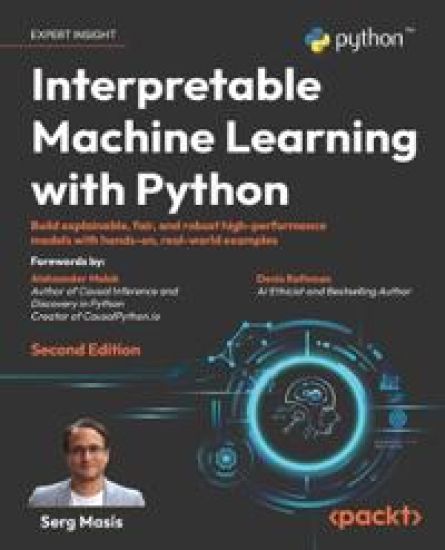
Interpretable Machine Learning with Python

Interpretable Machine Learning with Python

Serg Masís; Aleksander Molak; Denis Rothman

PACKT PUBLISHING LIMITED
2023
nidottu
A deep dive into the key aspects and challenges of machine learning interpretability using a comprehensive toolkit, including SHAP, feature importance, and causal inference, to build fairer, safer, and more reliable models. Purchase of the print or Kindle book includes a free eBook in PDF format. Key Features Interpret real-world data, including cardiovascular disease data and the COMPAS recidivism scores Build your interpretability toolkit with global, local, model-agnostic, and model-specific methods Analyze and extract insights from complex models from CNNs to BERT to time series models Book DescriptionInterpretable Machine Learning with Python, Second Edition, brings to light the key concepts of interpreting machine learning models by analyzing real-world data, providing you with a wide range of skills and tools to decipher the results of even the most complex models. Build your interpretability toolkit with several use cases, from flight delay prediction to waste classification to COMPAS risk assessment scores. This book is full of useful techniques, introducing them to the right use case. Learn traditional methods, such as feature importance and partial dependence plots to integrated gradients for NLP interpretations and gradient-based attribution methods, such as saliency maps. In addition to the step-by-step code, you’ll get hands-on with tuning models and training data for interpretability by reducing complexity, mitigating bias, placing guardrails, and enhancing reliability. By the end of the book, you’ll be confident in tackling interpretability challenges with black-box models using tabular, language, image, and time series data.What you will learn Progress from basic to advanced techniques, such as causal inference and quantifying uncertainty Build your skillset from analyzing linear and logistic models to complex ones, such as CatBoost, CNNs, and NLP transformers Use monotonic and interaction constraints to make fairer and safer models Understand how to mitigate the influence of bias in datasets Leverage sensitivity analysis factor prioritization and factor fixing for any model Discover how to make models more reliable with adversarial robustness Who this book is forThis book is for data scientists, machine learning developers, machine learning engineers, MLOps engineers, and data stewards who have an increasingly critical responsibility to explain how the artificial intelligence systems they develop work, their impact on decision making, and how they identify and manage bias. It’s also a useful resource for self-taught ML enthusiasts and beginners who want to go deeper into the subject matter, though a good grasp of the Python programming language is needed to implement the examples.
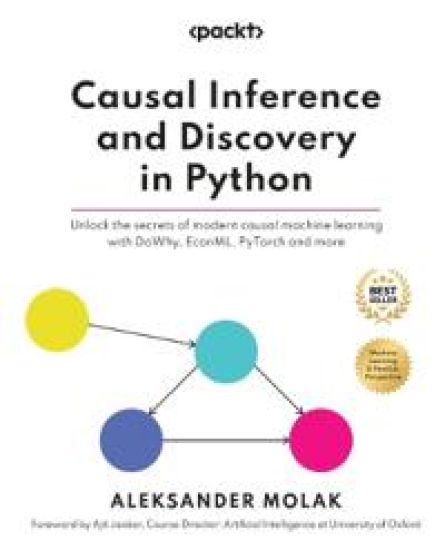
Causal Inference and Discovery in Python

Causal Inference and Discovery in Python

Aleksander Molak; Ajit Jaokar

PACKT PUBLISHING LIMITED
2023
nidottu
Demystify causal inference and casual discovery by uncovering causal principles and merging them with powerful machine learning algorithms for observational and experimental data Purchase of the print or Kindle book includes a free PDF eBook Key Features Examine Pearlian causal concepts such as structural causal models, interventions, counterfactuals, and more Discover modern causal inference techniques for average and heterogenous treatment effect estimation Explore and leverage traditional and modern causal discovery methods Book DescriptionCausal methods present unique challenges compared to traditional machine learning and statistics. Learning causality can be challenging, but it offers distinct advantages that elude a purely statistical mindset. Causal Inference and Discovery in Python helps you unlock the potential of causality. You’ll start with basic motivations behind causal thinking and a comprehensive introduction to Pearlian causal concepts, such as structural causal models, interventions, counterfactuals, and more. Each concept is accompanied by a theoretical explanation and a set of practical exercises with Python code. Next, you’ll dive into the world of causal effect estimation, consistently progressing towards modern machine learning methods. Step-by-step, you’ll discover Python causal ecosystem and harness the power of cutting-edge algorithms. You’ll further explore the mechanics of how “causes leave traces” and compare the main families of causal discovery algorithms. The final chapter gives you a broad outlook into the future of causal AI where we examine challenges and opportunities and provide you with a comprehensive list of resources to learn more. By the end of this book, you will be able to build your own models for causal inference and discovery using statistical and machine learning techniques as well as perform basic project assessment.What you will learn Master the fundamental concepts of causal inference Decipher the mysteries of structural causal models Unleash the power of the 4-step causal inference process in Python Explore advanced uplift modeling techniques Unlock the secrets of modern causal discovery using Python Use causal inference for social impact and community benefit Who this book is forThis book is for machine learning engineers, researchers, and data scientists looking to extend their toolkit and explore causal machine learning. It will also help people who’ve worked with causality using other programming languages and now want to switch to Python, those who worked with traditional causal inference and want to learn about causal machine learning, and tech-savvy entrepreneurs who want to go beyond the limitations of traditional ML. You are expected to have basic knowledge of Python and Python scientific libraries along with knowledge of basic probability and statistics.