Kirjojen hintavertailu. Mukana 12 595 353 kirjaa ja 12 kauppaa.

Kirjailija

Alex Mintz

Kirjat ja teokset yhdessä paikassa: 10 kirjaa, julkaisuja vuosilta 2010-2021, suosituimpien joukossa Terrorist Decision-Making. Vertaile teosten hintoja ja tarkista saatavuus suomalaisista kirjakaupoista.

10 kirjaa

Kirjojen julkaisuhaarukka 2010-2021.

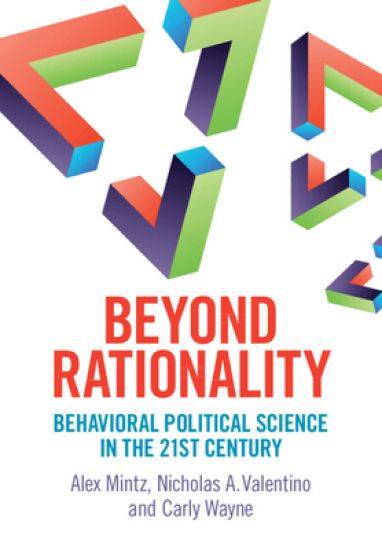
Beyond Rationality

Beyond Rationality

Alex Mintz; Nicholas A. Valentino; Carly Wayne

Cambridge University Press
2021
sidottu
How and why do people make political decisions? This book is the first to present a unified framework of the Behavioral Political Science paradigm. – BPS presents a range of psychological approaches to understanding political decision-making. The integration of these approaches with Rational Choice Theory provides students with a comprehensible paradigm for understanding current political events around the world. Presented in nontechnical language and enlivened with a wealth of real-world examples, this is an ideal core text for a one-semester courses in political science, American government, political psychology, or political behavior. It can also supplement a course in international relations or public policy.
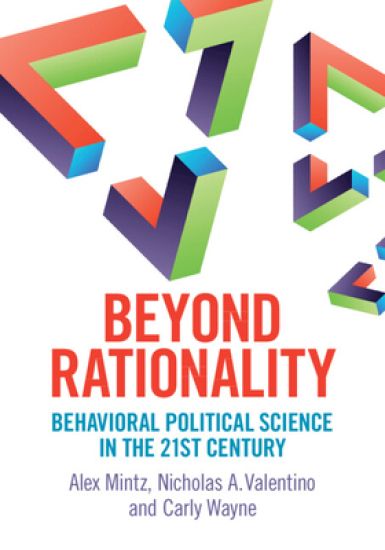
Beyond Rationality

Beyond Rationality

Alex Mintz; Nicholas A. Valentino; Carly Wayne

Cambridge University Press
2021
pokkari
How and why do people make political decisions? This book is the first to present a unified framework of the Behavioral Political Science paradigm. – BPS presents a range of psychological approaches to understanding political decision-making. The integration of these approaches with Rational Choice Theory provides students with a comprehensible paradigm for understanding current political events around the world. Presented in nontechnical language and enlivened with a wealth of real-world examples, this is an ideal core text for a one-semester courses in political science, American government, political psychology, or political behavior. It can also supplement a course in international relations or public policy.
Terrorist Decision-Making

Terrorist Decision-Making

Alex Mintz; Tyson Chatagnier; Yair Samban

Taylor Francis Ltd
2021
nidottu
This book analyzes a series of decisions by leaders of three major terrorist organizations and identifies a unique "Decision DNA" for each of them.The authors use the Applied Decision Analysis methodology to examine organizational and operational decisions made by the leaders of three major groups: Hezbollah (Hassan Nasrallah), Hamas (Khaled Mashal), and al-Qaeda (Osama bin Laden). Decisions that were of critical importance to each organization are identified and anaylzed, to uncover the particular decision rule employed by the leader in question and to establish their "Decision DNA." A Decision DNA is unique to each leader and can be used to explain previous decisions or predict future choices. The authors demonstrate that the findings presented can be used to promote effective counterterrorism measures, and they provide a series of policy implications that arise from their examination of each leader.This book will be of much interest to students of terrorist studies, political violence, security studies, and Middle Eastern politics.
Terrorist Decision-Making

Terrorist Decision-Making

Alex Mintz; Tyson Chatagnier; Yair Samban

Routledge
2019
sidottu
This book analyzes a series of decisions by leaders of three major terrorist organizations and identifies a unique "Decision DNA" for each of them.The authors use the Applied Decision Analysis methodology to examine organizational and operational decisions made by the leaders of three major groups: Hezbollah (Hassan Nasrallah), Hamas (Khaled Mashal), and al-Qaeda (Osama bin Laden). Decisions that were of critical importance to each organization are identified and anaylzed, to uncover the particular decision rule employed by the leader in question and to establish their "Decision DNA." A Decision DNA is unique to each leader and can be used to explain previous decisions or predict future choices. The authors demonstrate that the findings presented can be used to promote effective counterterrorism measures, and they provide a series of policy implications that arise from their examination of each leader.This book will be of much interest to students of terrorist studies, political violence, security studies, and Middle Eastern politics.
The Polythink Syndrome

The Polythink Syndrome

Alex Mintz; Carly Wayne

Stanford University Press
2016
pokkari
Why do presidents and their advisors often make sub-optimal decisions on military intervention, escalation, de-escalation, and termination of conflicts? The leading concept of group dynamics, groupthink, offers one explanation: policy-making groups make sub-optimal decisions due to their desire for conformity and uniformity over dissent, leading to a failure to consider other relevant possibilities. But presidential advisory groups are often fragmented and divisive. This book therefore scrutinizes polythink, a group decision-making dynamic whereby different members in a decision-making unit espouse a plurality of opinions and divergent policy prescriptions, resulting in a disjointed decision-making process or even decision paralysis. The book analyzes eleven national security decisions, including the national security policy designed prior to the terrorist attacks of 9/11, the decisions to enter into and withdraw from Afghanistan and Iraq, the 2007 "surge" decision, the crisis over the Iranian nuclear program, the UN Security Council decision on the Syrian Civil War, the faltering Kerry Peace Process in the Middle East, and the U.S. decision on military operations against ISIS. Based on the analysis of these case studies, the authors address implications of the polythink phenomenon, including prescriptions for avoiding and/or overcoming it, and develop strategies and tools for what they call Productive Polythink. The authors also show the applicability of polythink to business, industry, and everyday decisions.
The Polythink Syndrome

The Polythink Syndrome

Alex Mintz; Carly Wayne

STANFORD UNIVERSITY PRESS
2016
sidottu
Why do presidents and their advisors often make sub-optimal decisions on military intervention, escalation, de-escalation, and termination of conflicts? The leading concept of group dynamics, groupthink, offers one explanation: policy-making groups make sub-optimal decisions due to their desire for conformity and uniformity over dissent, leading to a failure to consider other relevant possibilities. But presidential advisory groups are often fragmented and divisive. This book therefore scrutinizes polythink, a group decision-making dynamic whereby different members in a decision-making unit espouse a plurality of opinions and divergent policy prescriptions, resulting in a disjointed decision-making process or even decision paralysis. The book analyzes eleven national security decisions, including the national security policy designed prior to the terrorist attacks of 9/11, the decisions to enter into and withdraw from Afghanistan and Iraq, the 2007 "surge" decision, the crisis over the Iranian nuclear program, the UN Security Council decision on the Syrian Civil War, the faltering Kerry Peace Process in the Middle East, and the U.S. decision on military operations against ISIS. Based on the analysis of these case studies, the authors address implications of the polythink phenomenon, including prescriptions for avoiding and/or overcoming it, and develop strategies and tools for what they call Productive Polythink. The authors also show the applicability of polythink to business, industry, and everyday decisions.
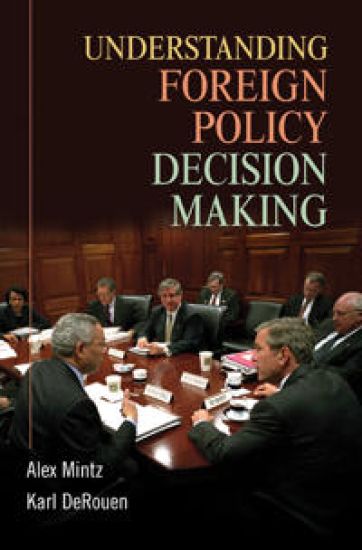
Understanding Foreign Policy Decision Making

Understanding Foreign Policy Decision Making

Alex Mintz; Karl DeRouen Jr

Cambridge University Press
2010
sidottu
Understanding Foreign Policy Decision Making presents a psychological approach to foreign policy decision making. This approach focuses on the decision process, dynamics, and outcome. The book includes a wealth of extended real-world case studies and examples that are woven into the text. The cases and examples, which are written in an accessible style, include decisions made by leaders of the United States, Israel, New Zealand, Cuba, Iceland, United Kingdom, and others. In addition to coverage of the rational model of decision making, levels of analysis of foreign policy decision making, and types of decisions, the book includes extensive material on alternatives to the rational choice model, the marketing and framing of decisions, cognitive biases, and domestic, cultural, and international influences on decision making in international affairs. Existing textbooks do not present such an approach to foreign policy decision making, international relations, American foreign policy, and comparative foreign policy.
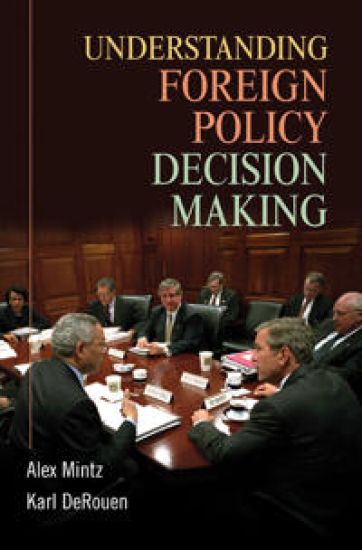
Understanding Foreign Policy Decision Making

Understanding Foreign Policy Decision Making

Alex Mintz; Karl DeRouen Jr

Cambridge University Press
2010
pokkari
Understanding Foreign Policy Decision Making presents a psychological approach to foreign policy decision making. This approach focuses on the decision process, dynamics, and outcome. The book includes a wealth of extended real-world case studies and examples that are woven into the text. The cases and examples, which are written in an accessible style, include decisions made by leaders of the United States, Israel, New Zealand, Cuba, Iceland, United Kingdom, and others. In addition to coverage of the rational model of decision making, levels of analysis of foreign policy decision making, and types of decisions, the book includes extensive material on alternatives to the rational choice model, the marketing and framing of decisions, cognitive biases, and domestic, cultural, and international influences on decision making in international affairs. Existing textbooks do not present such an approach to foreign policy decision making, international relations, American foreign policy, and comparative foreign policy.